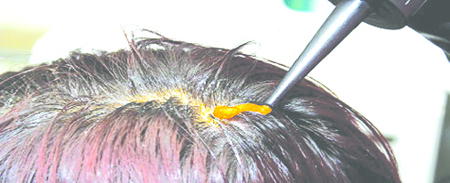
If you are among the 50% of women who colour their hair, or a man who covers his gray, you might want to do more investigation into your favourite hair coloring.
By JAPHET ALAKAM
For the average Nigerian women who are engrossed with western cultures, there is the need for them to go back to their roots as there are a lot of values in African culture especially their hairstyles. This is the central message in the ongoing exhibition at the Omenka gallery Ikoyi.
Tagged, Networks and Voids, Modern Interpretations of Nigerian Hairstyles and Headdresses, an exhibition of work by celebrated Nigerian photographer, ‘Okhai Ojeikere and one of the fast-rising names on the continent, American artist, Gary Stephens who lives and works in Johannesburg opened on October 5 and will run to 19, 2013.
On display were about 25 works. The works presented in varying media of photography, linoleum prints and charcoal on paper, are united by the central theme of Nigerian hairstyles and headdresses (geles) fashioned from hand-woven aso-oke and expensive imported textiles including damask and brocade. Speaking at the previev, Oliver Enwonwu, curator of Omenka gallery said that “the show draws its title from the variegated patterns formed by the network of interlocking branches of finely plaited hair and the open spaces or voids left in their wake. These patterns are repeated in the weaves of the headdresses, where they give the impression of low relief embroidery and mimic matching lace outfits populated by open spaces.”
For Ojeikere who started taking photographs since 1956, the works reveal some of the different photograph of hairstyles that Nigerian women adorn which are now regarded as old fashion.
Among the works on display are Ojeikere’s Onile go go ro (skyscraper), Suku oni di di and Suku Sinero ki ko.
In traditional African society, hairstyles had immense cultural and social significance, but in modem times, the social significance and personal meaning of traditional hairstyles have been eliminated and forgotten. Instead, ancient styles are re-born, with many variations linking them more with fashion than aesthetic feeling. This Ojeikere employs African women to go back to their roots as there are a lot of values attached to it.
For Gary Stephens who exhibited at the same gallery last year, this time he is bringing his monumental drawings of hairstyles that people feel and appreciate. Though in black and white, the works as usual portray the back and style of the geles modern women in Nigeria wear. This can be seen through works like Braids, Earrings and Sunglasses, The Moonlight Scarf and Shiny Braid Bun, he raises questions of hybridity and identity as his subjects adorn sunglasses, modem earrings and decorative ornaments in their hair. Of particular reference are his drawings Zig Zag Braids and Neema, the titles accentuating these notions of modernity and underlining the artist’s interest in capturing the distinctively African sense of urban fashion.
At first glance, it seems rather disconcerting that the artists employ contemporary media and techniques to engage issues of preservation. Perhaps the similarities between the artists end here. Since 1968, Ojeikere began to develop series of photographs exploring Nigerian culture. The Hairstyles and Headdresses are his best-known and most significant bodies of work. Importantly, these series are shot in black-and-white and largely with an analogue camera, which lends to the cultural and historical significance of the work.
Ojeikere’s series of photographs has since become a significant anthropological, ethnographic and documentary national treasure as it tends to preserve traditional hairstyles, but Stephens records the evolving culture associated with these hairstyles by capturing the sense of modernity and dynamism of urban style in Africa. He is also successful in his fusion of the comparatively more traditional media of drawing and printmaking with meticulously crafted string systems. This dedication and striking attention to detail is clearly evident in his drawings.
Combining long, vertical,repetitive folds and pleats in the paper with string systems, Stephens emphasizes the three-dimensional quality of the weave patterns and voids in the plaited hair. Here, the focus is slightly different. The system of strings and vertical pleats are a metaphor for the influence of modernity and the spread of global capitalism on post colonial Nigeria
The drawings and photographs of various hairstyles by Ojeikere and Stephens are veritable sites to assert the African identity and challenge these stereotypes. The works then assume greater importance and new meanings along two major lines of thoughts; first when viewed against the preponderance of imported human and synthetic hair and skin lightening beauty products, and second in documenting an ebbing culture.
Disclaimer
Comments expressed here do not reflect the opinions of Vanguard newspapers or any employee thereof.