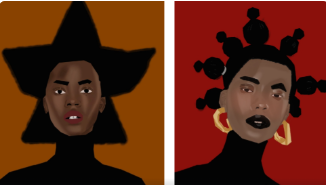
“Back to our roots” 1 & 2 by Fausat Olanike Ladokun
By Osa Mbonu-Amadi, Arts Editor
At the Roots and Resilience exhibition, hosted at Capital Art Gallery, London, Fausat Olanike Ladokun’s “Nina” was tucked in between her two other works, “Back to Our Roots” 1 & 2.
While the artist drapes Nina’s hair with a yellow stripped piece of blue cloth, the black hairs of the black women in her “Back to Our Roots” are left protruding upward like the jagged granite peaks of Mount Kenya. Why she decided to conceal Nina’s black hair, and chose to proudly display those of the other women, we may never know.
What is certain, however, is that while “Back to Our Roots” interrogates “the politics of Black hair and the discrimination it faces in schools, workplaces, and society”, as Ladokun puts it, the portrait, ‘Nina’, pays tribute to the renowned singer, Nina Simone, who used her music as a tool to advocate for total emancipation of black women as well as for celebration of Black History Month. One of Nina’s memorable songs, Mississippi Goddam (1964) was written as a protest against the murder of activist ‘Medgar Evers’ and 4 young black girls.
The exhibition, which celebrates the heritage, strength, and enduring spirit of Black communities, took place in October, which is black history month.
Roots and Resilience honours the cultural roots that shape Black
identity. It also recognises the doggedness employed by Black people in overcoming past and present challenges. Humans and their cultures are products of their past and present, hence the theme of the exhibition underlines the significance of remembering the past and celebrating the present, while continuing to strive to build a better future.
Hair and hairstyle are central to Ladokun’s “Back to Our Roots”. The black hair, as everything that had to do with blacks, was sgimatised as “unkempt” or “unprofessional” in schools, workplaces, and society generally. “Back to Our Roots” urges viewers to reject shame and instead embrace hair as an expression of cultural identity. What the artist did is to reclaim black hair and appropriately reposition it as natural, powerful, and as a proud cultural heritage. “In celebration of Black History Month, the series honours hair as a language of identity — a crown every Black woman should wear with confidence and without shame,” Ladokun says.
Born in 1988 in Lagos, Nigeria, Fausat Olanike Ladokun is a good example of a Nigerian artist whose itinery in foreign land has been both fruitful and inspiring. Presently, she resides in Birmingham, United Kingdom where she carries on with her creative work, mainly digital portraiture. Amongst her unique selling points is her ability to transform the human face and form into canvases for cultural reflection, emotional depth, and the bold reclamation of Black women’s visibility.
Ladokun’s works dwell on identity, migration, heritage, and womanhood. She challenges European dominated narratives, especially in the creation and description of African art and black women. As a matter of fact, Ladokun’s art, which bridges African traditions with global digital innovations, has redefined (African) beauty, belonging, and selfhood.
Ladokun’s evolution as an artist shows traces of a self-made artist. Since 2022, she has continued to improve herself and skills through online platforms like Domestika and The Addictive Sketchers (2025), employing digital tools that allow intricate and expressive compositions. This approach is well-suited to her advocacy kind of art. Good examples are her earlier works like “Innocence” (2023), which confronted child marriage in Nigeria through portraiture.
Ladokun is also a prolific exhibitor. The year, 2025 was a turnaround for her with seven shows across the UK and Brazil: “Winter 25 Exhibition” at Liminal Arts (London), “Dreamscape” at Fox Yard Studio (Suffolk), “Vintage Exhibition” at Artly Mix (Sao Paulo), “Mixed Media” at Open Art Gallery (Halifax), “Onidiri Festival” at Tayese Academy of Arts (London), and “Flags of Diversity” at Colonnade House (Sussex). She earned an Honourable Mention in Teravarna’s 13th Open International Juried Art Competition (Los Angeles), laying credence to her global footprint. She has also contributed to Gallery Programmes at Ikon Gallery and Wolverhampton Art Gallery, supporting exhibitions such as “What are the odds?”, bringing her passion into community service.
From all indications, as an artist who does not just reflect culture but reshapes it, there is more to expect from Fausat Olanike Ladokun. Through exhibitions and volunteering, she has immensely contributed to the diversity of visual culture, proving that indeed, portraiture art has power to empower people.
Disclaimer
Comments expressed here do not reflect the opinions of Vanguard newspapers or any employee thereof.