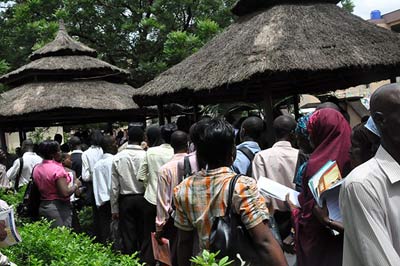
File photo: Unemployed youths at Alausa, Ikeja
By FUNMI KOMOLAFE & VICTOR AHIUMA-YOUNG
RECENTLY, employers in Nigeria, under the umbrella of Nigeria Employers Consultative Association, NECA, gathered in Lagos, at its 56th Annual General Meeting, AGM, to review socio-economic and political environment in the country in the last one year and as the impact on business operations.
FOR NECA every action, policy and decision of government should have job creation as target, to address the unemployment crisis in the country.
Addressing the gathering, President of NECA, Chief R.U Uche, lamented that in spite of government reported growth in the economy, “with our Human Development Index ranking 153 (out of 186 countries), coupled with lamentable ratings in health, education, and per capita income, Nigeria remains one of the poorest countries in the world and still bunched with the 30 poorest countries in sub-saharan Africa.
Henceforth, whenever our political leaders stand up to address the nation on the state of the economy, let them break their language down to the simplicity of the number of new businesses and jobs that have been created, the hours of uninterrupted power supply households and businesses have enjoyed, number of Nigerians with improved access to education, healthcare, housing, transportation etc, etc. These are the true measures of growth and development.”

*AGM: From left; Dr. Clement Illoh, Permanent Secretary, Ministry of Labour and Productivity, Mr. Larry Ettah, 1st Vice President, NECA, Chief R.U. Uche, President, NECA and Director-General, Mr. Segun Osinowo , at the 56th NECA AGM, Lagos.
Lamenting rising unemployment in the country, Chief Uche said “today, teeming population of our youths are unemployed. This is indeed a scary reality- a ticking time bomb, which, if we fail to defuse as quickly as possible, may erode whatever semblance of social harmony and stability that is left of our polity. We are, of course, not short of initiatives at all fronts: Federal Governments, state government, agencies and ministries, employers bodies, UN agencies, etc, etc. However, outcomes seem to have been very miserable. In terms of quantity and quality of jobs created, we are merely scratching the issue on the surface.
While those various initiatives are commendable, I believe we need to go back to the fundamentals of our economy where such big issues like diversification of the economy, backward and forward integration, policy coherence, policy consistency and cross-sectoral local content policy will be given their pride of place and execution impetus.
Constitutional amendment
Every policy action and decision of government should be judged on the basis of its impact on job creation. We cannot, of course, ignore the factor of good governance, as aptly exemplified by the Lagos State success story, which has created the most basic of skills.”
“All the aforementioned policy options should be underpinned by a sincere constitutional amendment that will enthrone true federalism and resource control. We should aim for a political structure where federating units will contribute to the centre, thereby assuming the status of multiple centers of productive economic activities and development. This surely will spin off jobs in their millions and create sustainable employment.
Speaking, Minister of Labour and Productivity, Chief Emeka Wogu, listed some challenges considered germane to the social partners in view of their roles in labour administration and to the country quest for peace and progress.
Represented by the Permanent Secretary in the Ministry, Dr. Clement Illoh, Chief Wogu said the challenges included “the provision of productive and decent jobs for the teeming youth population in an environmentally sustainable manner; the provision of adequate minimal social security protection systems for the aged, unemployed, women, children, vulnerable members of society including the provision of adequate system of labour protection; the provision of relevant and adequate skills to march global developments in ICT; the raising of national productivity competitiveness in order to address the issue of poverty, unemployment, inequality and wages differentials; , the provision of good governance systems ensuring developments in democratic and representative institutions, especially at work and in the larger society and the changing nature of work and work conditions in view of the global implications for development and inclusiveness.
According to him, “In the realm of industrial relations practice, the country is undergoing a process where the challenges of impunity should be urgently addressed by the social partners with a view to installing a system that ensures the practice of rule of law.
Impediments to industrial relation practice
Towards this end, it becomes necessary for NECA to address the following problematic which have constituted serious impediments in our industrial relations practice: What factors have constituted impediments to the success of social dialogue in our industrial relations practice? What impacts do public policies and programmes bear on the practice of industrial relations? To what extent are judicial processes impinging on the practice of social dialogue and tripartism in Nigeria? To what extent does Alternate Dispute Resolution contribute to the development of our industrial relations system?
This administration has in the last two years embarked on several policies, projects and programmes in the labour sector of the economy in order to address the above issues.
In the labour sector, the transformation agenda encompasses Key National Performance Indicators of various policies, programmes and projects which are aimed at: Employment generation and wealth creation; Improving national productivity and competitiveness; Improving health, safety and welfare of the workforce.
Enhancing industrial harmony and improving labour education and skills; Provision of social security protection and mitigating vulnerability at work; Enhancing skills development and certification and Improving the regulatory environment and application of international labour standards.
Disclaimer
Comments expressed here do not reflect the opinions of Vanguard newspapers or any employee thereof.