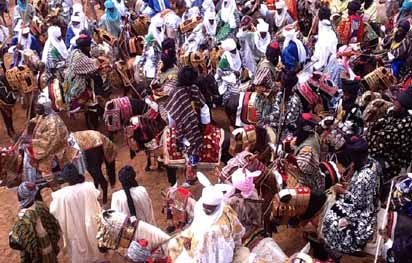
*A durbar of many colours
By Emmanuel Aziken
The durbar in Dutse, the Jigawa State capital commenced immediately after the eid prayers which ended shortly after 9.00 a.m. Once the prayer ended, Governor Sule Lamido, after a brief exchange of pleasantries with the Emir of Dutse, Alhaji Nuhu Muhammadu Sanusi, took his leave and rushed to the Government House, about three minutes drive from the prayer ground.
With the exit of the governor, the durbar commenced.
The beauty of the durbar is seen in the colourful parade on horseback of the title holders, princes and members of their entourage. Each title holder, depending on his ability, is accompanied by an entourage of horse riders. On this occasion, the least number of horsemen accompanying any title holder was ten. Some had as much as twenty-five.

*A durbar of many colours
The title holders were separated from their horsemen by their unique dressing and turban.
Even among the title holders, there was still a difference reflected in the kind of turban they wore. Princes and those from the royal family had two pointed fingers from their turbans. Those from outside the royal family had only one pointed finger from the turban they wore.
Once Governor Lamido arrived the emir’s palace shortly after 10.00 a.m., he was received in the outer court by Dalhatu who had been delegated by the emir to perform the task.
Governor Lamido, followed by Dalhatu, climbed the stairs to the elevated platform atop the main gate of the palace from where the emir and his guests watched the procession of horses coming directly to the palace.
Garu Road, beside the prayer ground and ends in a T- junction at the emir’s palace, was the setting for the durbar. From the prayer ground, the traditional title holders on that Sallah day proceeded with their horsemen singing and dancing along the road. They moved in batches with each entourage separated from the other by a distance of about 20 meters.
About 300 meters to the emir’s palace, each title holder made a momentary stop as he prepared to gallop the horses in his entourage for the final dash.
There was, however, one horny male horse in one entourage which sought to divert attention when it brought out its sex organ in a desperate attempt to mount a female horse. It was quickly whipped and brought to its senses.
Once the horse riders got to the front of the palace, the escorts of the title holders proceeded through a side alley on the left of the palace leaving the title holders to form a parade, awaiting the arrival of the emir who was at the rear.
While the title holders from outside the royal family stayed on top of their horses on the left of the expanded forecourt before the palace gate, those from the royal family stayed on the right.
The approach of the emir was celebrated with, first the arrival of royal princes and then the shooting of gunpowder. The Galadima Dutse, who is the senior brother of the emir, had two batches of at least 30 horses in his entourage.
Galadima was followed by Turaki Dutse and Ciroma Dutse, all princes who lined up with other princes awaiting the arrival of the emir.
The Sarikin Bindiga, who is the commander of the gun shooters, was not far from the emir who was on top his own very colourfully decorated horse with an umbrella shielding him. At the back of the Sarkin Bindiga was Sarkin Baka, the commander of the fighters with bow and arrow.
The line up was explained to be that an enemy passing through the defenders with gunpowder, would not pass through those with the bows and their poisoned arrows.
As the emir approached, Sarkin Bindiga gave orders to his men armed with guns, albeit with only gunpowder, to shoot. The sound of the gunpowder told those waiting in the palace that the emir was near. Once the emir approached the forecourt, all movements ceased. Praises of the monarch rent the air as his outriders and the title holders shouted Sarkin barka dole, meaning a visitor you must accept. That is, when the king comes to your house you must open the door to him.
The emir moved round first to the title holders from outside the royal family acknowledging obeisance before doing the same from the princes. At the end of the procession, he gave a short address to his subjects in which he urged them to support the administration of Governor Lamido given the good works on ground. He urged them to clear blockages from culverts in front of their homes, to avoid flooding and charged them against illegalities.
At the end of the address, he passed through the main gate of the palace and dismounted and was received by Governor Lamido and other guests who climbed down the stairs from the elevated platform to greet the royal father.
Disclaimer
Comments expressed here do not reflect the opinions of Vanguard newspapers or any employee thereof.