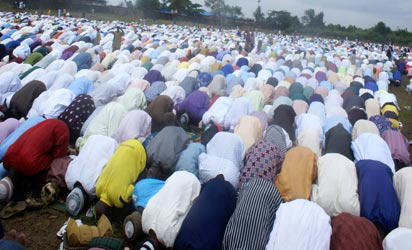
Muslims praying at Agege Prayer Ground, Lagos as part of activities marking the Eid-Kabir Celebration. Photo By Diran Oshe
By Ishola Balogun
There is no other time to purify your soul than now. Almighty Allah has offered us another opportunity to be alive to witness another glorious month, Ramadan. Alhamdullilah.
Not all those who prayed for it got it. Within the last twelve months, innumerable souls have gone to the great beyond, so many who had wished and prepared for the month even hours ago did not have the grace to witness it. Some though not dead but in critical conditions without the consciousness of observing the first Ramadan. We, of course are not better than them, we are rather specially blessed by Allah (SWT). Allahuma, Laka lihamdu-Shukran.
At this point, the purification of one’s soul is very essential in achieving the best of this month. It is better we plan and work in such a way that our personality and whole lives will be better for it at the end of the month. The beauty is that if we are able to achieve it, it will ultimately help to regulate what we do for the rest of the year.
Yes! We want to abstain from food and drink for 30 days as Allah commanded, but the inner dimension of the fast is necessary so as to reap fully the benefits of the blessed month.
Some of the ways to keep it away from contamination is to forgive those who have wronged you, be good to others. Seek forgiveness from Allah, show kindness and compassion to others, shun bad acts and free your soul from the grip of Shaytan, cleanse the soul of iniquities, evil thoughts, malice, backbiting, hatred and other bad acts.
Naturally, the two forces that usually inhibit us from doing good, are Shaytan and our nafs. (our inner self) The Prophet (s.a.w) said that Shaytan is chained during the month of Ramadan; that leaves us with the duty of purifying our own souls. Therefore, we need to work on purifying our souls so that we will get the total rewards of the month. Evaluate your nafs, or inner self, discover those things you have done wrong and repent never to do them again.
This is important because, fasting without the purification of the inner soul will not produce the fully reward. Every part of our body must fast. our eyes, mouths, toungues, hands etc. This is to ensure that we imbibe the consciousness of Allah, the piety and righteousness expected of us during the month. This will also afford us to maintain good traits even after Ramadan.
Let us for once remind ourselves that there is more to life than physical and material joy; there is a deeper fulfillment in fasting for Allah than eating, sleeping, and drinking. There is the need to take away focus from the worldly things we have been doing since the last 11 months, let us turn a new leaf, let us see one another as brothers, let us share from what we have and build better spiritual life. You must have a pure life, pure personality and a pure relationship with Allah and human beings. You must not only purify your ways of thinking and feeling, but must also purify your living.

Muslims praying at Agege Prayer Ground, Lagos: Photo By Diran Oshe
We know it is not an easy task combating one’s soul on what is bad, but the opportunity is here now.
Begin the month on a good note. It cannot be as usual, you’ve got to be a changed person this Ramadan. The Qur’an says “Truly, he succeeds that purifies it, (soul) and he fails he that corrupts his own self” (91:9-10).
Prayer: Allahumma ati nafsi taqwaha wa zakkiha anta khayru man zakkiha anta waliyyuha wa mawlaha
“O Allah grant my soul its piety and purify it, you are the best to purify it, you are its guardian and master.”
Ramadan Kereem!
One year after, no clue on Gawat
One year after Alhaji Razak Gawat, ace Television presenter and anchor of the sahoor (early morning) programme on NTA during Ramadan (fasting period), was declared missing, no one has any useful hint about his whereabouts. Since Tuesday, July 10, 2012, the family, friends and relatives have been psycholigically traumatised as a result of their missing breadwinner, not sure whether he is dead or alive.
Speaking on the development, the Lagos Police Public Relations Officer, PPRO, Ngozi Braide, told Vanguard in a telephone chat Wednesday that investigation is still on-going on the whereabouts of the television presenter. On whether there have been useful clues on the matter; Braide said: “On a matter like this we don’t have to disclose the information we have gathered so as not to jeopadise on-going investigation. All I can tell you is that investigation is still on-goin.”
Gawat’s black Toyota SUV with number plate RE 77 AAA with no visual sign of being hit by another vehicle was discovered on Eko Bridge inward Apongbon around 11:45 p.m. on Tuesday night,10th of July, 2012 by LASTMA officials led by the zonal head, Mr. Akinpelu Ayuba few hours after he was said to have attended a meeting in Ikeja.
Anwar-ul-Islam holds Ramadan lecture
As part of Ramadan activities, the Anwar-ul-Islam Movement of Nigeria will hold its national Ramadan Lecture on Sunday, July 14, at the main auditorium of Anwar-ul-Islam Model College, Agege, Lagos.
According to a release sent to Vanguard, the guest lecturer is Dr. Kabir Paramole of the Department of Religious Studies, Faculty of Arts, Lagos State University, LASU, Ojo. Theme of the lecture is “Leaders and Islam – Matters arising.”
Governor Babatunde Fashola of Lagos will be the eminent guest, while Chief Abdul Waheed Adeyinka Adeola, Director Sterling Bank Plc and Alhaja Hamdallat Amusan will be chairman and chairperson respectively. The event starts by 10am
The purpose of fasting
By Oshin Saheed Abu Azmia (Hikmatul Khilafa)
For every action in the Shari’ah, there is a purpose or wisdom. Even in the major acts of worship, we find that Allah has explained the wisdom behind the various obligations on us and their performances. In the verse related to wudu, we read: “Allah does not wish to place you in difficulty, but to make you clean, and to complete His favour upon you, [so] that you may be grateful.” (Al Ma’idah verse 6)
As regards the purpose of salah, we read: “Verily salah restrains [one] from shameful and unjust deeds.” (Al Ankabut v 45). In the verse relating to zakah, we read: “Of their goods, take alms, [so] that you might purify and sanctify them.” (At Tawbah verse 103)
In the context of hajj, we read the verse: “That they may witness the benefits provided for them.” (Al Hajj verse 28)
In similar vein, the obligation of fasting has a purpose and wisdom behind it. Allah the Exalted says: “O you who believe fasting has been prescribed upon you as it had been prescribed upon those before you so that you may become pious.” (Al Baqarah verse 183)
Thus the purpose of fasting is to attain taqwa (God consciousness). The great Tabi’i Talq Ibn Habib defined taqwa as ‘acting in obedience to Allah, hoping for His mercy, and taqwa is leaving acts of disobedience to Allah, out of fear for Him.’ This means to develop the quality of performing every action that Allah loves and refraining from those actions that He detests.
Etiquette of Ramadan fasting
By Harun Razaq
Any Muslim that wants his or her fasting in the month of Ramadan to be accepted by Allah must fast according to the instruction of Prophet Muhammad (SAW) because one of the conditions for acceptance of deeds in Islam is that it must conform with the teachings of Prophet Muhammad (s.a.w).
Some of these instructions are obligatory while others are recommended. They are as follows: (1) having intention of fasting before fajr. The Prophet (s.a.w) said: Whosoever did not intend his fast during the night (before fajr), no fasting for him.
Intention is the resolution in the heart to do something. Saying it aloud is bid’ah (a reprehensible innovation), and anyone who knows that tomorrow is one of the days of Ramadan and wants to fast has made the intention. (Majmoo’ Fataawa Shaykh al-Islam, 25/215).
The intention may be made at any point during the night, even if it is just a moment before Fajr. (2) Desire to take sahuur (the early morning meal) and delaying it until just before the adhaan of Fajr. (3) Avoid things that vitiate fasting such as eating, drinking, sexual intercourse etc. from fajr till sunset.
Allah said:…then complete your fast till the nightfall… (Q2:187) (4) Keeping away from sin, because the Prophet (s.a.w) said: “When any of you is fasting, let him not commit sin…” (Bukhaari)..(5) Keeping away from things that can destroy one’s good deeds and bring bad deeds and this include: allowing oneself to be distracted by quiz-shows, movies and sports, matches, idle gatherings, hanging about in the streets with evil people, driving around for no purpose or sleeping throughout the period of fasting. (6) Not allowing one to be provoked, because the Prophet (s.a.w) said: “If someone fights him or insults him, he should say, ‘I am fasting, I am fasting.’” (Bukhaari) (7) Being generous by sharing knowledge, material things, using one’s position of authority or physical strength to help others, and having a good attitude.
“The Messenger of Allah (s.a.w) was the most generous of people [in doing good], and he was most generous of all in Ramadan when Jibreel met with him, and he used to meet him every night in Ramadan and teach him the Qur’an. (8) Hastening the iftaar (breaking of the fast) because the Prophet (SAW) said: “The people will be fine so long as they do not delay iftaar.” (Bukhaari).
Breaking one’s fast in the manner described in the hadeeth (9) Not eating too much Sahuur and Iftar, because the Prophet (s.a.w) said: The best sahuur for the believer is dates.” (Saheeh al-Targheeb, 1/448), he said in another Hadith that: “The son of Adam fills no worse vessel than his stomach.” (Tirmidhi, no. 2380; he said this is a hasan saheeh hadith). (10) Combining fasting with feeding the poor is one of the means of reaching Paradise, as the Prophet (s.a.w) said.
Disclaimer
Comments expressed here do not reflect the opinions of Vanguard newspapers or any employee thereof.