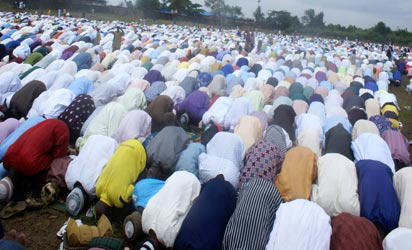
Muslims praying at Agege Prayer Ground, Lagos as part of activities marking the Eid-Kabir Celebration. Photo By Diran Oshe
By Ishola Balogun
The Qur’an says: Wazhakir faina zhikra, tanfau-l-Mumineen: “And remind, for indeed, the reminder benefits the believers.” We have to remind ourselves that there is no better time than now to prepare for the month. In fact, our preparations should have reached crescendo, bearing in mind that it is less than two weeks from now. The companions of the Prophet began preparation for the glorious month six months in advance.
Some of us delude ourselves thinking that when Ramadan comes, we will suddenly change and perform all the acts of worship. If we fail to internalise the acts or make adequate preparations for the month, by now, we may not be doing ourselves any good.
That is why some Muslims after the first week or so, return to their former selves. We are used to seeing mosques always filled at the beginning of the month but thin out after a couple of weeks into Ramadan, especially during Tarawih. This is merely because of the ill preparations and planning for the exercise.
We can now make a good preparation, no matter the time. First, draw a list of things you will do in Ramadan and how you will achieve them. Some of the activities we need to prepare for include the following:
Recitation of Qur’an
One important act is the recitation of the Qur’an. For many of us, the Qur’an has been abandoned since the last Ramadan. So, we must clean it and start to build a close relationship with the Holy Book. You need to constantly read the Qur’an if you are not the type that makes it your daily companion.
Perhaps, you can read to test yourself on speed and accuracy in order to determine how fast you can complete the Qur’an in a month. Some can complete the Qur’an two or three times over within four weeks. So, let us get into the habit of reciting the Qur’an now rather than begin it in the month of Ramadan. Again, it is not enough to read the Qur’an but you have to ponder over it intermittently to internalise the meaning.
We should set ourselves realistic targets on how much we want to recite daily. We could recite two or four pages a day, half a juz, or one juz; we can then manage and build up gradually.
Superrogatory prayers:
Endeavour to always perform some superrogatory prayers, (nafil). We should start now by observing all the daily supperogatory prayers. This will enable us to get accustomed to observing the Sunnah and Nafils in Ramadan and even increase them during the month. By increasing our voluntary worship, we can also give more attention and concentration to our regular daily salat and thus, gain closeness to Allah.
Making Dua:
What better time than now to get into the habit of regular communication with Allah via Dua. By the time Ramadan arrives, we would have already gotten into the habit of making the long and intense dua during this blessed month especially while fasting and in the later part of the night during Tahajjud.
Charity:
Ramadan is a time for generosity and giving. It is a time we think about the less privileged and also show gratitude to Allah for everything He has given us. Ramadan is a blessed month, and the rewards for charity are in multiple. Therefore, we should set aside part of our wealth to fulfil this act of ibadaah. It will not be nice if we are caught in the web of ill preparation and found wanting in this profitable act.
Moderation in eating:
Some erroneously believe that a few weeks before Ramadan, they have to eat voraciously to make up for the period of fasting. This is antithetical to the teachings of the Prophet. One hadith says: ”No human ever filled a vessel worse than the stomach.
Sufficient for any son of Adam are some morsels to keep his back straight. But if it must be, then one third for his food, one third for his drink and one third for his breath.” (Ahmad, At-Tirmidhi, An-Nasaa’I, Ibn Majah ) Besides, by controlling what we eat now, it will help us a great deal in our quest for sound health and enable us to worship more everyday during Ramadan.
Change your sleeping habit
If you are an individual who is used to sleeping throughout the night, it may be wise to change your sleeping patterns in order to ensure that you don’t miss your suhoor as well as attaining the benefit of Qiyaamul-Layl.
Controlling your tongue and character.
We must start controlling our tongues now. Bad habit can not be controlled in an overnight process. We must make a start now so that by the time Ramadan comes, we would have achieved the necessary changes in our manners and characters. Let us begin to feel that Ramadan is here and ensure that everything we do falls within what is permitted during the month.
We pray Allah to give us the grace to witness this forthcoming Ramadan, observe it and grant us the strength and ability to maximise the rewards therein. O’ Allah save us from the punishment of the hereafter. Amin.
Hajj 2013: FCT, Kwara to give preference to first time pilgrims
The FCT Muslim Pilgrims Welfare Board and the Kwara State Government have said that those performing hajj for the first time would be given preference during this year’s pilgrimage to Saudi Arabia.
Alhaji Muhammad Aliyu, Public Relations Officer of the FCT Muslim Pilgrims Welfare Board, said the decision to give preference to those performing hajj for the first time followed the reduction in the number of seats allocated to the board by the National Hajj Commission of Nigeria (NAHCON).
Aliyu said the board had made adequate arrangements to ensure prudence, objectivity and fairness in the registration of intending pilgrims in the FCT.
He, therefore, urged prospective pilgrims to comply with the board’s directives in order to ensure a peaceful hajj.
In the same vein, Hajiya Fatima Jimoh, the Executive Secretary of the Kwara State Muslim Welfare Board, (KSMWB), disclosed that the decision was in compliance with the National Hajj Commission of Nigeria (NAHCON)’s directive following the 20 per cent reduction of slots to countries by the Saudi Arabian authorities.
The Saudi authorities had slashed Nigeria’s hajj seats from 95,000 to 76,000, and accordingly NAHCON advised states to give preference to those performing hajj for the first time.
The commission said the worldwide reduction in the number of pilgrims was necessitated by “the giant development projects” in the Grand Mosque and other holy sites in the Kingdom.
“So we are appealing to all those who have been to Hajj in the past to step down this year.”
Jimoh said the screening of pilgrims would start on June 19 at the office of the State Pilgrims Welfare Board, adding that it was only fair to allow those who had not perform hajj before to do so because Islam stipulates that it was a life time experience.
FeedBack
Asalam Alaekum,
I write you as a follow-up to your article: Facing the Ka’ba, page 34, Vanguard, Fri. Jun.21, 2013. Therein, enough and sufficient disclosures were made and provided for the importance and benefits of prayer in our lives as Muslims.
I also read the other article too about the need for sisters-in-Islam to be wary and careful in using attachment-hair called “wig” as it is haram and forbidden in Islam. The write-up nourishes the quest and desire for knowledge and faith in the readers and illuminates the soul to embrace the true guidance and light of Allah. The publication is a service to Almighty-Allah.
Thanks.
Anonymous.
Re: 70 virgins in heaven? Another misconception
I read your article on the above subject and was wondering what you were trying to teach or may be clearly blame others for the ills in Islam. My concern is if pre and post Muhammad Abu Wardeh have not given their interpretation on 70 Virgins and 70 wives as a reward for suicide bombing, would non-Muslims have any reason to misinterprete this idea? Remember, this theory no matter how wrong it is, has never been adequately denied by Muslims and that is why Muslim suicide bombing will continue to happen all over the world.
Ustaz, really, the blame should be directed to Muslim Jihadists who twist the interpretation to kill non-Muslims against the principles of Islam.
Remember, non-Muslims did not start Jihad and the use of the word did not come from them. So, how come non-Muslims will twist the meaning of Jihad? Please, on what platform and ideal is Boko Haram killing – on Jihad?So, what do you want non-Muslims to do-may be, deny that Boko Haram or any Jihadist organization never mentioned Jihad in their text? The non-Muslims are the victims. The onus is on Muslims to clean-up and show clear signs of the reality of Islam.
Therefore, your blame on the misconception of ‘Virgins and Jihads,” on non-Muslims is unfortunate.
I hope you will reconsider your works. When the scourge of misinterpretation and misapplications of Islamic principles are adequately defeated, then, Islam will be appreciated by both Muslims and non-Muslims. The problem is not Islam but Muslims just like you have started.
Anwunzenku Zenku
Disclaimer
Comments expressed here do not reflect the opinions of Vanguard newspapers or any employee thereof.