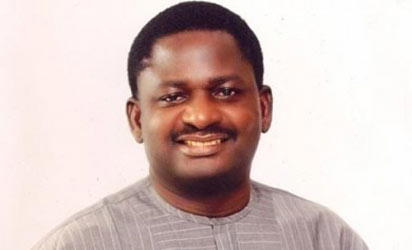
Femi Adesina
BY ISHOLA BALOGUN
Recently, at the biennial convention of the Nigeria Guild of Editors, NGE, held in Ibadan, Oyo State, Mr. Femi Adesina, the Deputy Managing Director of Sun Newspapers, succeeded Mr Gbenga Adefaye Editor-in-Chief/GM Publications of Vanguard Newspapers.
In this interview with ISHOLA BALOGUN, the new President of the Guild shares his plans about building a secretariat, welfare of members, professionalism, the challenge of on-line journalism, how he intends to further enhance the dignity of the Nigerian Editors among other issues.
Your election did not to come to many as a surprise, yet some people believed that leadership of the Guild should rotate between the North and South. As it were, what were those factors that led to your emergence as President, Adesina succeeding an Adefaye?
The leadership of the Guild had always rotated between the North and South for some time particularly in the last 20 years. If you go back to history, the Guild had problem and the association went into limbo.

Femi Adesina
It was revived around 1988, and the first President then was Onyema Ugochukwu and when he finished, Wada Maida took over, then Biodun Oduwole, followed by Garba Shehu, then Remi Oyo, Baba Dantiye and then Gbenga Adefaye. It was like an unwritten rule.
If you check the Guild’s Constitution, there is nothing about rotation in it. You should not be insensitive to the configuration of Nigeria. I believe in power rotation, but with a proviso that power should not rotate in perpetuity. After some time, naturally, you need to deregulate the process.
You need to build confidence, and remove the spectre of domination from any part of the country. And after you have built that confidence, you then deregulate the process and let the leader emerge from any part of the country. That is my personal opinion. The election came and I scored 149 votes to 57 by my opponent, Tukur Abdul-Rahman who has always been a friend.
He ran as Deputy President in 2008 to Mr Adefaye. For that election, I signed his nomination form and now that we ran against each other, we still remain friends. Since the election, he has called me twice and we spoke as friends. He indicated that whatever assignment I want him to do in the Guild, he would be glad to do it. You see, that election had the potential of polarising us into North and South, but I thank God it didn’t happen.
In fact, I was quite amazed that a good number of our colleagues from the North supported me openly, not covertly, and I believe they also gave me their votes. I want to thank them for putting primordial sentiments aside.
They came in chattered bus and told me they came because I was running. Religion could have been a factor, but it didn’t happen. Garba Muhammad, Gbadamosi Godje, Sule Yao Sule among others stood by me. Suleiman Uba Gaya, the Vice President, North was in my camp.
I want to thank all of them and commend that experience. It will be a good thing for Nigeria, if in our larger politics, we can put regional and religious sentiment aside when chosing our leaders.
Now that the election has come and gone, what are your plans and vision for The Guild for the next two years?
I promised our members that we will do a lot of training and retraining and I intend to stand by that. Fortunately, under the Adefaye exco, a memorandum of understanding was signed with the School of Media and Communication, Pan-AfricanUniversity. We have The Centre for Leadership in the Media, we will find ways our members from different parts of the country will undergo further training.
We will search for opportunities for training both within and internationally. We also promised to build a secretariat. Under the Adefaye’s Exco, attempts were made to get land in a commercial area in Abuja for The Guild.
The attempt has almost yielded fruit. By the time we get that land, the challenge will be to build the secretariat. By the grace of God, we will aggregate all our contacts, raise funds and build it. This mandate is for two years and I hope within the period, we would have done something substantial about having a secretariat of our own.
The Guild is over 50 years, we squat at the secretariat of NAN in Iganmu, we are thankful to them but I think the Guild is matured enough to have a secretariat of its own. The welfare of our members is also another area of our focus. We will be alive to any area that affects the welfare of our members.
On Freedom of the Press, if Freedom of the Press is abridged in anyway either at the corporate or individual level, we will be there to defend our members. Again, we must not forget the dignity of the Nigerian Editors; it is very important to us.
The way journalists and editors are regarded, that has started changing and it has to continue to change. One good thing Mr Gbenga Adefaye did was that he brought dignity to the Guild and that must continue.
We don’t want Editors to be seen as never-do-wells. We will not allow anyone to drag the reputation of the Nigerian editors to the mud. We will not merchandise with the Guild, we will give it respectability and integrity.
In trying to ensure professionalism, ethics and standards, there are still subjective interests, alliances of editors and what some people call “Echo Chamber Effect”, under your leadership sir, how do you intend to tackle these issues?
But you won’t find the leadership promoting anything like that. Whatever the leadership promotes is very important. The direction the leadership charts is very important, and I tell you, they won’t see the leadership of the Guild doing unethical things. They won’t do it and if any body does it, he does it on his own; not on the platform of Nigerian Editors. But by the grace of God, we will strive to do what is right at all times.
The FOI act has not been domesticated by most states of the federation, won’t this have any effect on the application of the law?
I don’t think that act needs domestication before it can be used. I have been at a forum where either Femi Falana or Fred Agbaje raised that issue, that the law is ready for use. It is fine if domesticated in any state but its non-domestication is not a limitation. Let us begin to use it. I want to charge the media to use the law.
In the light of growing popularity of on-line media, even though with the infiltration of non-professionals, the fear now is that the hard copy newspaper publication may soon go into extinction. How do you think the hard copy can be repositioned to meet this challenge?
I believe that the printed word will still be there. The newspaper hard copy will always be there. Yes, there have been challenges from on-line, but look at Newsweek. After almost a hundred years, it stopped the hard copy production last December, now doing online. I was very sad the day I heard that the Encyclopedia Britannica has stopped printing the hard copy, now you can only get it online. These are what we used through schools. When we were in Concorde, we had a library with a set of Britannica. But despite all these, I think the hard copy will always be there. I have attended a number of international seminars and courses on this issue. In one of the conferences the conclusion of that conference was that, yes, online would pose a challenge, it would erode the profit margin, but the printed words will always be there.
The challenge now is that we should begin to develop new business models round the printed copy so that online does not run you out of the market. You also have to be very creative in your production to face the challenge. Again, you can make money from the online itself. Now, all Nigerian newspapers will just put their materials online and readers just read them for free.
It will continue to be free unless we all come together and device a way we can make money from online. If The Guardian says you must pay before you read on-line, you will go to Vanguard as far as it is still free and if Vanguard begins to charge, you will abandon it and go to Punch. Unless these newspapers come together and say nobody can read us free again, even if it means charging money collectively and finding a way to share the proceeds.
How do you think government can handle the Boko Haram insurgency vis-a-vis the call for amnesty or no amnesty?
There are two clear positions which can both be tenable depending on how you look at it. The President says you can only grant amnesty to people you see. The other position says government should discuss with these people because there are people that can serve as the face of the group. I think the two positions must shift ground a little and meet themselves in the middle of the road. The government cannot continue to say they are ghost, if they are ghosts, what about the people that the JTF killed, are they ghosts? It shows they are not ghost. The onus is on government to find a way to engage them in dialogue. The same government told us they were using back-room channels to talk with them, so who were they talking with? Ghosts? It shows us that if there is a will, there is a way. Eventually, most major wars end at the negotiation table. I believe some form of dialogue or negotiation must come in, not necessarily outright amnesty for the sake of the country.
Out of your already busy schedule, you have the mandate of leading the Guild for another two years, what are those things this additional responsibility will take away from you?
It’s really going to take a lot. I am a church person, I am fully involved in church activities and you’ll find out that my life revolves round office-home-church and now added with The Guild. It is going to take a whole lot of my time and it is something I want to do very well. So, I am not under illusion that this assignment will not take my time. But I believe that my employers, family and leadership of the church are going to be understanding that I need to do this assignment very well.
Disclaimer
Comments expressed here do not reflect the opinions of Vanguard newspapers or any employee thereof.