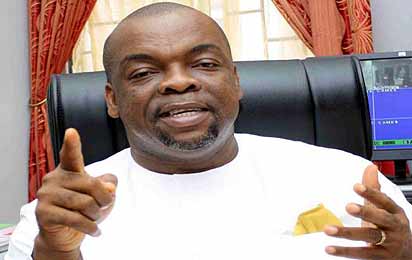
*Chief Emeka Wogu, Minister of Labour and Productivity
By Soni Daniel, Regional Editor, North
Emeka Wogu, lawyer and politician, has set a record in the political history of Nigeria, as one of the youngest Nigerian politician from his state to head the Ministry of Labour and Productivity, a post that the first and last person from his Ngwa Ethnic Nationality of Abia, Dr. Jaja Nwachukwu, vacated over 45 years ago. Today, Wogu takes the punches on behalf of the Nigerian government, as the one who mediates between Nigerian workers and the government on several burning national issues without looking back.
As a deft technocrat and mediator, Wogu, in this interview, explains how he has largely succeeded in stemming the tide of incessant strikes and protests by organised labour in Nigeria through consultation and negotiation, a development that has ultimately created goodwill, understanding and support for the administration of President Goodluck Jonathan. Excerpts:
What have you done to keep incessant strikes by labour at bay?
Well, what I can say is that the relationship between government and labour is cordial. We achieved that cordiality through serious effort in promoting social dialogue and partnering because in labour administration there is this doctrine of tripartism, which involves Nigerian Employers Consultative Association, NECA and government and labour on one side. It is a doctrine propounded by the International Labour Organisation, ILO. It is equally further deepened and furthered by the support I get from Mr. President, Goodluck Jonathan, who is respecter of the Rule of Law, who believes that it is better to dialogue than to jaw-jaw.
The encouragement I get from the President has equally helped me to sustain good ideals of labour-government relationship and over the years, as Minister of Labour, I have a good serious discussion with labour leaders and others and we always agree that it is better to dialogue over issues that affect the nation and workers than to fight and flex muscles. As a rule I have put in place as a minister, we are always interfacing with labour in Nigeria and they also realise the need to discuss with us what bothers them with a view to finding an amicable solution. This has led to a drop in the frequency of strikes and disruption of work and productivity in the country.
Moreover, I am pursuing a paradigm shift in the Ministry of Labour and Productivity from the usual adversarial approach to labour issues to developmental approach, which seems to have caught the fancy of the labour people and then the observance of the Rule of Law and the insistence of the government that the laws must be obeyed by both sides no matter whose ox is gored, has endeared government to labour. That is why we are making progress and we are using the institutions set up by law, like the Industrial Arbitration Panel and the National Industrial Court of Nigeria to arbitrate in most of the cases when consultation and mediation would have failed at the level of the ministry as provided in the Labour Act.
Your have made some progress in the enactment and payment of national minimum wage to Nigerians. But there are still pockets of employers and state governments yet to comply fully with the law. What is the government doing about that?
Well, the National Minimum wage Act is an Act of the National Assembly, which means that it applies to all parts of the country. It is an item in the Exclusive List of the 1999 Constitution. But the main issue is before now, what was the minimum wage? It was a mere N7,500. It took the intervention of Mr. President to push through a new national minimum wage because of his love and concern for the overall welfare of the Nigerian workers. Mr. President has through that law done what no Nigerian head of state has done in a very long time. No Nigerian leader dead or alive has so identified with the Nigerian workers like him.

*Chief Emeka Wogu, Minister of Labour and Productivity
You will recall that on May Day 2010, Jonathan attended the workers celebration at the Eagle Square. That act really endeared him to the Nigerian worker because that day he stood with them, marched with them, took the salute, interacted with them to know their grievances, read the placards carried by the workers and even took back some of the placards to his office to study and identify what the workers were looking for. At the end of the day, there was this strike by Federal workers that was already going on when I assumed duty as the minister.
They were asking for a pay increase and other things. The president then directed the then Head of Service, Steve Orosanya, and I to go and look at the workers demands and do something about it. We than entered into negotiation with the workers and at the end of the day, we came with a recommendation that the salary of federal workers be increased by 53.46 percent and when you translate that into the lower and upper limit, it came to N17,500 and that was before the minimum wage came into effect.
But still, we still pursued the pan-Nigerian workers welfare-pan Nigerian in the sense that it has to benefit all Nigerian workers. We worked with the Minimum Wage Panel headed by the former Chief Justice of Nigeria, Alfa Belgore. So we computed everything and it amounted to N18,000 that became the National Minimum Wage. The Federal Government has paid its workers to the letter, some states have paid but others are yet to pay in full. There are places where you have partial implementation and so on. That is for the public sector. The National Minimum wage has a proviso that if you employ from 50 persons and above you have to implement the national minimum wage for workers.
But university staff are still edgy in spite of the fact that other public workers have become wary of strikes and protests?
Well, there are agitations by ASUU and others. These are centred around the agreement that was reached in year 2009 between the government and the labour unions and ASUU. That followed a period of strikes that lasted several months by ASUU. Then we have been able to discuss with them. A committee was set up and the Secretary to the Government of the Federation is leading the mediation. We still discussing with them.
What have you done to boost productivity and the welfare of Nigerian workers?
As a ministry, we presented before the Federal Executive Council, the first ever national policy on productivity, the first by any administration in this country. It was discussed and approved by FEC after approval by the National Economic Council, which involves all the state governors. They all welcomed the idea because the President wanted a National Policy on Productivity so as to boost the economy.
What does the National Productivity Policy entail?
The policy is aimed at increasing national productivity because before now, there was none in the country. There was dwindled productivity in all sectors, and this impacted negatively on the national economy. The model produced has been accepted by the government and it is being put to use and a national productivity day has now been set up by the government all in a bid to give meaning to the new policy. The idea is that since we have a motivated workforce, we need to put in motivation in place to boost productivity in both the private and public sectors. I have also set up a new department in my ministry to measure productivity measurement and some states are already keying into it, asking us to come and open offices for them.
Workers compensation is still a problem in Nigeria in that some are injured and some even die on their duty posts without being compensated adequately. What are you doing about that?
Sadly, the Workman Compensation Act is an archaic law and is no longer being used in most Commonwealth countries. But it took Mr. President’s interest and intervention to improve the welfare and social security of the Nigerian workers that he initiated through my Ministry, the Employee Compensation Act, which he immediately signed into law and even set aside seed money to the Nigerian Social Insurance Trust Fund to manage. The NSITF was even before now moribund. But it has been revived. That agency and the parastatal under me are doing very well. Unlike before, work place injuries are being compensated promptly by the employers because of the renewed policies and programmes we have put in place.
Right now, the Inspectorate Department of my ministry has been reposition to undertake effective and routine monitoring and supervision of work places to ensure that the workers are adequately protected and compensated in case of any injury or accident. They are also mandated to ensure that work places are not only conducive but are also safe so that people are not injured or wounded in the course of their operations. The implication is that we are trying to minimize work place injuries. The point is that we have a social responsibility for the welfare of our workers. All these have been done between 2010 when the President assumed office and now.
What about job creation for teeming Nigerians roaming the streets with certificates? Does your ministry still create jobs?
Well, the truth is that the aspect of job creation was taken off our ministry. But what is important is that there is a provision on the Exclusive List of what we are expected to do. The Federal Civil Service Commission is in charge. But we are entrusted with the responsibility of coming with policies that are articulated in such a way that employment would be created through such policy. One recent policy of the Ministry of Labour and Productivity, which I took to the FEC and got the support of the council and the approval of Mr. President the National Policy on Employment Creation, NAPEC. It identifies about 15 sectors of the economy where jobs could be created and in that policy, there are provisions on how to achieve it.
The Federal Government is pursuing the implementation of that NAPEC policy and it has created jobs in various sectors already. As a follow up, we came up with another one called the Local Employment Content Initiative, which has made it compulsory for ministries and departments and agencies of government, which are embarking on contracts and projects to declare the number of jobs that are to be created and engage Nigerians. And between the time it came into effect between 2011 and 2012, several hundreds of thousands of jobs have been created. No fewer than 200,000 jobs have been created by that process. This is without prejudice to the jobs created by other sectors. The SURE-P and other are also generating thousands of jobs for Nigeria.
Then because Mr. President is desirous of tackling unemployment, which is a global problem, and because of our peculiar situation, he has set up a standing committee on Job creation and I am chairing that committee and we are charged with the responsibility of finding ways and means of reducing unemployment in the country. We have been given a marching order by the president. So everybody in the cabinet is involved in job creation. The National Bureau of Statistics is a member of the committee and the total number of jobs created will be released at some point.
How did the Federal Government arrive at the sum of N384 billion for the payment of severance benefits to PHCN’s workers? They are saying that they were not carried along in the calculation…
Let me answer that question in three ways. First, there was an agreement between the government and labour and the heads of agreement were noted down and signed. At the end of the day, those agreed portions will definitely be monetized. Secondly, there are agencies of government involved in the calculation. The central body that plays a central role in the whole process is the Bureau of Public Procurement, BPE. There is an implementation Committee that is working on the matter.
The reason for putting an implementation committee in place is that where there are issues of complaint, it can look at the issues. Already, we are planning to meet with labour to discuss it. The committee is still doing its work and that the announcement should have come after the committee might have completed its work. The point is that there is an implementation committee and that the issues should be handled at that level. That implementation committee is being chaired by Minister of State for Power. It is an all-embracing commit
tee and labour is aware of it.
How do you feel being Minister of Labour? Are you excited, challenged or afraid that the whole issue of labour in Nigeria is being put on your shoulder?
I feel honoured that I was invited by Mr. President to join his team, just like any other Nigerian would feel when invited to serve the nation. My prayer is that God will give me the wisdom to continue to do the right thing. And I am very grateful to Mr. President for giving me this opportunity. It is indeed, a rare opportunity when you look at where I come from. I come from the Ngwa Ethnic stock of Abia State and the last Minister to come from that part of the country was late Dr. Jaja Nwachukwu, who was the first Speaker of the House of Representatives and Minister of Foreign Affairs and later became a Senator in the Second Republic.
He left cabinet at about 1965 or thereabout. I was born in 1965 and I became the second minister to be appointed from the Ngwa area of Abia State in 2010 and so for 45 years we did not have any minister from that part of Nigeria. And I have the support of the state where I come from, the support of the people and the governor of the state. They are most grateful to Mr. President for giving the post not only to the Ngwa stock but to Abia State.
And then being a minister of labour comes with its challenges but every ministry in any country comes with its challenges and responsibilities. So I am facing my own challenges and responsibilities with a lot of dedication, honesty and determination to make sure that the Transformation Agenda of Mr. President works. We are doing that as a group, it is teamwork and the entire ministers are on their feet to ensure its success. We are looking at tomorrow and the future and Mr. President insists we must bequeath a better place to Nigerians, where power will be constant, where the infrastructure is working. And these are problems of many decades.
Nigerians should be patient because Mr. President is actually working hard to fix these problems once and for all. The problem is that a few Nigerians want to criticise everything even though they don’t even know that the government has done and is doing. This action has led to so much misinformation in the public domain. I give kudos to Mr. President for being courageous enough to come with a transformation agenda. You know that it is painful when you are building, transforming and all that but it must be done and it is being done. So we plead with Nigerians to support him.
What would you like to leave as a legacy at the Ministry of Labour?
I want Nigerians to remember me as part of the team that contributed a lot to development of the country. Initially when I was asked to come and served, I was looking at what positive impact I could make within a year or so. I see myself as a change agent and without sounding immodest, I have done a lot to change the way things were. The records are there and I would want others to talk about them. I cannot begin to praise myself. My work will speak someday.
Disclaimer
Comments expressed here do not reflect the opinions of Vanguard newspapers or any employee thereof.