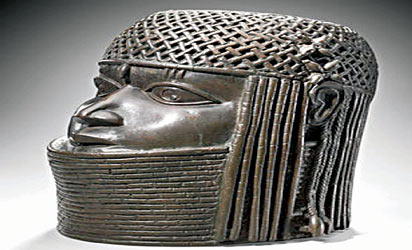
*Commemorative head of an Oba, Benin, Nigeria, now in Museum of Fine Arts, Boston, USA
By Kwame Opoku
“There was a dim grandeur about it all, and also these seemed to a fate. Here was this head center of iniquity, spared by us from its suitable end of burning for the sake of holding the new seat of justice where barbarism had held away, given into our hands with the brand of Blood soaked into every corner and …….. fire only could purge it, and here on our last day we were to see its legitimate fate overtake it (1)
R. H. Bacon, the Punitive Expedition’s Intelligence Officer wrote on the burning of the Benin Royal Palace.
We have just read a detailed report from Tajudeen Sowole on the so called Benin Plan of Action for Restitution (2) and would like to make a few comments on some of the issues arising that we did not deal with in our previous article on this subject. (3)
The meeting at which this miserable document was prepared on February 19, 2013, happened to be the same date on which the British carried on their nefarious attack on Benin in 1897.
Was this a mere coincidence? We can only hope that at least a minute’s silence was observed in the honour of all those who lost their lives in one of the most egregious acts of British imperialist aggressions in Africa. (4)

*Commemorative head of an Oba, Benin, Nigeria, now in Museum of Fine Arts, Boston, USA
We learn from the report that the British Museum was invited but could not attend because of unresolved travel difficulties. Can anyone believe this? Or were the officials of the venerable museum playing again a game similar to the one they played with the notorious Declaration on the Importance and Value of the Universal Museums which they inspired and engineered for support against Greece but did not eventually sign?(5)
Regarding the 1970 UNESCO CONVENTION (Convention on the Means of Prohibiting and Preventing the Illicit Import, Export and Transfer of Ownership of Cultural Property 1970) which the meeting hoped to discuss and review next time, Prof. Folarin Shyllon, an expert on the Convention, pointed out that the Convention has no retroactive effect and that no State would enter into a treaty with retroactive effect.
It is not clear to me which side raised the issue of the Convention but the Minister of Tourism, Culture and National Orientation is reported to have pleaded with the visitors and noted that “the hurdles placed on our way by the various Conventions and applicable international laws that govern repatriation of heritage objects”. This suggests to me that some participant must have created the misleading impression that the UNESCO Convention and other rules of International Law place obstacles on the way to restitution.
Nothing could be further from the truth than this myth deliberately and knowingly entertained and spread by some Westerners.
That the UNESCO Convention has no retroactive effect is accepted by all and is indeed common knowledge. This means that the Convention does not affect acts done before its entry into force. It neither approves nor disapproves of past events.
That is all. From this, some Westerners have developed the notion that the looting and other wrongful acts done before the entry into force of the Convention are saved by the Convention and one is prohibited by the Convention from reclaiming artefacts looted or stolen before 1970. They thus give the Convention a retroactive effect in their favour. But this is surely wrong.
That the Convention does not provide a basis for reclaiming acts done before its entry into force clearly does not mean it prevents or prohibits reclaiming artefacts looted before 1970. The various restitution to Egypt, Greece, Turkey, and Peru show that no international law prevents restitution if States are willing to do so. (6)
The Convention itself provides in its article 15 that:
“Nothing in this Convention shall prevent States Parties thereto from concluding special agreements among themselves or from continuing to implement agreements already concluded regarding the restitution of cultural property removed, whatever the reason, from its territory of origin, before the entry into force of this Convention for the States concerned.”
States are thus free to enter into bilateral agreements to effect restitution. They may also bring legal action on the basis of International Law or Municipal Law, independent of the Convention.
We hope that the legal experts at the meeting pointed out some of the difficulties involved in trying to revise a convention and the time it would take to reach an agreement concerning the text of a convention on a subject where there are great divergences of views.
The 1970 UNESCO was ratified by many major European States only 30 years after its entry into force and many African States have not yet ratified it.
What the representatives of Western museums tend to omit in their statements on restitution is the fact that the United Nations and UNESCO as well as several international conferences have urged the return of cultural artefacts to their countries of origin. (7)
These museums are also required by the Code of Conduct of ICOM (International Council on Museums) to take the initiative in starting discussions with the owners of the looted artefacts.
Some of the statements attributed to Dr. Peter Junge, Director of the Etnologisches Museum, Berlin, are remarkable. ”Between 160 years ago and now, nothing has been done, but the dialogue has started now.”
It should be recalled that after the defeat of Benin in 1897, following the notorious British invasion, the Kingdom of Benin became part of the British colony of Nigeria which gained its independence in 1960.
Thus for most of the period Dr. Junge is talking about, only the British could have done anything about the looted Benin artefacts. They should indeed have returned the objects at the Independence of Nigeria.
Nothing of the sort happened. According to the great Ekpo Eyo, after Independence, when a museum was to be opened in Benin City, a request was sent to all the holders of Benin bronzes, including Dr, Junge’s own country, Germany, asking for the return of some of the Benin bronzes. Not a single item was returned.
Disclaimer
Comments expressed here do not reflect the opinions of Vanguard newspapers or any employee thereof.