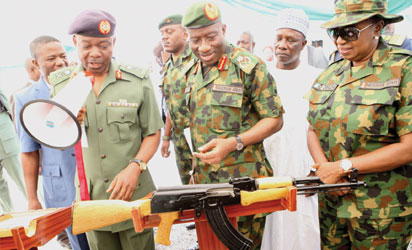
From left, DG DICON, Maj Gen. Su Labaran, President Goodluck Jonathan, Gov. Patrick Yakowa of Kaduna State and Minister of State Defence, Erelu Olushola Obada During the President’s visit to DICON on Monday.NAN Photo
By Rotimi Fasan
POLITICAL leaders are by their very status newsmakers; none more so than the president of a country. But there are times when such leaders seem to enjoy more media attention than they normally do in the ordinary run of things.
This appears so for President Goodluck Jonathan who seems to have run into pretty bad weather, thereby courting avoidable bad press, with his last ‘media chat’.
As president, Goodluck Jonathan tends to be in the news but most times not always for the best reasons. Not even on occasions when the President actually sets out to do the right thing. He ends up making a hash of everything, bungling it all up, as he did his decision to honour MKO Abiola by renaming the University of Lagos after him.
It was as if the President thrust his face down a steaming broth and is rewarded with scalded cheeks. The last chat the President had with some media personalities was another occasion when he opened up his soft underbelly for the sharpened dagger points of angry Nigerians, not all of them his political opponents. In the first place, I had no idea the President had had a presidential chat.
The chat had become so irregular and had, perhaps for that reason, attracted far less attention than it had under the initiator of the parley, former President Olusegun Obasanjo. Thus was I to learn of the meeting but only after I had heard it on news reports on television well after the event. These reports were accompanied with clips of some of the highlights of the interview- full of bland and dry responses, as uninspiring as they could possibly be.
But I would later read texts of the interview in newspapers, not any better than the clips I had seen on television. The part that interests me and which is of relevance to what I’ll be saying next is the President’s response to question concerning the declaration or non-declaration of his assets, statutory demand imposed on public officers.
Asked why he was yet to declare his assets publicly, the President’s response was revealing- says quite a bit about his true person, a foxy mind very much at odds to the cultivated image of a quiet, innocent and unambitious politician that he maintained right to the eve of his ascension to the Aso Villa throne and, thereafter, one full year into his own presidency. “I don’t give a damn about that,” the President said.
“The law is clear about it and so, making it public is no issue and I will not play into the hands of the people. I have nothing to hide.” And he goes on to conclude that: “I declared under the late President Musa Yar’Adua because he did, but it is not proper. I could be investigated when I leave office…You don’t need to publicly declare it and it is a matter of principle”.
And which principle is the President talking about here- the one that makes him keep up his guard against the Nigerian people who voted for him but whose hands he is careful not to play into now? What principle, I ask, is the President talking about here? Is it the principle that allows him to claim to be honest and true to his oath of office without being seen to be honest?
It is true the code guiding the conduct of public officers demands that they declare their assets: but it does not require them to do so publicly.
Yet, should someone choose to declare their asset publicly, what is not proper in it? What is not proper in anyone, especially, the President choosing to demonstrate his compliance with this basic moral demand in a country where everyone knows public office holders, including respected politicians, have no more respect for declarations made on oath any more than they respect the paper on which such declarations are made? Of course, one does remember that a few eyebrows were raised when, then, Vice President Jonathan declared his assets way back in 2007. Not a few thought the VP couldn’t have acquired all he claimed on a lecturer’s salary. Yet, the heavens did not fall then. If anything, many praised the courage behind the decision of both the president and his deputy to declare their assets publicly.
The President would be very naive to imagine Nigerians believed all he put down then on paper as being all he owned on God’s earth even when they praised him. Now, though, we know that Jonathan never liked what had happened then. And we can only wonder how many such things Jonathan never liked about his late principal that he never mentioned, to say nothing of now that he is the President and Commander-in-Chief. Since the President likes to maintain a placid countenance that reveals next to nothing, would he oblige us with an explanation of his likes and dislikes? In declaring his assets publicly, President Jonathan would not only be saying that he is morally clean but he would also be showing that he is transparent in deed and utterance.
But to go back to the President’s use of language in that interview- a lot of it could be overlooked because it boils down to our generally poor or inadequate grasp of English. Our poor knowledge of this language many times leads the best of us into saying what we don’t mean or want to say. Many times we say the very opposite of what we mean as in the case of many of us who call a trouble making, cantankerous fellow a ‘trouble shooter’ in direct opposition to what we mean- a trouble maker!
So when the President says it’s not proper to declare his assets publicly if only to show that he truly has nothing to hide and in recognition of what damage he knows corruption has done to our country- when he talks about what is not proper like this, some of us can only understand him to mean that it is not proper from the perspective of someone who thinks he might be revealing what could be potentially dangerous to his claim of transparency, and not that it’s not proper for everyone. It’s also in that context I would put his use of the word ‘damn’.
Not in any way for its four-letter status but that it, along with the entire sentence, shows a lack of respect for Nigerians- a careless dismissal of their wish.
As we cannot know yet what the President considers right or proper because he leaves too much to the imagination while putting up the right attitude, we cannot conclude he truly does have no respect for Nigerians. Shall we wait for another media chat to know this?
Disclaimer
Comments expressed here do not reflect the opinions of Vanguard newspapers or any employee thereof.