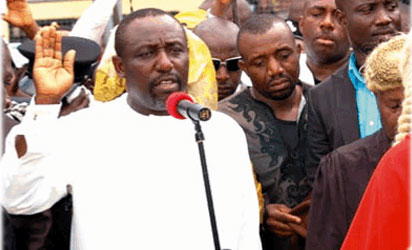
Gov Okorocha
By Obi Nwakanma
Last week the Federal Court of Appeal handed down a long-expected judgment in a suit instituted by the elected Chairmen of local governments in Imo state against the governor of the state, Mr. Rochas Anayo Okorocha. In their suit, the chairmen prayed the court to declare ultra vires the decision by Mr. Okorocha acting in his power as the governor of the state, to depose them, and in so doing to recognize their stature as an independent tier of government.
The court in its deliberation and decision apparently agreed with the chairmen by declaring the Imo state governor’s action as unconstitutional, and an overreach of his executive powers. I would say no surprises there. The court of appeal is right in coming to this conclusion, and thus hopefully brings to some resolution the specific question raised by Rochas Okorocha’s action about the validity and independence of the local government as its own epicenter of civil authority.
On assuming office, one of the very early actions which Rochas Okorocha took was to ‘sack’ the elected Chairmen and councilors of the 27 local government areas of Imo state, and to replace them with what he called “transitional committees” of his cronies. It was an egregious action to put it mildly, and in my view amounts to an executive coup.
Critics of Okorocha’s action were consistent in pointing out to the governor that he lacked the constitutional power to sack an elected and equally constituted government. More so, that under the federal constitution of Nigeria, the local government is a third tier of government, not a mere appendage of the state government and its administration. In other words, the constitution makes the various local government authorities equal authorities within their specific jurisdictions with the governor of the state who is simply primus inter pares – that is first among equals.
Not even the president of the federation is invested with the authority to remove or countermand the authority of an elected head of the local government. I think this is a lesson Okorocha ought to have learned had he taken even elementary civics or basic high school government on the meaning and structure of federalism. But it does seem that there is too much military-style mentality still at play in the understanding of the relationship between those levels of government.
This problem in Imo state apparently did not start with Rochas Okorocha. In the Ohakim administration before it, there was an inexplicable forced appropriation and pooling of local government grants from the federation account, which left the state government controlling the financial resources and independence of the local government administrations. Successive administrations have operated on the premise that the local government authorities are under them.

Gov Okorocha
This is not so. I think the Federal Court of Appeal’s decision ought to make this very clear. Just on Wednesday, the Ekiti State governor, Dr. Kayode Fayemi, in a statement released by his Chief spokesman basically issued an executive order to the Ekiti state Local Government Service Commission to query workers in the Ilejemeje local council to explain their absence during his unscheduled visit to the local government Council secretariat.
The query apparently may be issued to both the Chairmen and the Director of Administration, and Council Treasurer, as well as elected Councilors who were not there to receive the governor. First, I’m afraid that the governor has no grounds on which to issue such a query. Secondly, the elected Local government chairman of Ilejemeje is neither obliged to receive the governor of the state paying an unscheduled visit, nor even to respond to a query issued by the Local government service Commission.
The chairman is not answerable to the governor. He is answerable only to the people of Ilejemeje who elected him. Who says that at the time ofthe governor’s visit without a prior notification to his office, the LG chair was not having a committee meeting, or a constituency meeting, or visiting a road project in some outlying district, or carrying out any one of the numerous functions for which he was elected? He was certainly not elected to anticipate the governor’s unscheduled visit.
It is also a terrible throw-back to military-era mindset to spring surprises on public servants and disrupt their schedules by such rude and unplanned visits by state governors calculated at proving what? Public servants are not employed simply to sit in their offices. They conduct meetings outside of their offices. They meet other officials for lunch or coffee; they have inter-departmental meetings; they conduct community outreach functions.
The unscheduled visit of governors are far more disruptive to the function of administration than the absence of an official from their offices. It is left for the Chairman of Ilejemeje Local Government Council to determine whether his Director of Administration or Chief Financial officer or Treasurer have been derelict by their absences. It is not up to the governor of Ekiti State.
It is the job of the elected councilors of Ilejemeje to carry out the oversight duties, and query the elected chairman of the local government, not the governor. Indeed, the Local Government Service Commission is an antiquated and unnecessary carry-over of the military government under a unified administrative structure that placed oversight of local administration in the hands of a military governor.
Under a civil democratic government, such a power does not exist. The local governments, deriving their power from the constitution, and their grants straight out of the federation account, are endowed with both financial and political independence to function as legitimate third-tier governments.
It is enough time already for these authorities to assume full governance of their jurisdictions. And this brings me to the question of municipal services: given their autonomy, local government officials must be held fully accountable for the expenditures or lack thereof they make of allocations to basic municipal services – roads, street lights, garbage collection, schools, county hospitals, sports, libraries, art galleries, local security, etc. It is the function of the local authorities to provide these basic services.
In the case of Imo state, there must be a full accounting of the local government funds which the governor and his cronies had seized from the local governments this past year. More importantly, there is a real need to review the Imo state electoral laws to include a more transparent process. The state governor should not have the authority to decide when to conduct local government elections.
It is the mandate of the House of Assembly to promptly pass the electoral bill at every election cycle for the mere accent of the governor, whose duty ought simply be to put the resources in the hands of the independent agency of government responsible for elections. The electoral law must be amended to establish Town Council electoral committees to conduct and supervise polls at the county level. That way, there’d be greater transparency, and lesser risk of manipulation of local government elections by state governors.
Disclaimer
Comments expressed here do not reflect the opinions of Vanguard newspapers or any employee thereof.