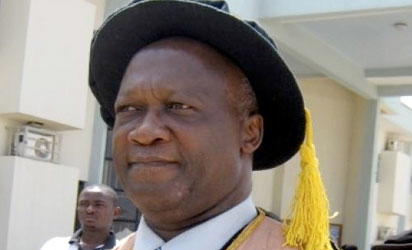
Prof. Boniface Egboka, Unizik V.C
By Ebele Orakpo
For many years, the Nigerian public university system has been fraught with disjointed academic calendar mainly due to disagreements between government and the Academic Staff Union of Universities (ASUU). It is common for a student to get into the university for a four-year programme and end up spending seven years following incessant ASUU strikes due to the unwillingness or inability of government to meet their legitimate demands.
When two elephants (government and ASUU) fight, the grass (student) suffers. But unlike what obtains in other government-owned institutions, Nnamdi Azikiwe University (UNIZIK) Awka, has over the years, maintained a regular academic calendar. In this chat with Vanguard, the Vice-Chancellor of the institution, Professor Boniface Chukwukadibia Egboka, a hydrogeologist, speaks on sundry issues including UNIZIK’s stable academic calendar, the recent ban by NUC of part-time programmes and advocates the use of indigenous languages in teaching. Excerpts:
How has UNIZIK been able to run a normal academic calendar for so long?
For over 12 years now, Nnamdi Azikiwe University has run a normal academic calendar. We don’t believe in strikes. In as much as we believe in the demands of ASUU for better educational funding, better infrastructure, internationalization of our university system so that we can compete favourably with any university in the world; all these are very good. I am happy the present administration is making some efforts to solve these problems.
ASUU’s demands are very genuine but I personally believe in dialogue. I believe in force of argument not argument of force. It is always very good to negotiate, to dialogue, to discuss because if you are to go to war, after every war, you must come back to discuss peace. If you must do that, why not skip war? So UNIZIK has been very lukewarm in organising or participating in strikes because when you have these strikes, both students and lecturers suffer for it because if you are a serious lecturer and a professional researcher, you don’t want your work to be disrupted.
Students are forced to become vagrants, travelling up and down, and sometimes they get involved in accidents and research projects are stalled. Living materials used for research in medicine, vet medicine or agriculture, are impaired. Those in Chemistry and related areas also have problems and machinery are not left out. In the long run, you discover that both government and universities are losing. Therefore, one is very happy at the present changes in the country.
ASUU has reached a lot of agreements with government and government has tried to meet up with some of the agreements and efforts are being made to meet up with the rest so I believe there may not be strikes again in the Nigerian university system.
Does it then mean that UNIZIK has no ASUU?
We had a problem of having no ASUU but we do not want to be a pariah university so every effort is being made to start off ASUU at UNIZIK and we hope to be able to achieve that. Nobody likes strikes. I believe even ASUU people do not like strikes. Their going on strike may be a result of stressed situations but from the attention government is paying to the university system, strike may be come a thing of the past very soon.
President Jonathan, Education minister, National Universities Commission’s executive secretary, Professor Ojerinde of JAMB, head of Tertiary Trust Fund, are all ASUU people. The entire education system is headed by people who were in the university system so there is a fair understanding of the system.

Prof. Boniface Egboka, Unizik V.C
It has been said over and over again that the standard of education in Nigeria has fallen. Do you agree with that?
There is no doubt that there is a general problem in terms of socio-economic activities in the country. There is a lot of technological, engineering and economic issues that require funding. You have the so-called civilized/developed world and the developing countries such as Nigeria but you discover that in Nigeria now, we are doing things that both developing and developed countries are doing. We are working very hard to catch up and to catch up to modernisation ventures requires a lot of capital.
Therefore, our educational system, educational management and running are cost-intensive. How can our educational standard be falling when you have so many students graduating from our universities every year? Out of every 12, you must have a Judas so of course, you may have a few that are not good enough but majority of them are doing very well. The statistics are very clear. Every year we turn out thousands of graduates from various universities and polytechnics.
They are absorbed in various units, industries, governmental agencies, parastatals, local government authorities, schools etc., as youth corpers and wherever they are posted, they service the area accordingly. There have never been major problems with our youth corpers. Unfortunately, when the service year ends, they are thrown out and the system absorbs new corpers. A lot of our graduates go to Europe and the US and do their master’s and doctorate degrees within record time.
Many of the agencies that employ them, like the print/electronic media and film industry, are peopled by our products and they are working. We have so many entrepreneurial skills developed by many of our products in the universities and polytechnics and many of these young men and women, given little chance, develop their skills and do very well. All over the country, you find many of these graduates on their own performing, even with minimal encouragement.
Despite the fact that you hardly have good laboratories for the sciences in our secondary schools, these students eventually take SSCE or NECO and come to the university through JAMB. They have that poor background but in the universities, within the first year or so, they catch up and they do well. There is no doubt that there is a lot of emphasis on the English language as the official language for the country but it is a second language.
Are you saying that the English language, as the official language of instruction in our schools, is impacting the education system negatively?
You are first brought up in the language of your parents. As an Igbo man, I first learnt Igbo language before I learnt English so many a time, you find that the English our children speak is translation of their indigenous languages. So when you insist that somebody must speak English as fluently as the English man, it is not easy. China, India and Japan do not speak English. So, many a time, people say the standard of education is falling. It is not falling.
When I read geology at UNN, I knew how many courses I took. When you compare my experience then with UNIZIK, our students take more courses than we ever took. There is a lot of computer science, higher mathematics, entrepreneurial studies component in addition to your core course in geology so you find that the products we have today are much more broad-minded and broad-based.
What is the way forward?
I think the government should lay more emphasis on indigenous languages. Language is a key part of culture and culture is life. You cannot just come out from your mother’s womb and jump into English language. So many English people cannot write good English. That is why at UNIZIK, we have made it compulsory that students should take Igbo Language in their General Studies course. In the west, they emphasise on Yoruba language, in the north, it is Hausa language. It is very important and should be encouraged. English should not be a replacement for your own language.
Do you think the funding of Education in Nigeria is adequate?
I think it has improved. Tertiary Education Trust Fund (TETF) before now, was taking care of all the various branches of the educational system but now, it is limited to tertiary education so there is a better platform for funding. Budgeting for money is one thing, it is another thing to release budgeted money but there is hope. Recently, the Federal Government through TETF organised a needs assessment to know what universities in the country have and what they are supposed to have to be able to become as international as possible.
Some people come out with a first class and are not as useful to the society as those with third class. What is missing here?
There is need for skills acquisition and skills development. That is the aim of entrepreneurial studies. Theoretical appraisal and analysis are very good but theoretical component should have applied aspect. What you read and learn should have a practical application on issues within your environment. Practicability, usability and self-sustainability are very important key words and that is why somebody may have a second class upper division and may not be as useful as someone with a third class honours because one has an ingrained skill which can easily be ignited to become very useful.
At UNIZIK, we have Chike Okoli Centre for Entrepreneurial Studies where we offer diploma and certificate programmes in entrepreneurial studies on various aspects of living and culture.We also have a compulsory course for every graduate on entrepreneurial studies. This is in line with what the present government wants, the opportunity for our children to acquire skills so that when they leave the system, they can fend for themselves.
Disclaimer
Comments expressed here do not reflect the opinions of Vanguard newspapers or any employee thereof.