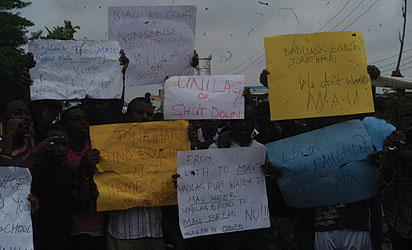
Democracy Day Gift for UNILAG student; A Peaceful protest by University of Lagos student , at Yaba Roundabout, over the re-naming the University of Lagos to Moshood Abiola University on Tuesday 29-5-2012, in Lagos. PHOTO; Kehinde Gbadamosi
By Rotimi Fasan
NINETEEN years after the pan-Nigerian mandate he won at the polls was voided by the military and 14 years after he died in incarceration fighting for the restoration of that mandate, recognition finally came the way of Moshood Kashimawo Olawale Abiola – or so it seems.
But in what must go down as one of the greatest ironies of Nigerian history, what should have marked the highpoint of nearly two decades of democratic struggle for the recognition of one of the most iconic symbols of Nigeria’s democratic coming-of-age instantly turned ash in the mouths of many who had looked forward to this time.
The major highlight of President Goodluck Jonathan’s May 29 so-called Democracy Day broadcast was the renaming of the 50-year old University of Lagos as Moshood Abiola University.
In making this announcement, the President had probably not anticipated the degree of opposition that decision had so far elicited from Nigerians. But it would be naive of him not to have thought of some form of opposition to that decision.
Which probably explains the sudden, even clandestine manner, the announcement was made. To present those likely to oppose the decision with a fait accompli – something they could hardly do anything about. This proves nothing but Jonathan’s own naivety and show him up as a novice in the slippery terrain of political gamesmanship. He must be quite a political character to have turned what could have counted as a political master stroke into the faux pas it has become.
This must be really an embarrassing time for the Abiolas and those who have in the last many years called for recognition of Abiola’s role in the restoration of democracy to Nigeria. June 12, 1993, the day Nigerians massively voted for Abiola or July 8, 1998 the day he died fighting for the restoration of the mandate he won should be Nigeria’s Democracy Day and not the self-serving May 29 that Obasanjo selfishly foisted on the nation.
I said the loud protests that have greeted Jonathan’s announcement must be very embarrassing to supporters of MKO Abiola, many of whom must count among those who have been on the streets protesting or have been reported in the media condemning the renaming of Unilag after Abiola. It’s not so much the recognition as the nature of it that has seen Nigerians giving Jonathan’s decision the cold shoulder.
Now all those who have for ethnic, political or religious reasons stood against June 12 and Abiola might want to deceive themselves into believing that they had been right all along. But such belief would be resting on nothing more than their own ignorance and dishonesty.
What the Nigerians who have criticised Jonathan’s decision are against is not recognition of Abiola but the nature of the recognition. Nor is it correct to say many of the students protesting the name change are too young to know of Abiola’s role in history.
Even then, I daresay that many who are against the decision might not have been able to articulate it in the manner they should. Mine was visceral rejection upon hearing the announcement but I couldn’t at the time explain why I felt that way. I just knew it didn’t sound right – for reasons I can now understand and which I will give shortly.
The University of Lagos was one of the major centres of opposition to the military in the wake of its annulment of the June 12 election.
Students, lecturers and other staff of that great university vehemently stood against the military and the so-called interim regime it sought to prop up after General Babangida ‘stepped aside’. I was both an eye witness and a participant in the events of those times at the university.
We were beaten, tear-gassed and shot right in the campus by forces in the pay of the military. But the university stood its ground. Such a body of Nigerians cannot be opposed to Abiola or recognition of his role. True many in Unilag and other Nigerians have rightly criticised the apparent lack of consultation before the announcement of the name change.
There have been talks of the university being a creation of an Act of Parliament and that any name change ought to go through legal channels. All of this is correct. But what many of those opposed to the decision might not have said or been able to articulate is what might sound on the surface as the provincialisation of a cosmopolitan institution.
There is no doubt that Chief MKO Abiola was a well known Nigerian who became better known, a world figure, in the heat of the June 12 struggles. But his name in the context of the history of the University of Lagos, a 50-year old university located in Nigeria’s most cosmopolitan city, may not carry the weight such renaming would demand of it- at least for now. Which is really why that is not a problem, for I believe, over time, the world would adjust to it.
The same feeling followed the renaming of the University of Ife to Obafemi Awolowo University in 1987. But today, OAU seems and sounds natural as any other university name even though some purists insists on a difference between Great Ife and OAU. Great Akokites as Unilag graduates and undergraduates are called may for now find it cumbersome to say ‘Great Moshoodite’ or whatever they may eventually settle for if the name change remains. But time might change all that.
The name ‘University of Lagos’ has acquired a resonance and recognition that places it in the same league as, say, University of London, University of Cambridge, Oxford or any such university closely associated with particular towns or cities.
Careless tampering with such names is at once crass and insensitive to the feelings of those who have to bear the name. It’s therefore nonsense for Labaran Maku, the Information Minister, speaking for Abuja, to say the decision is final and irreversible.
This is where consultation comes in. As Chief Abiola would, himself, have put it, you cannot shave a man’s head in his absence. However, my major quarrel with Jonathan is that his decision reduces Abiola’s struggle to a South-West or Yoruba thing even if Unilag is probably Nigeria’s most ethnically-diverse university.
Why pick an institution in the West and not, say, Abuja or elsewhere in Nigeria to name after Abiola? What’s wrong with, say, the Eagle’s Square in Abuja? After all the former Race Course in Lagos was renamed Tafawa Balewa Square.
In the early 1990s MKO doled a million Naira to each Nigerian university. Naming one after him and with consultation cannot be a big deal. Nor should we hang Jonathan who did what Obasanjo, Abiola’s kinsman and main beneficiary of his struggle, refused to do for eight years in power.
Disclaimer
Comments expressed here do not reflect the opinions of Vanguard newspapers or any employee thereof.