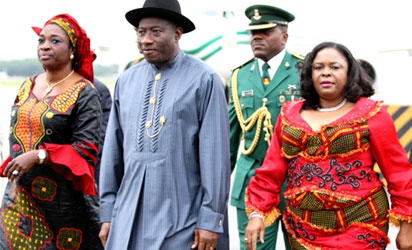
MINISTER OF ENVIRONMENT, HAJIA HADIZA MAILAFIA, PRESIDENT GOODLUCK JONATHAN AND HIS WIFE PATIENCE
By Obi Nwakanma
There are many people today across the world who earn their living as professional naijaskeptics. These people drum up and sustain the idea of Nigeria as an impossible creation, a place existing between Dantesque purgatory and hell. Nothing good will ever come out of Nigeria, and for them, the greatest good will come only with the collapse of Nigeria as a sovereign nation.
I have over time reconciled myself to one basic reality: Nigeria may be Lugard’s creation, and Nigeria may indeed be the product of problematic alchemy; a fusion of many disparate nations and peoples, but there is a great beauty to that alchemy. It is difficult and challenging, but it is not an impossible nation to fashion. Nigeria is possibly colonialism’s best gift to Africa.
Nigeria has fought a war, certainly, and we have caused much violence against each other, and within a generation, almost wasted the massive potential of creating a modern African economic, industrial and military power, and thus subverting the idealism of the anticolonial nationalist movement. The momentum of the nationalist idealism that shaped the discourse of the modern nation in Africa has all but disappeared. In its place today, is a nation that is sorry for itself.
Nigeria is remarkably not doing well. We know this. We can see it. We can feel the extreme levels of incoherence that frame both our goals as well as our realities. But far more dangerous is how the Nigerian has been made to view the self – the idea of being Nigerian today as something evil and unrewarding. We are quick to destroy the most beautiful things about this nation simply because others tell us that these things about us are not beautiful.
We acquire strange tastes and habits; our gazes are glued externally rather than internally, and so we tend to overestimate the value of external agencies. Nigeria is a great project nonetheless, but it is also a country in danger of disappearing.
It is disappearing right before our very eyes, because, for the past fifteen years, especially since the so called transition to democracy, its sovereign will and capacity has been whittled. We look to the world outside; even Nigeria’s national political leadership is of inferior quality, largely because those who have unique skills, and who could come into public service either have given up on the idea of this nation, and are secretly plotting for its dismemberment, or they are far too lethargic to care.
There is strange nostalgia for the past because the present is aberrant and seemingly unsustainable. The problem, we say is leadership. This may be true in many respects. But the problem is also about citizenship. Citizens who are unable to contain, direct, and shape the quality of the ministration of political leadership are often badly led.
There are no saints in government anywhere in the world. There are only leaders who fear – and the word is fear – the power of its citizens. Nigerian leaders do not fear Nigerian citizens. They hold them in contempt because, clearly, Nigerians are disorganized, frenzied and alienated.
A disorganized public becomes the bitch of an organized elite. But Nigerians today, invested in the future of this country; in the security of its people, in the protection of its sovereignty; in the general happiness of its present and future generations, must begin to meet at the cellular level to push for a movement of national restoration.
As a journalist, I have watched developments in the polity since 1998: the mafia style execution of political opponents; the unresolved questions around these assassinations; the rise of various ethnic militias; the kidnappings especially in the South; the weakening of Nigeria’s military and security apparatus by various imponderable agreements with certain external powers;the inexplicable case of Boko Haram; the general incoherence of government under the PDP administration which seems to get its marching orders more from the governments of the United States and the United Kingdom rather than from Nigerian peoples and a well-established parliament, and it doesn’t make sense.
There is a strange and inexplicable missing piece. It seems clear to me that what we have is not just simply a failure of leadership but a gradual collapse of the nation. Nigeria is under attack. But who is behind these sustained attacks on Nigeria? Who wants Nigeria permanently disabled and perhaps even destroyed? Why?
Is the current government – the Jonathan administration telling us all that it knows about the current security situation and is it up to scratch in dealing with it? I should say this: I do not blame President Goodluck Jonathan alone for the current failures of government.
The last time I checked, under the rule of law, there are three institutions that govern the Federal Republic of Nigeria: the executive, the legislature and the Judiciary. But the constitution endowed in the office of the president, all the resources available to this country, to sort out the national economic and security challenges. The Legislature, the legal keepers of the Nigerian purse, has given the president all that he has asked for to contain this situation. But the president and his national security and intelligence services have failed to protect this country.
Last Sunday, the city of Kaduna came under a barrage of attacks by the group claiming to be Boko Haram. Just as Kaduna was burning, the president was flying to Brazil, for a non-essential summit. True, both Mr. Labaran Maku, the minister for Information, and Dr. Rueben Abati, presidential spokesman, defended the president on the grounds that modern technology makes it possible for the president to govern in the air.
Well, true, but he’ll be governing in the air, and not on ground zero. The symbolic and reassuring presence of the president taking direct charge, would have more Nigerians believing that he has a hands-on grip on this increasingly strange and intractable question of Boko Haram and national security.
This especially with new claims by many leaders in the north on the new, and I must say incredible angle that Boko Haram may be the covert operations of an external power intent on destroying Nigeria. Labaran Maku again dismissed such a claim saying, “Nigeria is not under external attack. It is our people killing each other.” But how does he know?
How can Nigerians trust such a statement when the government has not given us any single concrete proof that it actually knows what Boko Haram is about? Nigeria’ security apparatus seems utterly compromised and impotent before this strange phenomenon. The president, rather than taking strategic action, has now asked God to intervene, even in the clear evidence that God has since taken a furlough from Nigeria? This is why Naijaskeptics are winning.
Kaduna is burning and the president is in the air, to a more stable Brazilian clime, for an inconsequential earth-day summit. Hear Reuben Abati:“issues that will be discussed at this conference are also issues that are relevant to Nigeria’s interest. It is also an opportunity for Nigeria to promote its interest in terms of its place in global community.” Well, yes. But you must have a country first, before worrying about its place in a “global community.” When a nation disappears, it has no place. This is the danger Nigeria faces.
Disclaimer
Comments expressed here do not reflect the opinions of Vanguard newspapers or any employee thereof.