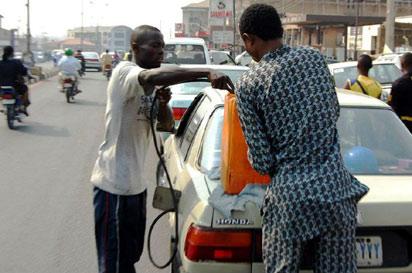
*File photo: Fuel sold in black market
By Les Leba
The issue of fuel subsidy removal has become recurrent in our economy. The following are answers to salient questions on the beneficent resolution of this dilemma:
1. Is There a Relationship Between Fuel Subsidy and the Naira Exchange Rate?
In reality, there will be no need for fuel subsidy if Central Bank (CBN) adopts a naira and people friendly framework for infusing dollar component of monthly allocations into the economy. If we cast our minds back, we will recognize that the bogey of fuel subsidy evolved from the dastardly blows to naira and welfare of Nigerians by Babangida’s reckless devaluation of the naira in consonance with IMF’s prescribed Structural Adjustment Programme in the late 1980s.
The reason for this inverse relationship between naira value and fuel price is obvious; fuel prices, like most commodity prices are denominated in dollars; thus, if for example, the international ex-refinery price of P.M.S. (petrol) is about 50 U.S. cents, then, our domestic price will be N75/litre (@ N150=$1) plus shipping/transportation and clearing charges, plus reasonable profit margin for the importer.
It should be obvious from above that naira value vis-à-vis dollar is a significant determinant of local price of fuel. Unfortunately, neither the media nor Labour Unions, nor indeed, government seem to recognize this reality! Consequently, Nigerians are misled into searching for solutions to fuel subsidy removal everywhere else but this one!
Incidentally, if the naira, for example, conversely appreciates to, say, N75=$1, when ex-refinery price of petrol remains at $0.5/litre, then, of course, our domestic pump price will fall in nominal terms to N36.5/litre plus shipping and clearing, plus a margin for the importer!
In such scenario, petrol price will become cheaper than the current subsidized rate of N65/litre. Thus, instead of all the furore on subsidy removal, the government can in fact levy a tax of N10/litre or more on each of the 30 million litres reportedly consumed by Nigerians daily. In addition to projected savings of N1000bn from subsidy removal, almost N400bn can also accrue to government as tax revenue annually.
2. Will Infrastructural Enhancement and Economic Growth be the Product of Subsidy Removal?
If one believes government’s promise of infrastructural enhancement from savings from erstwhile subsidy leakages, then one will believe anything; Nigerians are very familiar with government’s failure to deliver on such promises in the past.
For example, the huge infrastructural and social welfare enhancement promised after the Paris/London Clubs debt exit have remained a mirage; meanwhile, we gleefully parted with about $18bn on this false premise of huge debt
service charges becoming available for revamping our economy!
Indeed, a fortuitous reserve base in excess of $60bn was whittled down to just over $30bn within four years, and yet, such expenditure has not resulted in any major improvement on our social welfare and infrastructure; if anything, Nigerians have become poorer than we were 12 years ago!
Besides, even if as claimed that the abolition of subsidy might indeed generate savings of about N1000bn a year for government, the reality is that the impact of a deregulated pump price of over N150/litre for fuel will create a poisonous ripple that will further deepen the extent of poverty nationwide as the purchasing power of all naira income earners plummet from its already precarious level.
Ultimately, Nigerians will not witness any significant improvement in infrastructural and social welfare enhancement, while they will continue to slip further into poverty as their paltry naira incomes buy less and less in the market place.
3. What is the Impediment to the Establishment of More Refineries?
We recall that about 20 licences have been granted for private sector sponsored refineries, but understandably, none of these licencees has shown much seriousness to progress the project to completion. In reality, prevailing high cost of borrowing, no businessman is so trusting as to borrow between $500m to $1bn and above with rising cost of funds for a business, whose success depends on government’s usually unreliable and undefined schedule for payback of subsidy differentials from actual market selling price.
On the other hand, the festering sore of corruption, and the eternally rising cost of maintenance of existing refineries should be a warning to desist from pouring more public funds into what is patently a wasteful escapade to build more refineries; besides, there is no evidence of any major government utility that has been efficiently and profitably managed, so why should we trust that government’s fresh forays into such projects will be successful this time
around?
In any case, the relevant question is what would be the impact of subsidy removal on Nigerians and national growth and development. How would N150/litre price affect the standard of living of most Nigerians, who live on less than $2 a day?
A combination of the pervasive impact of fuel price hike of such magnitude, with lending rate well over 20% (as can be expected with MPR currently at 12%!) and a naira that is under pressure and widely speculated to fall to about N200=$1, will deal a deadly blow to the welfare of Nigerians as our incomes rapidly lose more value because of the unmitigated rage of inflation.
The volatile mix may spur an inflation rate above 20% and reduce the profitability and security of any investment including that of building new refineries.
4. In the Event that Nigeria is a Major Exporter of Crude Oil, is it Not Fair That Nigerians Should Enjoy Subisdy?
My position and recommendation on the appropriate handling of petrol pricing is well articulated in several articles and interviews in both print and electronic media. The concept of fuel subsidy in the Nigerian context is a promotion of waste and an instigation to spiraling inflation with devastating consequences on the welfare of Nigerians.
Disclaimer
Comments expressed here do not reflect the opinions of Vanguard newspapers or any employee thereof.