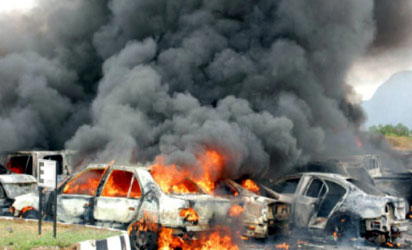
*Kano blasts
By Dele Sobowale
Capital is a coward; it takes flight at the slightest indication of prevalent violence and destruction”. Anonymous.
The Vision 20:2020 project; at best a foolish stunt because it is not based on sound economics, had become increasingly another scam foisted on the Nigerian nation to siphon money into private pockets – especially those of its most ardent promoters in government.
That is why none of them had dared to answer the simple questions: “by how much must Nigeria grow annually to reach the top 20? Have we ever grown at that rate? The answer to the first question is 13 to 15% per annum. The reply to the second question is an emphatic NO! The best we have been able to do is to grow by 7.8% per annum and that only in the last three years.
Each year we fail to grow at 13 to 15% we place ourselves in a situation in which we have to grow 17 to 19% in subsequent years in order to catch up. Even, a none economist knows that this is impossible. Yet, President Jonathan has allowed himself to be persuaded to that all the fairy tales were possible.
Unpardonable as that might be, it becomes totally unacceptable to continue to hang on to this fig-leaf long after the national economy had been “disrobed” by spreading violence in the Northern parts of the country and the collateral damage that it will do the rest of the economy.
For a start, the Vision 20:2020 Committee, a self-deceptive lot, should now be disbanded. They have travelled to Abuja and lodged in choicest Abuja hotels at our expense for no justified reason long enough. Incidentally, some of these unpatriotic elements actually knew all along that Vision 20:2020 was just a figment of the imagination of the Minister for National Planning and Chairman of the National Planning Commission, Dr Shasudeen Usman.
That is why the Minister had avoided answering the two questions posed above for years as Minister. Now, even the Minister will have to admit that an economy cannot grow at 12% per annum when large segments of it are under 24 hours curfew or when all the people live in fear round the clock.
Under the circumstances the first group of individuals to flee are investors or potential investors; those whose capital would have made any GDP growth possible at all.
The core North has for months now become a “no-go” area. With spreading violence, which is threatening to escalate and spiral into all out religious conflict, even those with investments are already decamping to safer zones. It is a safe bet that, even if peace returns to the North today, a remote possibility, capital flight will not stop immediately and those already withdrawn will not return soon.
The year 2020, which was dangled in front of our eyes during the Yar’Adua administration – five years ago – is a mere eight and a half years away. Meanwhile, at least five of those eight and a half years are certain to be dissipated by mindless violence and destruction – to which government has no answer at the moment; and this government might never have.
The 24 hours curfew imposed on Kaduna and Yobe States provide vivid examples of what is in store for Nigerian agriculture, which in addition to providing jobs foe most people, contributes almost 40% of our GDP. Kano, Kaduna and Yobe States are pivotal to the success of Nigerian agriculture which is over 75% northern based.
Kano and Kaduna, apart from being major contributors, are vital trans-shipment points for produce from the Northwest; while Yobe performs the same role for transport of agricultural produce from the Northeast. Even without 24 hour curfew, there has been a sharp drop in the flow of agricultural output. Post harvest losses, previously estimated at 40%, had soared to more than 50%.
Because most farm produce are raw materials, any delay between farm gate and markets increases the post harvest loss incrementally with the days spent on the road. With curfew, most of what is loaded at the farm will have to be thrown away.
This was the situation in the 1990s when Kano State was rocked by a series of violent demonstrations. The entire length of the Kano-Zaria Expressway was littered with rotten tomatoes, peppers and vegetables. We are headed for a wider regional catastrophe on account of the tragedy that Boko Haram insurgency had brought about.
The problems we face are multi-dimensional. First, there is already the threat of lower output as farmers flee the to safer territories. That means that large tracts of farmland will not be cultivated this year and may be not for a long time to come. Second, those who still brave the odds to go farming (mainly because they have no other means of livelihood and no place to go), might find it difficult to evacuate their farm produce now that transporters are reluctant to go to the North.
This writer went to Iddo, and Apapa in search of transporters to move goods to Maiduguri, only one out of 35 was willing to go; and that was because the company’s headquarters is in Maiduguri. Even, that “willing” driver set conditions that would have been considered insane only two years ago. Apart from charging three times the normal rate for the trip, he could not guarantee reaching Maiduguri in less than two weeks (it was five days before); and at the sign of great trouble, he will abandon the consignment and run for dear life.
Third, and that is becoming a real problem now, the transport might eventually be found but the consignment might have to be thrown away – if the vehicle is caught in a curfew lasting two days or more. This is happening right now in Kano, Kaduna and Yobe States.
In case you are wondering why so much time is spent on farm produce, let me quickly explain the linkages. Despite our over-dependence as a nation, on imported raw materials, there are some agro-allied manufacturing businesses which depend on local agricultural input for production.
NESTLE, the world’s largest food marketer purchases millions of tones of onions, soybean and sorghum; so does Cadbury. UACN’s feed processor, Grand located in Jos, is perhaps the nation’s largest consumer of groundnuts and soybeans; so does Livestock Feeds.
These are only a few of the manufacturers whose fortunes, and ours, are inextricably tied with the fate of farmlands in the North and the calamities that will inevitably befall them if the mindless violence continues. The bigger tragedy lies in the fact that famine and hunger which might result could actually make the situation worse.
The hungry man is till an angry man any day and the devil is still the greatest employer of idle hands. I know, because of my years in the Northern farm land. This is not a prophecy of doom but a wake-up call to government to address an urgent situation before it become uncontrollable.
Disclaimer
Comments expressed here do not reflect the opinions of Vanguard newspapers or any employee thereof.