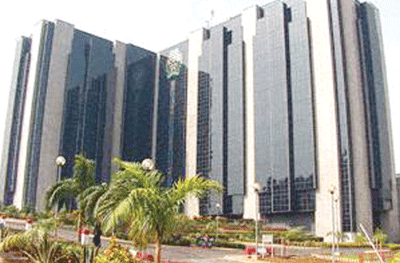
The Central Bank of Nigeria head office in Abuja.
By Les Leba
A bill to amend the Central Bank of Nigeria Act on Wednesday passed through second reading at the House of Representatives.
The bill provides for the appointment of a person, other than the CBN Governor, as the chairman, and the exclusion of the deputy governors and directors as members of the bank’s Board of Directors.
It also seeks to divest the board of the power to consider and approve the annual budget of the bank.
The bill, according to its sponsors, will enhance transparency and entrench the principle of checks and balances in the administration and operations of the CBN.” (Bill to Amend CBN Act Passes Second Reading, Punch 3/5/2012, pg. 24).
The preceding report can only be indicative that members of the Lower House are not particularly enamoured by what they consider to be excessive powers of the apex bank under the CBN Act 2007. The sought amendment coming just five years after the Act is possibly indicative that the preceding legislature may not have done a thorough job.
However, some critics may suggest that the amendment was a way of clipping the ‘flippant’ wings of the Central Bank Governor, who has so far successfully stonewalled their probing inquiries by taking cover behind the existing provisions of the Act; besides, Lamido Sanusi hardly misses an opportunity to decry the excessive consumption pattern of Members of the National Assembly.
Whatever maybe the true motive of Members of the House, one thing is clear, appointment of an external Chairman and Board is not a guarantee for good governance. The list of failed government parastatals with external boards and non-executive directors is endless!
Of course, the amended organisational structure would provide some critical checks and balances in a disciplined environment, where appointments are based on merit rather than on ethnic or religious consideration or political patronage. Indeed, the moribund and drainpipe public enterprises that dot our landscape are sufficient testimonies of the effectiveness of non-executive directors and chairmen.
This is not to say that the CBN’s current operating structure and service delivery is of best practice standard. In order to make a fair assessment of its performance, it would be appropriate to identify what the core mandate of the CBN is.
Indeed, a brief published on the internet by the Legal Services Division of the apex bank describes the objects of the bank as contained in Section 2 of the CBN Act 2007 as follows: “The object of price stability has now been distinctly included in the core mandate of the bank.
This is informed by the fact that the core function of every Central Bank is the maintenance of price stability. It should be noted that macroeconomic stability is essential for growth and development in any economy. Macroeconomic stability is itself a function of price stability which is the ability of the Central Bank to moderate inflation, attain stable interest and exchange rates and create a conducive investment climate for long term growth and development.
In order to achieve and maintain this objective, however, it is imperative to keep a close watch on government spending as persistently huge budget deficits tend to lead to volatility in prices, which in turn negatively impacts the standard of living. The price stability objective will therefore enable the CBN to adopt the necessary measures, in collaboration with the fiscal authorities, to control the rate of inflation.”
So, in the light of the above self-established standard, how well, we may ask, has the CBN done? We will answer the above question with an excerpt from the series “The Putrid Mess Also in CBN”, which was first published in this column in 2009 (see www.lesleba.com).
“Increasingly more Nigerians look back in nostalgia at the good old days when a medium size loaf of bread cost 10kobo and primary, secondary and even university education in some states were free! Nigeria is now catalogued amongst the poorest nations in the world inexplicably at a time when we earned more foreign revenue than ever before!
The government readily admits that over 50% of our population are jobless, and that almost four million youths are thrown into the pool of Unemployed every year! The current minimum wage of N18,000 buys much less than the N250 paid in the 1980s.
Obviously, something is fundamentally wrong as these wide price and wage variations cannot be classified as consonant with the CBN prime objective of price stability in the economy and may, indeed, be regarded as prima facie evidence of the failure of CBN in bringing succor to our people in the implementation of its mandate.
“The dysfunctional state of the banking sector before the advent of the present Governor is possibly conclusive evidence that the CBN not only knowingly failed woefully in its role of regulation and supervision of banks, but also missed the achievement of its prime objective of price stability in the economy by a very wide margin; this failure was in spite of the fortuitous ‘excess’ foreign revenue that should have primed us for success!
“In the light of the foregoing, one must recognize the adept propaganda machinery of the CBN in the last five years, such that while we progressively descended into the pits of poverty as a nation, most Nigerians saw the evil machinations of the CBN from a benevolent perspective!
“However, we may ask, how did the CBN get it so wrong with such a costly price to our wellbeing?
The answer to this has been canvassed in this column in several articles over the last eight years, and we have maintained unflinchingly that the failure of CBN’s monetary policy framework and the consequent adverse impact on our fortunes as a nation is the bank’s gross mismanagement of money supply!
Macroeconomic stability, according to the CBN brief quoted above is defined “as a function of price stability, which is, the ability of a Central Bank to moderate inflation, attain stable interest and exchange rates and create a conducive investment climate for long term growth and development”.
“Inflation impacts negatively on all income earners and consequently adversely affects our standard of living. In growth-focused economies, inflation is regarded as intolerably high if it approaches 3%, and this may be contrasted with consistently double-digit inflation in Nigeria over the last two decades!
Lending rates for commerce and industry in progressive economies hardly exceeds 9%; check Japan’s less than 1% against the 25%+ for such loans in Nigeria. Exchange rates in successful economies recognize the simple laws of demand and supply; in other words, a country’s exchange rate would be stronger in the face of rapidly increasing foreign revenue, especially if its imports values remain largely unchanged or indeed fall.
Contrast this with the naira experience, which has suffered tremendous downward pressure in spite of quadrupling foreign income over the years! A graphic example is the naira rate of N80=$1 in 1996 when our total foreign reserves of $4bn provided imports cover for just four months, as against our foreign reserves of over $60bn providing over 36 months imports cover in 2007-8, yet our naira fell to N140=$1 by the end of that year! Indeed, our current reserves of just below $40bn still provides us with possibly 15 months imports cover, but the naira is still falling and is presently just below N160=$1!
“What we may ask is the impact of these anomalies to economic growth. Well, to start with, serious economies recognize the role of interest rate as a driver of economic development. They recognize that investors and entrepreneurs will refrain from initiating expansion or indeed an industrial concept if the cost of borrowing is prohibitive.
A loan taken at over 20% would almost double in three years, possibly even before the project for which the loan is taken is fully operational. Reduced investment means fewer jobs, and fewer jobs mean less income, not only as tax revenue to government, but also as a depletion of total disposable income in the economy.
This in turn creates an impediment for the survival of existing industries, which depend on a larger base of disposable income. With interest rates above 20%, it is not surprising that we have over 20% of Nigerians unemployed and, we are inevitably now reaping the reward of increasing insecurity.
“The unfortunate inverse relationship between the naira and our foreign reserves is also responsible for the collapse of industries and depletion in the purchasing power of the naira. Indeed, if our exchange rate mechanism recognizes the laws of demand and supply, fuel prices will fall, deregulation will become possible with all the attendant advantages and industrial raw materials will fall in prices, and price stability with increasing employment will be maintained in the economy!”
Banking supervision and regulation may well be described as Central bank’s secondary role, although, by its nature, it attracts more public attention than the role of maintaining price stability! However, the topsy-turvy nature of the banking subsector in the last 12 years has brought severe deprivations to millions of Nigerians.
Consequently, public perception of CBN’s role in the banking subsector is that of an economically destructive cronyism rather than that of a custodian and enforcer of banking best practices. In spite of the usual boastful assurances of wellbeing by CBN Governors in the past, the banks have always systematically faltered with much collateral distress to millions of Nigerians.
It was thus a paradox in May 2012, for Kingsley Moghalu, Deputy Governor Financial Systems Stability, to decry manipulation by stakeholders as the cause of near collapse of capital market at the ongoing House of Representatives Ad-hoc Committee.
Next week, we will take a closer look at what most critics would describe as utmost negligence in CBN’s supervision and control of the money market.
SAVE THE NAIRA, SAVE NIGERIANS!
Disclaimer
Comments expressed here do not reflect the opinions of Vanguard newspapers or any employee thereof.