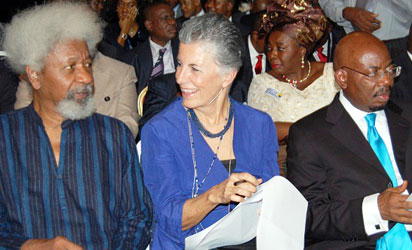
L-R Prof.wole Soyinka, Prof.Graciana Del Castillo of Columba University and Mr.Jim Ovia Chairman Visa Phone Nigeria Ltd, Photos Nath Onojake and Akpokona Omafuaire
By John Amoda
TWO approaches to the present security and governance crises have been floated. The one, a Northern approach, was presented to the public by Professor Ango Abdullahi, former VC of ABU and former Adviser to President Obasanjo.
Professor Abdullahi says the North has organised itself both for self- sufficiency if that be the outcome of national conference with the South or for negotiated accommodation with the South.
This option we will call the Northern Option and its intent is to declare the Northern readiness to contemplate the possible dissolution of Nigeria while holding out the prospects of a new Nigeria with a reformed Federation.
Professor Soyinka presents an alternative that addresses the issues at stake in terms of a discourse that changes the basic premise of the move for a national conference. His proposition is as summarised in the following report:
“Nobel Laureate, Professor Wole Soyinka, has urged Nigerians to drop… clamour for national conference, saying it is no longer necessary in view of emerging democratic liberties.
In place of the conference, he called for regional groupings, which would, rather than summon it, begin to “act the national conference” by taking their destines in their hands. Soyinka spoke in Asaba, yesterday (Thursday, April 26, 2012) while delivering a keynote address at the opening of a two day South-South Economic Summit.
He said it was time for the region to engage in policies and strategies of development that would progressively reduce the central government’s power to determine the “fate” of the people. He said the Federal Government was impeding the pace of development of the constituent parts and noted that only vibrant regional groupings could moderate its overbearing disposition”.
The above is one of the most economic arguments made for the reform of government within the present constitutional framework. I recognise the proposal that regional groupings “act the national conference” because they have already created their own autonomy of actions and initiative.
This idea is buttressed by the argument premised upon their very existence as regional groupings. If you can convene a South-South Economic Summit you can convene a South-South Summit on development or on reform of the structures and functions of government; this is to extend the proposition of Professor Soyinka.
In so doing, the Professor argues that the victim-complex can be jettisoned and a process of reform instituted that “would progressively reduce the central government’s power to determine the ‘fate’ of the people”.
The conclusion is established that the future of a reformed federation “sans” the National Conference requires the activities of vibrant regional groupings “that can moderate the over-bearing disposition of the Federal Government that presently impedes the “development of the constituent as parts” of the federation.
The work carved for such groupings as the South-South entails a statecraft that is yet to be developed. The policy thrust of Professor Soyinka is in the shift of the locale of reform from the Federal to regional groupings. Their capacity to effectively shoulder this responsibility assigned them is not to be assumed. It is to be developed. Is it not interesting that Professor Soyinka’s exhortation to the South-South groupings was assumed by Sir Ahmadu Bello?
Have we spent 50 years travelling to the starting point of our nation building race? Nothing learnt from our history as administrators of the Nigerian polity? I quote from Ahmadu Bello’s intervention during the 1956 Action Group motion for independence by 1956. In his amendment to the AG’s motion substituting “as soon as practicable” for the date 1956, Ahmadu Bello said inter alia:
“We from the Northern Region never intended to retard the progress of any region. Nor do we say that those who demand self-government, if it is for their own region alone, are wrong. Far from it, for, after all, every community is the best judge of its own situation. In this regard, Mr. President, the people of the North are the best judges of their own situation and we feel that in our present situation we cannot commit ourselves to fixing a date for the attainment of self-government…
Before we commit the people we represent in such matters we must, I repeat, we must seek the mandate of the country. As representatives of the people, we from the North feel that in all major issues such as this one, we are duty-bound to consult those we represent, so that when we speak we know we are voicing the views of the nation.
If the Honorable Members from the West and East speak to this motion… for their people, I must say here and now, Sir, we from the North have been given no such mandate by our people. No Honorable Member can therefore criticize the Northern legislators for refusing to associate themselves with such an arbitrary motion fixing, as it does, a definite date for the attainment of national self-government.
We in the North are working very hard towards (regional) self-government, although we were late in assimilating Western education… It is our resolute intention to build our development on sound and lasting foundations so that they will be lasting”.
Ahmadu’s regional confederal policy for the political development of the North assumes that regional groupings should “act the national conference” in order to free themselves from the impact of the Federal Government whose policies can only cause the retardation of these groupings.
The contemporary North has been organised into committees to prepare the North’s submission at a national conference if such be the consensus: and as it was declared recently by Professor Ango Abdullahi, the preparation for a national conference is also an indication of the North’s readiness to go it alone if need be.
That the strategies for the management and resolution of our political conflicts have remained for over 60 years within the spectrum of regionalist confederal union and break-up of a self-governing British colonial Nigeria defines our contemporary the challenge of state making and nation building.
If uncoordinated separatist regionalism is currently proposed, surely such a proposal cannot be more than a tactical ploy. Separatist regionalism is not an adequate agenda of political reform of British colonial Nigeria. INEC’s political parties cannot play the ostrich or follow Emperor’s Nero piping as he beholds Rome Burn!
A connection has been made between Nigeria’s security situation and the political behaviour of these parties. Whatever are the ways the NSA’s pronouncements on the PDP’s zoning policies are read, what needs to be examined is how INEC political parties have addressed the twin challenges of state making and nation building.
These two task cannot be out-sourced to the Federal Government. Everywhere they are the tasks defining the decolonising rationale of political parties in the reconstruction of empires.
Disclaimer
Comments expressed here do not reflect the opinions of Vanguard newspapers or any employee thereof.