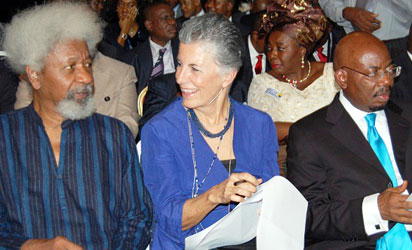
L-R Prof.wole Soyinka, Prof.Graciana Del Castillo of Columba University and Mr.Jim Ovia Chairman Visa Phone Nigeria Ltd, Photos Nath Onojake and Akpokona Omafuaire
By John Amoda
THE Vanguard, Thursday, April 19, 2012 carried the following in its News Section:
“States of the South-South region are to tap from the experiences of Rwanda in resolving its conflict and tackling the security challenges and economic problems of the region.
Already a delegation of the states, including the chairman of the South-South Governors Forum, Governor Liyei Imoke of Cross River State and his Delta counterpart, Dr. Emmanuel Uduaghan, had met with President Paul Kagame of Rwanda to work out the modalities of the cooperation. To cement this new partnership, President Kagame will be in Nigeria this month to give a talk during the Second Economic Summit of the South-South States billed for Asaba, Delta State between April 26 and 28″.
This initiative is reminiscent of ventures of regional governments of the First Republic that had their own foreign policies and did pursue collaboration with governments of their own choosing. I say the South-South initiative was reminiscent of the constitutional autonomy of the regional governments of the First Republic in the foreign policy arena, and not that they had identical autonomy.
It is important to note that the constitution of 1979, 1989 and 1999 have placed external affairs in the Exclusive Legislative List of the National Assembly. If it is assumed that the South-South States in the organisation of their Second Economic Summit were exploring new terrains that can enhance their policy capabilities, the presence of the Vice President of the Federation and the National Security Adviser is evidence of active Federal support for the Summit. And it is in this Federal support that we locate a problem in the agenda of the South-South States.
The South-South Governors are seeking partnership with Rwanda on conflict resolution in addition to fostering economic cooperation.
The first thing to be noticed is the disparity in the character of the South-South States and Rwanda. The South-South States are a zone of the Federal Republic of Nigeria, while Rwanda is a national independent entity.
Under the 1999 Constitution, the South-South cannot conduct their own foreign policy; their interest in drawing from the experience of Rwanda has to be mediated by the Ministry of Foreign Affairs whose executive head is the Minister of the Ministry. Nigeria has diplomatic relations with Rwanda and I presume that Nigeria has an embassy in Kigali and an Ambassador in charge of Nigeria’s business with that country.
If all of the above is statement of facts, then it is to be expected that the Foreign Affairs Ministry would not only to have been consulted and through this prior consultation , the Ministry would determine the feasibility of the profitableness of the intended South-South partnership with Rwanda and assessed the strategic advantage to Nigeria for instituting that bilateral collaboration through a sub-national diplomacy.
These comments are necessitated because there is now in place a worrisome incursion of event branding diplomacy characterised by bringing heads of states, foreign ministers and heavy weights of the international business to give speeches and dispense wisdom in social entertainment settings.
I believe it will not be farfetched to call this Nigerian innovation as Glamour Diplomatic Cameo Events. President Clinton, the Secretary of State, Hilary Clinton, General Colin Powell, Tony Blair and his wife have all made their appearance on platforms that are more suited for parties to bring to a close the hard work of global policy making, than that is typical of the assembly at Davos. The South-South convener of the Second Economic Summit have extended this tradition.
They invited the 17th Chairman of the Joint Chiefs of Staff, Principal Military Adviser to the President of the United States and Secretary of Defence, National Security Council and a former Mayor of New York City, Mr. Rudy Giuliani, and the above named did accept the invitation.
They were invited according to Saturday Vanguard, April 28, 2012 “to share their perspectives with the South-South Governors and other stakeholders on security development and investment” at the Economic Summit. Those in charge of the Security of the United States concluding that the South-South was an unsecured political space prevailed on the invited not to attend the Summit.
There may be more to the US decision than concern for the safety of these officials. After all said and done, President Clinton and Prime Minister Tony Blair have been hosted in Abuja, a place not more secure than Asaba, the venue of the Summit. Can it be that bringing these global policy makers to such a summit was deemed inappropriate?
Someone at the State Department may have reached such a conclusion after an appreciation of the event. Similar appraisal ought to have been made at the Nigerian end on the choice of Rwanda for best practice conflict resolution praxis relevant to the Niger Delta.
Rwanda’s experience of conflict resolution is one of successful state making not of a conflict over equitable control and utilization of the oil and gas resources of the Niger Delta.
The Niger Delta conflict escalated to resource control war waged by the militants against the oil companies and the Federal Government is not in the main a war waged to establish a new country, a new order of power and authority. Paul Kagame has no counterparts in the Niger Delta, even among the leadership of MEND.
Therefore by what process of the course of war did the consultants to the South-South Governors Forum reach the conclusion that the course of ethic-national state making in Rwanda contained best practice and worst case lessons relevant to the Niger Delta?
If a country is to be chosen whose experience could be profitably theorised, Sri Lanka may be more promising of strategic value than Rwanda. Of course Paul Kagame has much to gain in the currency of image laundering and the South-South Economic Summit was tailored made for such occasion.
This is a case where second opinions ought to have been sought about the choice of cases for comparative analysis of appropriate lessons. The South-South Governors are not poor in professional expertise that can be enlisted. All is not lost even in the choice of Rwanda.
The point is that Paul Kagame was a leader of insurgency that successfully overthrew a constitutional state and transformed its insurgency into state making and the establishment of a new regime of government and security. Paul Kagame has led the founding of a new state. He is one of a few of such leaders in Africa.
The Eritrean insurgency that effected the establishment of two states in Eritrea and in Ethiopia is another example. Insurgents’ transformed into state makers can be excellent teachers of counter-insurgency statecraft. Perhaps there is a case of serendipity here.
Disclaimer
Comments expressed here do not reflect the opinions of Vanguard newspapers or any employee thereof.