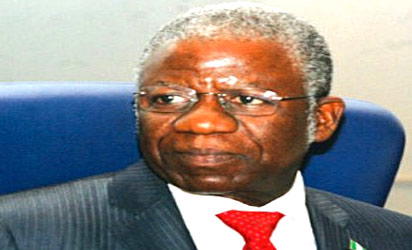
*Mr. Stephen Oronsaye
By Tonnie Iredia
On April 10, 2012, a Presidential Committee on the Rationalization and Restructuring of Federal Government Parastatals, Commissions and Agencies submitted its
report. Since then, many critics have hit hard on the report while some have used the opportunity to vilify the person of the committee’s chairman, Mr. Stephen Oronsaye, a former head of the Civil Service of the Federation.
Although everyone has a right to his opinion on any subject which is the beauty of democracy, some of the views expressed lacked rationality and proper understanding of the issues at stake. First, the report was not the handiwork of one man but that of a committee of seven distinguished Nigerians which reportedly arrived at its conclusions by consensus.
Thus to attack Oronsaye alone would erroneously impute that the other six members were mere robots. Second, the report ought not to surprise anyone who had followed the consistent calls from several quarters for government to do something about the high cost of governance in Nigeria caused by factors like an over-bloated bureaucracy.
For instance, General T.Y. Danjuma who many see as one of the godfathers of the present administration had called for a reduction in the number of Ministries, Departments and Agencies (MDAs) while he was Chairman of the Presidential Advisory Council.
Thus, by amplifying the same notorious point, the Oronsaye panel did not say anything new. Indeed, Government gave the direction when it asked the committee to “examine critically, the mandates of the existing Federal Agencies, Parastatals and Commissions and determine areas of overlap or duplication of functions and make appropriate recommendations to either restructure, merge or scrap them to eliminate such overlaps, duplication or redundancies”.
The committee did not appear to have spared anyone as it took off with a damaging observation ‘that successive Administrations established Parastatals without regard to existing laws and, in some cases, out-rightly replicating extant laws’. Many other issues raised by the committee are virtually unassailable.
It argued for example, that while the inefficiency of an institution is not a sufficient basis for creating a new one, it is worse that the new one is made to duplicate rather than to replace the old one.
Accordingly, while it is true that the Federal Road Safety Commission (FRSC) has been quite proactive, what the body is engaged in today-the maintenance of safety and law and order on our highways -cannot in the opinion of the committee be differentiated from the functions of the Highway Department of the Federal Ministry of Works as well as that of the Police.
The premise of the Oronsaye panel therefore is that it is wrong to create a new Agency as a response to the poor performance of an existing one instead of strengthening the existing Agency by redressing its challenges. It is difficult to disagree with the point more so when the existing Agency and the new one are allowed to exist side by side with enabling laws that empower both bodies to carry out the same functions.
Even if Nigeria was buoyant enough to sustain two bodies that do the same work, it would amount to profligacy to so act. As a result, one of the bodies has to give way. If we think that a new Agency that is doing well should not be scrapped, then we are left with the thought of scrapping the existing one-because we cannot eat our cake and have it.
However, if all that the new body is proficient in is an aspect of the entire job, it stands to reason that it should be subsumed into the existing body to avoid duplications and excessive overhead costs.
Government should therefore find no difficulty in dealing with the profound findings of Oronsaye’s committee such as that Nigeria has two separate space research institutes, whereas other more technologically advanced countries of the world where space research is a priority, have only one.
The same is true in the education sector where three different agencies- the Universal Basic Education Commission (UBEC), the Nomadic Education Commission (NEC), and the National Commission for Mass Literacy, Adult and Non-Formal Education perform the same functions concerning basic education.
There is also the paradox of establishing the Economic and Financial Crimes Commission (EFCC) and the Independent Corrupt Practices and Other Related Offences Commission (ICPC) to fight corruption which the Police supposedly failed to do, yet government has continued to appoint the Chairman of the EFCC from the Police while the ICPC uses Police methodology to conduct investigation and train its personnel.
The committee should however not expect many people to support these arguments. For instance, the Nigerian Labour Congress (NLC) is understandably anxious about job losses that would arise from government’s acceptance of some of the recommendations.
The NLC has a point which it is free to press home provided it bears the larger national interest in mind. Similarly, the average Nigerian broadcaster including this writer is free to object to the merger of the Nigerian Television Authority (NTA), the Federal Radio Corporation of Nigeria (FRCN) and the Voice of Nigeria (VON) because to us, leaving them as separate bodies is expedient.
We know though that there are climes where one organization handles Radio and Television combined thereby reducing overhead costs. It is therefore not enough to canvass that the three bodies be left intact if the all funds the government is ready to give all of them cannot adequately meet the requirements of just one of them.
However, the recommendation that some 14 Agencies should be turned into departments in their mother ministries is rather curious because ministries are slow coaches which only specialize in red tapism and nothing may be achieved in asking an Agency to be bureaucratic.
But none of these issues is as crucial as the exact use into which the report would be put because government has hardly ever taken any committee’s report seriously in the past. This explains why the Oronsaye committee was unable to obtain official copies of previous reports of Committees set up by Government for similar exercises because they had been discarded and thrown into the trash can.
More importantly, it explains why twelve years after the White Paper on the report by Ahmed Joda’s Panel, some bodies which Government had decided should either be scrapped, commercialized or self-funding, are till date still receiving full Government funding.
It is therefore hoped that government would be proactive this time around, otherwise we will remain with such issues in the public service as two different bodies responsible for fixing public sector salaries – the Revenue Mobilization, Allocation and Fiscal Commission (RMAFC) for salaries of political appointees and the National Salaries, Incomes and Wages Commission (NSIWC) for those of career civil servants.
We will also have to contend with outrageous Boards of Directors such as that of the National Film and Video Censors Board with 54 members and an unwieldy top-heavy manning level in an agency like the Nigerian Airspace Management Authority which has 253 Assistant General Managers. In reality therefore, the Oronsaye committee is not our problem.
Disclaimer
Comments expressed here do not reflect the opinions of Vanguard newspapers or any employee thereof.