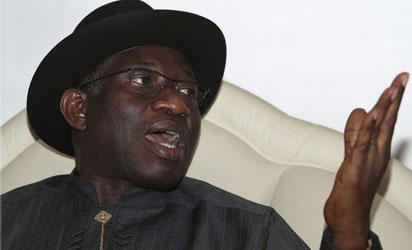
President Jonathan
By Dele Sobowale
Allocations for SURE in the 2012 budget has again been slashed to less than N450 billion. Increasingly, it looks as if the clarifications made by Dr Reuben Abati, last week, might be unnecessary after all. With only N450 billion in the kitty to be distributed among the three tiers of government, it would appear that the Christopher Kolade Committee, a high-powered group, will have only about N240 billion to work with.
That is hardly more than some of the more financially buoyant states are called upon to manage each year. Worse still, the figure might again decline.
However, as long as SURE and the allocation of savings from fuel subsidy remain on the national agenda, we need to take a look at the method adopted in allocating the January 2012 savings.
According to the Federal Ministry of Finance, N12.9 billion was allocated to the states and N6.4 billion to the local governments. Below are the specifics.
STATES ALLOCATIONS (Nbillions)
(including 13% derivation)
Abia 0.21 Ekit 0.18 Nass 0.19
Adam 0.22 Enug 0.21 Nige 0.26
A/Ibo 1.46 Gomb 0.20 Ogun 0.22
Anam 0.22 Imo 0.28 Ondo 0.39
Bauc 0.26 Jiga 0.25 Osun 0.21
Bayel 1.07 Kad 0.28 Oyo 0.26
Benu 0.24 Kan 0.35 Plat 0.22
Born 0.26 Kats 0.27 Rive 1.42
C/Riv 0.24 Kebb 0.22 Sok 0.23
Delta 1.20 Kogi 0.22 Tara 0.22
Ebon 0.18 Kwar 0.20 Yobe 0.22
Edo 0.26 LAGO 0.32 Zamf 0.22
The first question arising from this table of allocations pertains to the 13 per cent derivation which only oil-producing states enjoy. But, subsidy is not in connection with crude oil; it is concerned with finished petrol which government claims is mostly imported and sold to Nigerians at less than real landing cost.
If so, there should be no 13 per cent derivation at all. The petrol imported is not different from any other finished goods; it might have been refined from crude from any other country apart from Nigeria and a great deal of it comes into Nigeria from Lagos State.
Second subsidy is consumption-dependent; the more a state consumes, the more its consumption is subsidized. Lagos State, according to supporters of government during the fuel strike in January 2012, consumes 60 per cent of the petrol in Nigeria.
That, admittedly is high and was thrown in by government supporters among all the lies they tried to sell to the public at the time. But, undoubtedly, Lagos Sate consumes more petrol than any other state in Nigeria; more than Akwa Ibom, Bayelsa, Delta, Rivers and Kano.
The comparison with Bayelsa actually reveals the absurdity in the allocation of subsidy savings. All the vehicles in Bayelsa State today cannot be more than one tenth of the vehicles in the smallest Local Government in Lagos State.In fact, what this subsidy savings allocation formula had done is to turn Lagos State into the subsidy provider for other states.
Yet, the absurdity does not end there. Anambra, Enugu, Abia and Imo states in the South-East have more vehicles plying their roads than Bayelsa and Delta; similarly, Kano and Kaduna in the Northwest, Oyo in the Southwest.
Indeed, nothing less than 20 states in Nigeria, north and south, have more vehicles and use more petrol than Bayelsa. If consumption is the parameter for determining subsidy as well as the savings from it, then Bayelsa should receive among the smallest allocations.
It is strongly suggested to the states which are now being cheated by this allocation method to call for a halt to further allocations until a mutually agreed and equitable sharing formula had been evolved.
The allocations to local governments are even more disturbing. Here again, fuel consumption patterns have not been taken into account. Lagos State, or any other state for that matter, is an aggregation of all the local governments in the state and the consumption of goods in those political domains.
So, who can honestly claim that more petrol is consumed in Katsina’s local governments than in Lagos? Yet, Katsina received a higher allocation for its local governments than Lagos; so does Oyo, Kano, Kaduna, Borno and Akwa Ibom.
Surely, this allocation formula needs to be revisited. Lagos State residents have a vital stake in this; so do the Southeastern states with large vehicle populations.
Disclaimer
Comments expressed here do not reflect the opinions of Vanguard newspapers or any employee thereof.