By Rotimi Fasan
THE reactions to the New Year’s Day increment in fuel price are generally the same across the country and are by no means friendly. If anything they promise to be more hostile and aggravating as the days go by.
After making it determinedly through Christmas in spite of violent attacks from desperate groups like Boko Haram, Nigerians must have hoped for some quiet, stress-free New Year’s Day.
But that was not to be, no thanks to President Ebele Jonathan and his team of oil ‘subsidy’ removal lobbyists. Even though they had made it clear that the removal was inevitable despite lame attempts at engaging in ‘dialogue’ with Nigerians, many didn’t think the sledge hammer would fall this soon.
After all, Ngozi Okonjo-Iweala, the Finance Minister had, only days before, said government was yet to decide on when to implement the policy on ‘deregulating’ the downstream sector of the oil industry that was to effectively raise the price of fuel.
Abuja had, itself, given the impression that the earliest date of implementation would be April. Only for us all to wake up to the spectacle of shut fuel stations with long queues of vehicles, which was Abuja’s way of announcing the so-called subsidy removal.
Who said President Jonathan is not learning fast the way of Nigerian politicians? It’s a way that is full of dirty tricks and underhand tactics. They say one thing and do another. It was a trick Jonathan’s predecessors in office had used to devastating effect even though a couple of them are not in any way enthusiastic about the latest increment.
I guess our leaders only learn to behave as human beings after they have left office. The effect of the increase in PMS price was immediate. Prices of goods and services simply went through the roof, doubling if not tripling in many cases.
Many who had travelled home for the holidays suddenly realised they couldn’t return to work as they were stranded at motor parks. They could only curse their fortune and those responsible for making them beggars in their own country.
While commercial vehicle owners didn’t know how to respond to the change in fuel prices initially with some raising fares by 100 percent or slightly less. They would soon come to what look like a consensus position and raise fare by between 200 and 350 percent. The pattern is what is being followed all over now with sellers of even top-up cards adding a little ‘something’ to their wares.
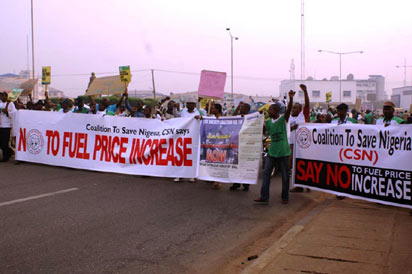
As I said, the increment took many by surprise, not the least of all labour that could only respond by calling attention to government’s bad faith in raising PMS price at a time consultation was supposed to be going on. Labour restated its opposition to the increment while promising ‘the mother’ of all battles.
The battle has, however, been on since Monday last week when protests started in Lagos. In Ilorin at least two people, protesters, were reportedly killed by police fire. One wonders why live bullets should be taken to scenes of civil protests.
But as usual in cases like this, the police is disputing the claim of death, putting the blame of the death of one person on the protesters who it said attacked the deceased for refusing to join in the protest. Whatever the truth is and wherever it lies the point is that the Jonathan fuel price hike is already taking its toll on Nigerians with many calling for more vigorous kind of resistance.
Opposition to the Jonathan administration is getting stronger and spreading across the country, from the West to the East, South to North. Many see in the increment an attempt by a non-performing government to worsen an economic situation it has neither the willpower nor know-how to improve not to say ameliorate.
Since it came into office, Nigerians are yet to be convinced of the ability of the Jonathan administration to deliver on its promises of steady power, improved security, better infrastructure and more jobs for the army of qualified graduates Nigeria produces from our harassed higher institutions yearly.
Rather than improve their lot what many see is the thickening climate of fear caused by insecurity from insurgent groups of armed bandits and religious vagabonds like Boko Haram.
In the battle of will between these outlaw groups and government, the former seem to be gaining the upper hand, demonstrating more sense of purpose and determination in the prosecution of their violent and retrogressive agenda.
To this state of systemic insecurity has Jonathan now added that of economic hopelessness. And like a people that thinks but only act after, Abuja is only now talking of providing mass transit vehicles to convey Nigerians in their day to day activities.
Rather than the rush to increase fuel price what would it have caused government to put in place measures to cushion the effect of this unending deregulation of the downstream sector? Why didn’t the proponents of this harsh measure take into consideration what their decision might translate into for Nigerians in practical terms?
In his submission during the town hall meeting sponsored by the Newspapers Proprietors Association of Nigeria, Ben Bruce, the chief executive of the Silverbird Group had enumerated a number of measures he thought should precede the raising of PMS price.
Both Sanusi Lamido Sanusi, the Central Bank Governor who had spoken forcefully for subsidy removal and Diezeani Allison-Madueke, the Minister in charge of the petroleum Ministry had been part of the government team apparently led by Ngozi-Okonjo Iweala.
What report did they take back to President Jonathan, assuming he was too busy fine-tuning details of his plan to remove subsidy to have followed what his lieutenants were out selling to Nigerians?
Surely this government can do better than courting the anger of Nigerians who had extended all necessary goodwill to the president in his march to Aso Rock Villa. It’s easy for the government to enumerate plans it hopes to implement in order to lessen the harshness of these times.
But such promises do not extend beyond the moments they were uttered. They serve no meaningful purpose beyond meeting the rhetorical needs of politicians who have no desire to put their utterances into action. With its latest action, this government’s goodwill account has gone into overdraft.
It has to watch its steps having drawn the first blood. It must prepare for the consequences of its determined effort to take Nigerians through the valley of economic hardship. It’s always the hardship that Nigerians see in situations like these.
They would only have to wait for some months before the same government that told them ‘subsidy’ had been removed from oil comes with tales of yet another removal of subsidy. Jonathan has sown the wind. He must reap the whirlwind.
Disclaimer
Comments expressed here do not reflect the opinions of Vanguard newspapers or any employee thereof.