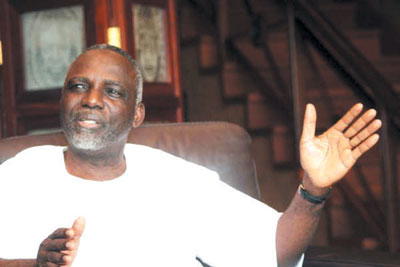
Barth Nnaji, former Minister of Power
By Clara Nwachukwu
The Minister of Power, Prof Bart Nnaji, at a recent interactive session with journalists in Lagos, said the privatisation of the power sector will see the removal of government’s control on management, while also giving an update on developments in the power sector, especially with regard to improving the quality of electricity supply to Nigerians. Excerpts:
Preamble
Our reform which is a derivative of the Power Sector Reform Act of 2005, and to which we developed a firing map which I am sure most of you were here last year when we came to register it in August here in Lagos, and the reason why we chose Lagos to launch it, is to demonstrate the fact that the fuss about the private sector within the power is going forward and that is what power is going to be, that the government will tend to get away from being the pivot of power sector because government is never a good runner of business to begin with, and how much more in the power sector.
So there are aspects of the power sector that will now be undertaken by the private sector and the process of handing this over to the private sector is what the privatisation programme is about; and the structures that will make the system take it and work well is what the reform initiative is all about.
I am happy you mentioned the Power Roadmap, and given the benchmarks contained in the road map to deliver sustainable power to Nigerians, would you say that we are following them to the letter, and if we are not; what are the issues?
The Roadmap has Nigerian Independent Power Plants, NIPPs specific expectations in terms of what should be done. So what we have is that we are following a chart, we are off in some areas in terms of timeline but we are not off in terms of others. If we look at the targets of power delivery in the short time, we are off in terms of target.
A lot of things we are doing, we must be able to offer time limit in everything; this government is about transparency, and we are not trying to forge figures and facts. The Roadmap was developed with special intentions and developed in such a way that will rigorously implement the Power Sector Reform Act.
So in terms of the short term, yes, we are off but not so much because when you look at the recovery of the federal government power assets, we are on target. But with the implementation of the NIPPs we’re off, that’s where they have major short fall in the energy they are delivering.

PHCN power station
But when we look at the other areas in the reform like the privatisation programme, we are on target. So I think overall, there are some areas where we are off and there are some areas where we are on. I will say that even though we are off in energy delivery, that does not mean we will not deliver.
That seems to me we have more offs than on course?
That does not mean that at all, I said the federal government power plant is not doing as well as expected, I have also said that the reform itself is on target…
That suggests that the whole timeline may not be met judging from what you have just said?
That is not what I said. I am saying that there are certain things on the Power Roadmap; one is Short term delivery, short term delivery towards long term delivery. Now I am saying that in short term delivery, we are off, what I mean is that we are off in those things that make short time delivery. But on the federal government asset recovery that we are ok, and that the power sector privatisation programme reform and those that have nothing to do with the NIPP power, those we are on.
What are these assets that have been recovered?
We have turbines that are being repaired like Sapele, Egbin and Kainji; those and even Afam, so as we affirm they are on. Some have already been recovered, rehabilitated and some that we expect to be completed soon.
But what are they generating presently?
When the PHCN Roadmap was launched, I’m not sure if you recalled we were less than 3,000MW but now we are over 4000MW, about 300MW is being preserved and it is what we have and there is every possibility that we will improve on that once the NIPPs deliver
Recently there was a story on a price tag in one of the dailies and that investors are being scared away by this. Secondly, in view of the fact that the revenue estimates for the distribution companies, DISCOs, fall short of expectations; Ikeja Zone is the highest with about N20billion in 2010, how do you justify the price tags put on the DICOs?
It may not be correct but according to the figures, revenue estimate N20billion 2010, Eko N17 billion, Jos N1.5billion, Ibadan N13 or N14 billion. They performed given the number of staff that re in those units. The estimated revenues are not encouraging enough and if you are supposing revenue plus the five cards you will discover there is a lot of disparity in those things and watch your comments on those things they are not.

Barth Nnaji
The revenue that we talked about today is true but I’m not sure about the exact figures but the revenue generation by the various distribution companies cannot possibly justify the price tag put on it, that is what the investors are lamenting on.
But really what they were looking for is not just to base price on the current revenue, we are expecting the people that are coming in should be able to do better. We are looking at future projections rather than just current because if we look at how the system is functioning then there will be very little to attract investors.
There is an allegation that because of the failure of an agreement between the union, BPE and the ministry, government decided to send soldiers so that it will facilitate access to investors to enter into the plants and carry out their evaluation and due diligence. How true is this?
First of all, on the issue of evaluation, the evaluation was done by the Nigerian Electricity Regulatory Commission. But that first evaluation has not been optimised and what is the optimisation that they want to do? If for instance, you come to this building and install 1mb and this building costs N500, you should expect that the building be paying for the cost of one mega byte on earth.
What you should be charging the building because of the value of what it is using is the N500, so what they are doing is optimisation because there are so many things they are optimising on, like what they did before, they simply had the price tag on it, then ok let’s just remove 25% out of it; that is not how you deal with it.
There is an appropriate verification all over the world, it has never been done so, so they have to look at it again, come up with an evaluation that will be reasonable, the goal is to ensure there is no lost of value, so whatever they put as the price tag is what the price should be and should attract investors.
If investors don’t come after that then we will know that we have over valued ourselves or because Nigerian target combined with the value did not attract investors. The goal is to see that we have achieved appropriate evaluation that will make sense, a balancing act and at the same time ensure the target is linked to the value and also will be looking at the Act.
With regard to the soldiers, what we have to think about is in which part of the world would power assets be left insecure? Is it in America, Britain, Germany or wherever? Whenever power goes out for one hour billions are lost, that is what Nigeria should be about because if the government decides that privatise power assets it should also maintain appropriate security for them. You people should be applauding the government, so what I would suspect is why would someone want to remove security at these power stations, and you should ask why do you want the security removed?
Then on the issue of the Chinese investors, I don’t know what the BPE has done, but the full essence of privatisation is to bring in investors, if they, the BPE, brings in Chinese investors in the power plant then that is fine. I think the goal is to bring in these investors so they can be able to see it, if you are going to invest in anything or buy anything would you not want to see it, When you go to the market to buy tomato don’t you want to look at the tomato? Do you just say you want tomato, and they just bring tomato blindly?
There is privatisation programme and that part of reform is on and therefore, for anybody to look at what should be privatised, they must go there whether it is Chinese or Indian or American, it doesn’t matter, they have to go there. I don’t think any Nigerian will buy anything without going there; they must go there, I don’t know how many of you have seen, Ugheli power plant or Afam power plant or Kainji dan power plant, because you are energy reporters so you probably have and might have gone to some places with us. But other than that, ordinary Nigerians may never have seen these places. In
I would like to know if you have kept to all the agreements, and I will like to also know why the soldiers are guarding the plants since soldiers are for war not for security?
If you remove soldiers from there (plants) I will not go there. Beyond that, in the Catholic Church I worship in Asokoro, Abuja, it is soldiers that give us protection, so it is a general thing all over because of the security situation in the country. But I’m surprised that all of a sudden, people are talking about the soldiers, but you see them every day; please let us not be unduly emotional about things like this. Young lady what do you have against soldiers?
(I don’t have anything against soldiers after all there have been soldiers there but why the increase in number)
I have explained to you that if previous government did not deploy appropriate security, this administration will. I thought everybody is saying we should be protected and why are you complaining about appropriate security and I’m worried if anybody is saying federal government should not protect assets very well.
Disclaimer
Comments expressed here do not reflect the opinions of Vanguard newspapers or any employee thereof.