By Is’haq Modibbo Kawu
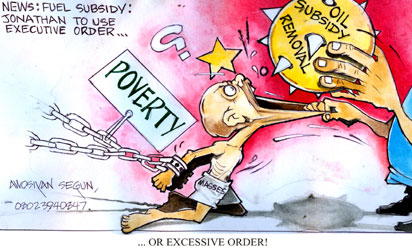
LAST week, the wind of nation-wide opposition to an unpopular agenda finally exposed the ugly hind place of Nigeria’s political (economic) fowl, when Nigeria’s Senate named beneficiaries of the much-vaunted fuel subsidies.
Thanks to a surprisingly responsive Nigerian Senate, we now know that between 2006 and this year, Nigeria spent N3.655trillion on subsidising IMPORTATION of fuel, and as Senator Magnus Abe, Chairman of the Senate Committee on Petroleum Downstream revealed, some of the beneficiaries include construction companies who “have no business importing petroleum products”.
Furthermore, Abe added that the process which brought them on the “subsidy” gravy train was faulty as they did not follow proper guideline.
But who will reject freebies offered on a platter when it is the sweetest way to cream off billions of naira from a prostrate country? It is particularly instructive that the list of beneficiaries looks suspiciously like members of the clan regularly mobilised by the ruling PDP for donations at fund-raising dinners of the party.
Crooks in politics and business
This strengthens Nasir El-Rufai’s recent observation that Nigeria provides a classic expression of “clique democracy”. Nigeria is held in a bear hug by an alliance of crooks in politics and business whose ‘shock therapy’, neo-liberal capitalism has allowed the creaming off of huge resources from the country.
The direct consequence is the deepening of anti-state acts of terrorism and the general insecurity which prevails. So, the politico-economic cabal systematically rapes the country; bandits prowl the highways and households and terror groups explode bombs with citizens caught up in the middle.
Determined to uphold this criminal economic enterprise they refused to build new refineries since 1999. Their preferred solution to the unsustainable ‘subsidy’ regime has engendered a typically ruling class one: Transfer the burden to the Nigerian people so the gravy train can keep rolling! Luckily enough, last week, the House of Representatives again threw out the subsidy removal clause from the Jonathan administration’s expenditure proposals for 2012 to 2014.
That stiffens national resistance to the criminal economic project and sharpens the contradiction between an increasingly incompetent and unpopular government and the people of Nigeria.
The exposure of beneficiaries of subsidies complicates matters for President Jonathan. Now that we know the sacred cows creaming off fuel subsidies, he certainly has a lot coming, attempting to ram his project down the throats of Nigerians!
The delights of Katsina
I SPENT last weekend in Katsina which I have not visited in nine years. Katsina occupies an important place in the history of education in Northern Nigeria, with many of our grandfathers having attended the old Katsina College. My visit last weekend had been a consequence of a discussion with Garbadeen Muhammed about two weeks earlier.
Garbadeen enjoys having a cup of tea in some of the most beautiful locations around Abuja, and had invited me to join him at one such venue in Maitama. As usual, we discussed the Nigerian situation, zeroing in on crises in Northern Nigeria. Garbadeen then invited me to Katsina to assess the work being done in Katsina State by its governor, Ibrahim Shehu Shema. I took up the challenge.
So last Friday, I drove to Kaduna and then hired a taxi to Katsina. What struck me as we drove through Zaria and Hunkuyi in Kaduna State; and then Danja, Malunfashi, Kankara, Kurfi, Dutsin Ma to Katsina, is the network of solar-powered street lighting in roadside villages helping to make nightlife a pleasure for inhabitants whose nights used to be lit by the moon and stars.
I arrived into the embrace of a cold and dusty harmattan evening and was lodged in the renovated Katsina Motel. Last Saturday, we drove round the city inspecting projects; the most eye-catching were the Katsina Ring Road which is opening up the city and various housing estates, decently designed, constructed and spaced adequately to respect the sanctity of family life; the remarkable Umaru Musa Yar’Adua University and the orthopedic hospital that is near completion.
But for me, the most innovative project is the Youth Craft Center. In the past few years, Governor Shema had endured a running battle with Katsina youth who used to shout slogans against him whenever he appeared in parts of the city. Northern Nigeria faces a serious demographic challenge with a predominantly young population in need of education, skills and jobs.
At the Katsina Youth Craft Centre, young people from the 34 local government areas of the state acquire such skills as GSM phone and computer repairs and networking, auto mechanic, tie and dye, film and photography, pottery, leatherworks, wrought iron and catering. The ambience of learning is very decent and the youth are taught by individuals who successfully run businesses in each of these areas. Even disabled beggars were recruited to learn trades and one of these has become a master in the wrought iron trade, potentially becoming an employer before long. \
Personal commitment
The students have built generator sets that are being sold to people in town. There was on display, two recently constructed generators. Later that evening, we met Governor Shema who confirmed his personal commitment to the Youth Craft project. The students repair his personal vehicles and all poles carrying solar-powered street lights in Katsina are fabricated by the students of the centre.
I encouraged him to make a presentation about the project to his colleagues in the Northern Governors’ Forum for it to be reproduced all around the North. Governor Shema told me further that education was central to achieving modernity and for that reason, his administration funds free education in Katsina State. In respect of the cost of the various projects, he assured me that everything was achieved within the monthly allocation of about N3.2 billion that Katsina receives from the Federation Account.
He said the administration has never borrowed from a local or foreign source, spending N1.5b on the monthly salaries of about 22 thousand civil servants and boasted that by the time he went into the 2011 elections, Katsina State had a cash liquidity of N17b! After the success of the Jihad of the 19th Century, Sheikh Muhammad Bello wrote a famous letter to the first Fulani Emir of Katsina, Umaru Dallaji.
In that letter, USUL SIYASA, Muhammad Bello emphasised the strict standards that a leader was expected to meet in societal administration.
I thought about those words as I left Katsina, convinced that there are some significant green shoots of growth in some of the far-flung destinations of Nigeria, as I saw at the weekend in Katsina.
Prof. Alfred Opubor: My teacher, colleague and friend
I ARRIVED home in Kaduna last Sunday afternoon, when I received a mail from the Nigerian Community Radio Network, announcing that Professor Alfred Opubor died around midnight on December 2, at the Teaching Hospital in Cotonou, in the neighbouring Republic of Benin, where he has lived and worked in the past couple of years. Frankly, I was in shock for a couple of minutes, as my mind raced through several phases of my encounter with that truly remarkable intellectual and very decent gentleman.
What I have never forgotten is his remarkable insight when he did a critique of a radio documentary that I did on the “History of the Nigerian Working Class Movement” for the Department of Mass Communication at the University of Lagos in 1981. He argued that in trying to posit a very sharp ideological message, I must never forget that the form of conveyance of message was dialectically related to the message.
Content suffers damage when form is deficient, he argued. But at the age of 20+, I was still hot-headed in my ideological attitude, but much later in life, and with greater experience of the process of existence, I learnt the truth of Professor Opubor’s position. He was not only doing a critique of a documentary, but was also helping to fine-tune the world outlook, without showing an arrogant attitude. I was often curious about his ability with languages, especially his very good Hausa, until I learnt much later that he had grown up in Northern Nigeria, and his ability to accommodate people came from the multi-cultural content of his upbringing. Professor Opubor would become the leading light of Nigeria’s Community Radio Network and as was his style, gave his all to open that niche of broadcasting in our country.
Reputed to be the first African to take a doctorate degree in Mass Communication, Professor Opubor taught generations of students around the world and played a central role in developing communication platforms for development in many parts of Africa, Latin America and other regions of the world. He died at the age of 75, but in his passing, we have lost a remarkable intellectual, a very decent human being and a patriot.
For me, I have lost a teacher who became a colleague and friend, and one who seemlessly made those transitions without thinking that he was diminished in his achievements. The development of all the people he mentored and those who came into contact with him, merely added to the enrichment of his humanity. We are indeed a head shorter with Professor Opubor’s death. And his was one of our truly outstanding heads! May the Almighty God give the family the fortitude to bear his death.
Disclaimer
Comments expressed here do not reflect the opinions of Vanguard newspapers or any employee thereof.