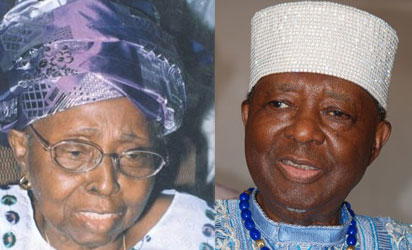
HID Awolowoand Oba Sijuade, Ooni of Ife
By BASHIR ADEFAKA
Story in brief
The Yoruba nation is in search of unity amid concerns that a section of the people that matter in the in quest to move the race forward is being left out
The first pan-Yoruba conference, held at Ikenne,Ogun State, on Thursday, October 6, has come and gone but the fall-out from that supposedly first-of-its-kind meeting, aimed at charting the way forward for the Yoruba race, remains an issue.
The Alaafin of Oyo, Oba Lamidi Olayiwola Adeyemi, was conspicuously absent at the meeting which the Ooni of Ife, Oba Okunade Sijuwade, convened with the matriarch of the late Chief Obafemi Awolowo dynasty, Mama H.I.D. Awolowo and first elected governor of Lagos State, Alhaji Lateef Jakande, who were visibly seated on the high table.

HID Awolowoand Oba Sijuade, Ooni of Ife
Former Vice President and Chief of General Staff, Lt General Oladipo Diya; immediate past Head of Service of the Federation, Prof. Afolabi, and the two factional leaders of the Oodua People’s Congress (OPC), Dr. Frederick Fasehun and Otunba Ganiyu Adams were also on the high table at the conference.
Though the conference held, it couild not be said to be a total success due to what people like the Afenifere chieftain, Chief Ayo Adebanjo, and many of the traditional rulers present blamed on the Alaafin’s absence.

Oba Adeyemi, Alaafin of Oyo
“Without the Alaafin on seat,” Adebanjo said, “nothing can be said to have been done. Before we can say this meeting is a success, no Yoruba son must be left out.”
The Alaafin, specifically reacting to a Vanguard’s report on the conference, said it was a good starting, meaning he is prepared to cooperate with the peace and unity process.
Over a year before the Ikenne meeting, the Alaafin, who praised Vanguard for what he described as its objective report of the Yoruba conference, had granted an exclusive interview, where he poured out his mind on his pains on the Yoruba problem.
He said Yoruba race would not get anywhere so long as its leadership control was placed in the hands of sitting public officers or politicians, who, he said, had always ceased to function after their tenures of office and thus disappeared.
Former Military Governor of the defunct Western Region, Major General Adeyinka Adebayo, corroborated the Alaafin’s position in an interview with Sunday Vanguard during which the President of the Yoruba Council of Elders (YCE) said the Yoruba problem was not disunity per se but political.
The Alaafin said: “What I am saying is that the Yoruba should resuscitate its own pressure group to meet the challenges of national exigencies. To me, the institution of traditional rulership around should be an agency for uniting rather than dividing the political class, which is what the Obas are doing now.
“Do they want to say Yorubas in other political parties are not leaders in their own rights? What of other political office holders like Yoruba members of the National Assembly?”
It also disturbed the mind of the sole custodian of the customs and traditions of Oyo Empire that Yorubas were not utilizing their human resources well.
“Other nationalities make use of their retired citizens, whether in the public or private sector. But to the Yoruba, qualification for leadership is being reduced to sitting public functionaries, especially the governors. To me, selective leadership is not the solution to our problems,” he pointed out.
Agreeing to the monarch’s argument, some stakeholders, who preferred anonymity pending when the unity process will have arrived at logical conclusion, told Sunday Vanuard this a that one of the major setbacks the “Yoruba people suffer comes from their negligence of their resourceful members who were in power yesterday but are today retired but not tired.”
They said Yorubas, revered for their fine culture of using historical experiences in developing themselves and whom people hitherto gathered to watch as they progressed in terms of everything, now do things the other way round.

Ayo Adebanjo
“They no longer take their retired doing-well officers seriously and now they are the ones that gather to watch while those watchers of the past now take the centre stage and are moving far ahead of them.” .Asked why, they said many things were at stake and these included egocentric behaviour whereby everybody sees himself as a leader, who must not bow to the other and misinterpretation of the role of education in human resources development and society building.
Sunday Vanguard learnt that in the past, Chief Obafemi Awolowo became acceptable as Yoruba leader long after his time as premier of Western Region and that it was about that time or thereafter he was picked into the General Yakubu Gowon’s Federal Military Government as Federal Commissioner for Finance, where, seeing himself as representing the Yoruba at the Federal service, he caused his performance to beat the imagination of many people, nationally and internationally.
The Igbo, it was said, still remember Awolowo’s role in how they failed to secede into the Republic of Biafra. That was the typical Yoruba leadership being talked about and a return to that age in the race’s forward-match process, the Alaafin of Oyo said, would help in quick arrival.
“In the 1967 experience, the Obas worked assiduously in bringing all the warring political interests together, especially against the backdrop of the rancour between the Action Group and the NCNC. But what do we have today? Obas and governors alone charting a course for the Yoruba. We have to look beyond transient position holders,” said Alaafin before the October 6 Ikenne conference.
Yoruba are blessed with brilliant sons and daughters who, in the past, had played their own respective roles in the building of modern Nigeria. After retirement, the Yoruba sons and daughters are neglected by their own clan. They retired from their government services: the military, the police, civil service, but they are not tired.

Tinubu: Leader of ACN
The stakeholders charged: the Yorubas can do away with egocentric behaviour and begin to take everybody as important in moving the race forward. “If those retired people are contacted and reintegrated into the Yoruba leadership, they could brace up to contribute in a way that would lift the once-upon-a-time glorious race back on its feet.”
Findings also showed that whether Generals Diya and Olanrewaju agree or not, the reason the late Head of State, General Sani Abacha, used the fathom coup of 1996 to punish them was because of their concerns for the interest of the Yoruba race . Olanrewaju single-handedly achieved the jumping from 12 to 20 local governments in Lagos, being a Lagos State prince in the army and in government during the Abacha regime. His attempt to secure further increase from the 20 local governments to 44 when the Osun State-born Brigadier-General Olagunsoye Oyinlola was Military Governor of Lagos, during the same Abacha regime, where Olanrewaju was not only minister but was also a member of the Provisional Ruling Council (PRC), was said to have been frustrated by some Yoruba stakeholders under the pretext of not wanting to do business with Abacha. But history, it is said, now proves that Ekiti State people, an integral part of the Yoruba race, now enjoy their statehood which the same Abacha regime made possible and that most of the stakeholders who refused Abacha in the case of Lagos 44 local governments now jostle for power in the state.
“Unfortunately, 15 years after their travails and years again after the Oputa Panel set up by another Yoruba man as President, Chief Olusegun Obasanjo, had recommended that Generals Diya, Olanrewaju, late Adisa and others unjustly punished with the cooked up Diya coup should be apologised to, compensated and get their military rights restored to them, nothing has happened. Not even the sitting President Goodluck Jonathan has done anything and Yoruba keep quiet and are not talking,” an aggrieved stakeholder exclaimed, querying, “How can such unjustly penalised people raise their heads any longer for the race?”
It was, as a matter of responsibility, it was gathered that Obasanjo’s last civilian regime, failed because his own Yoruba people left him alone to it. It has been argued that the three-time head of Nigerian government made his failure by himself due to “his non-challant attitude and lack of respect for his race’s views on his administration during his reigns,” It was however said that the Yoruba race could still have been better for it should they have forgiving spirits towards themselves.
The Nigerian Civil War of between 1967 – 1970 was another area , which, the stakeholders said, could not be completely talked about without the mention of Yoruba fighters. “Where have we kept those Yoruba fighters? Where are the scorpions – Benjamen Adekunles? Where are the Alani Akinrinades? Where are the Adeyinka Adebayos? Where even are the Olusegun Obasanjos the stakeholders asked rhetorically. Yoruba are said to now need a serious overhauling of their think-tank system and have thus been advised to sieze the opportunity provided by the just instituted pan-Yoruba conference to put their acts together for the good of the people and overall interest of the race.
Confronted with questions bordering on the update on activities of the 50-man committee set up at the last Ikenne conference, Adebanjo, said that it was not possible that they would neglect a glorious task of moving an enviable race like the Yoruba forward.
“We have not neglected the process. What we want to avoid is too much talking for now and we will remain so until we have got positive results,” he said.
He went further, “We are making progress. We have met with the Alaafin of Oyo and Ooni of Ife and we have made progress from there. Now I’m just coming from the Awujale of Ijebu Land and I can assure you that effort is going on.
Asked if the committee had met with the governors of the six states of the Southwest, the 83-year-old lawyer, and Afenifere chieftain, said the issue of the governors was not important for now and that things would sort themselves out as time went on.
Disclaimer
Comments expressed here do not reflect the opinions of Vanguard newspapers or any employee thereof.