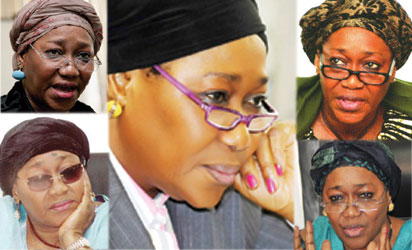
Madam Farida Waziri
By Rotimi Fasan
ALTHOUGH much like an overdue prophesy but when it finally came, the ouster of Farida Waziri still happened rather suddenly.
It was as if President Goodluck Jonathan suddenly came to the realisation that Waziri’s time at the Economic and Financial Crimes Commission, EFCC, had been long due for a review and couldn’t stay a moment longer. And when the announcement came, not even Waziri could be said to have anticipated it.
If one report is to be believed, Mrs. Waziri’s employers hadn’t given her the courtesy of prior notice as she had to get the news of her ouster from members of her staff. This rude gesture is in no way as bad as the manner her predecessor in office, Nuhu Ribadu, was shoved aside and left to run for his life. In Ribadu’s case, it was as if the forces ranged against him were equally bent on humiliating him as well as terminating his life.
They went after him with a viciousness that could not in any way be explained rationally. Many Nigerians had then criticised the shoddy and untidy way a person originally appointed to serve the state was being treated.
The criticisms fell on deaf ears and in it all, Madam Waziri didn’t appear the least bothered. She sat smug and unconcerned and went about her job as if on a demolition mission. Now the seasoned whip used on Ribadu has been fetched from the rafters and the consequences don’t look amusing at all. Whether Nigerians like it or not, therefore, a bad precedent has been established with the manner heads of the EFCC are hired and fired.
Ultimately, it is the so-called anti-corruption war that suffers as every step taken forward is followed by three backwards. We are back, it seems, to the pre-Waziri era with the appointment of Ibrahim Lamorde as her successor.
But it remains to be seen just how much has changed since Lamorde who had been Ribadu’s right hand man and had, in fact, acted as EFCC chair in the immediate aftermath of Ribadu’s removal- it would be interesting to know how much of the Ribadu-era fire is still left in him.
One cannot help speculating in this manner because much of what Ribadu did in his time became anathema after Waziri took over.
The entire goal on the part of the new team was to keep a wide berth between their approach and that of Ribadu. No doubt Ribadu made a lot mistakes but they didn’t look like the picture created by the new power house at the EFCC after he was replaced. A lot was said about ‘due process’ and ‘rule of law’ but in the end Waziri would face the same criticisms levelled against Ribadu.
In the last few months she would be criticised for violating the rights of Nigerians that came under EFCC investigation and arrest. Yet, her activities during the last few months appeared directed at increasing the tempo and span of the fight against corruption. Which makes it all the more difficult knowing why she had to be shoved out in the manner she was.
At what point and for which reason did her work become unsatisfactory to her employers? What exactly could have prompted her removal more than a year before the end of her tenure? At her appointment in May 2008 the impression was created that government wanted to make the activities of the chief executive of the EFCC stable by making their appointment a tenured term of five years.
This does not look like the case anymore. What really happened to change matters? Can the sudden removal of the top executives of the EFCC at the point when they appear to be doing the work for which they had been appointed be healthy for smooth running of the body? This surely cannot be answered in the affirmative.
The point, however, is that until the element of uncertainty is removed from the manner EFCC chiefs are appointed and fired, the quality of their work cannot be guaranteed and Nigerians would be at a loss knowing what these executives did right or wrong.
The role of their employers or others they have to work with would always appear to cast a dark and unwanted shadow over the position of the EFCC chair.
For one, a clear line would need to be drawn in terms of how executives of the EFCC are to relate with the minister that oversees their office, specifically the Minister of Justice and Attorney General of the Federation. The last EFCC chairs at some point or another had frosty relations with persons that occupied that position. Michael Aondoakaa had nothing good to say about the EFCC under Ribadu. He sought and exercised overbearing influence over the EFCC chair and he would not be satisfied until the latter was shoved out of office. For a while he seemed to enjoy better relationship with Waziri. But this too would end suddenly despite Waziri’s more pliant and cooperative attitude. The truth is that Aondoakaa couldn’t see himself in any position except where he is the one exercising unaccountable power. The apparent accord between him and Waziri would end on a sour note. The situation didn’t improve between Mohammed Adoke, Aondoakaa’s successor, and Waziri. Their relationship was at best cold and it couldn’t be clear why this was so. But it was clear that Waziri didn’t enjoy the confidence of the minister. It may not be really as rewarding to speculate on the actual reasons for their disagreement as that the disagreement portrays the government as unserious about fighting corruption where the top people involved in the fight continued to work at cross purposes. Certainly, someone somewhere didn’t see the war against corruption as one that could be won by government. And so the rigmarole continues and we must wonder if the appointment of Lamorde would be for the best.
We’ll have to wait and hope that matters turn out right. Yet there is every need to worry in the face of what looks like failure on the part of government to take the fight against corruption beyond the level of rhetoric. There is too much talk at the expense of action. Would Lamorde take us beyond this? One guess is as good as another.
Disclaimer
Comments expressed here do not reflect the opinions of Vanguard newspapers or any employee thereof.