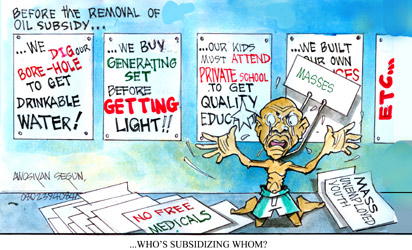
By Pini Jason
THE most dominant topic of discussion in the country at the moment is a very unpopular one—the removal of subsidy on petroleum products.
It has expectedly divided the nation into two opposing viewpoints, those who support removal of subsidy and those opposed to it. Leading the opposition forces is the Nigeria Labour Congress. The state governors have been at the forefront of the call for subsidy removal.
Governors’ call for subsidy removal
When the Governors called for the removal of subsidy in order to be able to pay the new minimum wage of N18,000, my brother Olusegun Adeniyi wrote in his column, The Verdict in Thisday of June 30, 2011 an article titled: “Where the Governors Got it Wrong”.
He argued that “their call for removing subsidy so that they could have more money to share is not only cynical but completely misses the point, especially at a period of serious economic challenges for the large majority of our people”. And reading through the body of the article I began to wonder what Segun was disagreeing with in the position of the Governors, especially as he agreed that: “Whether we want to admit it or not, the current situation is unsustainable as the nation is gradually going bankrupt even with the oil revenues”.
Segun proceeded with unassailable facts and figures, to in my view, uncannily justify the removal of subsidy and surmised that “…even all these do not obscure the fact that the current regime of subsidy is in favour of a few at the expense of the collective”. It was at the tail end of his article that I saw his point of disagreement with the Governors when he wrote that “…government has to begin a conversation with all the critical stakeholders on what should be done with the ‘savings’ from deregulation as opposed to the idea of simply sharing the money as being proposed by the governors”.
It is therefore safe to conclude that Segun is not necessarily against the removal of subsidy, but is against sharing it according to the fancy of the governors.
In his own intervention in Thisday of Sunday October 16, 2011, titled: “Before Nigeria Goes Bankrupt”, my other brother, Simon Kolawole brilliantly x-rayed the nation’s penchant for squander mania. He concluded with this caution: “Across the country the wage bill is very high. The subsidy bill is crazy. Meanwhile, oil income is, as things stand now, uncertain—with another global economic crisis approaching.
If we don’t curb our appetite for wasteful spending and begin to tap other sources of income as a matter of urgency, we will soon go bankrupt”. While SK did not openly weigh in, in favour of subsidy removal, it was clear from his thesis that subsidy is one major avenue of annoyingly wasteful spending!
Economic illiterates
In an article titled: “The End of Medieval Economics” (Vanguard, July 8, 1994) during the Gen Sani Abacha era of what the London Economist described as “cabinet meetings by economic illiterates”, I took this view of government involvement in our economy: “Economic regulation brings with it government intervention. Government intervention in any economic activity creates distortion, exacerbates scarcity, introduces corruption and nepotism, and slows down economic growth”.
In an earlier article in Vanguard April 10, 1992, I observed that: “While the general preoccupation seems to be the rapacious looting of whatever the oil sales bring, there is equally an attitude which tends to suggest that we don’t need to do anything for our economic miracle”. Since then we have quarrelled about deregulation, appropriate pricing, market forces, Gulf War windfall and subsidy removal.
Primitive economics by corrupt govt
The subsidy debate is not a new one. It is a recurring debate that simply signifies the lack of political will to get the government off the economy. My position today is not a new one. Right from the days of “government intervention in the commanding heights of the economy”, through the days of economic xenophobia called indigenisation to the fraud called “transfer of technology” that simply transferred the products of technology and littered our skylines with junks of prototypes we could not maintain, I have been uncomfortable with primitive economics run by corrupt government.
As before, the subsidy debate has been emotional, sentimental and personal. The adverse reactions have been anchored on the hardship it could impose on the poor masses and the fact that we believe that the money might end up in the pockets of the corrupt elite. But I think that our future is bigger and more important than all the governors put together. Our wealth is not in the oil money, but in the taxes we are not paying and we are not collecting! That is the import of Kolawole’s article.
Look at it this way; we expect government to provide quality education (ASUU is warming up for another strike!), health, water, uninterrupted power, good roads, airports, housing, food, petrol, transportation, etc. All these require huge capital outlay to meet international standards. Even if the entire revenue was deployed to these, it will still not be sufficient for as long as provision of these infrastructure and services is entirely in the hands of government.
I do not know many developed countries in the world where these infrastructure and services are provided efficiently and in first class standard by government. The reason is that government business has a very high co-efficient of corruption. Part of our problem is that our corrupt elite live in opulence giving a phoney impression of a rich country where government can provide everything free.
The President told the nation at a presidential retreat that gains of the subsidy will be invested in infrastructure, evoking the memory of Abacha’s Petroleum Trust Fund after petrol price increase. I do not believe that we need palliatives which, as soporific as anaesthesia, wear off after a while.
Palliatives cannot come after the removal of subsidy. Rather government should, must take certain fundamental steps as conditions precedent to removal of subsidy.
We must take these steps to prepare the grounds before removal of subsidy because petroleum products are right now essential commodities. The argument that subsidy benefits a few fat cows may be true, but it does not remove the fact that its removal will severely hurt the poor. I therefore propose the following steps:
Palliatives before subsidy removal
We need a complete and comprehensive review of our fiscal and tariff policies. We cannot continue to import certain luxury items just to satiate the taste of our elite of sybarites. We cannot continue to import what we can produce locally. We must return to the culture of thrift which the British bequeathed us. That is how India has succeeded in managing its poverty and Nigerians are flocking there now.
The Central Bank of Nigeria must resume the publication of the monthly consumption of our foreign exchange. Let us know who uses our foreign exchange and for what, and we march it against the tax paid by the organisation and individual. Abolish all waivers except for books, medical and educational materials and de-monopolise the market for many products. The President may have forgotten that he once gave order for the crashing of exorbitant cement price last June. Instead of crashing, the price is still above N2000 a bag! That is the effect of monopoly!
Repair existing refineries and build new ones to embark on refining in Nigeria, not in Indonesia, for local consumption and export, especially since refined petrol is not included in OPEC quota. Refining in Nigeria will also yield other by-products for petro-chemical industry that will create jobs. Stop importation of petroleum products! To continue to import petrol is not only mad but a deliberate measure to fatten few pockets at our expense! In a deregulated petroleum market, we shall not need the PPPRA; therefore scrap it!
Before we embark on removal of petroleum subsidy, we must massively improve the railway system as a popular means of transportation and rehabilitate our roads, while the governors (since they are pro-subsidy removal) must introduce adequate, efficient and sustainable urban and intercity transportation through Private and Public Partnership.
I know the question will be how does government get the money to invest in railways and roads if it does not first remove subsidy? My answer is that we begin by pruning down the size of governments and tightening up our budgeting that provides for fiscal haemorrhage in our system. This is probably the only country where the legislature, instead of using a scalpel to trim the budget proposal of the executive, scandalously pads and bloats it!
One plank of government’s argument in favour of removal of subsidy is the activity of a corrupt cabal that feasts on the subsidy. The cabal and their collaborators in PPPRA and NNPC must be exposed and punished. Don’t just tell us about a cabal as part of government’s sensitization strategy; punish the cabal!
The benefit of a lame-duck president is that he can take tough decisions a vote seeking president may not touch. The President has vowed to “take certain hard decisions that, to probably ordinary person sometimes will appear painful at the beginning but will definitely in the end be quite rewarding”.
But he needs not put the cart before the horse. It may be enough if he takes the next two years to lay the foundation for the tough decisions by taking steps to prepare the ground before removing the subsidy on petrol. Certainly removal of petrol subsidy is a tough call. The question is for how long shall we be waltzing our way to bankruptcy?
Disclaimer
Comments expressed here do not reflect the opinions of Vanguard newspapers or any employee thereof.