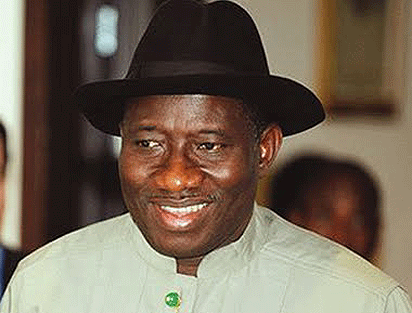
President Goodluck Jonathan
BY HUGO ODIOGOR
The Palestinian quest for definitive step at the weekend when Mahmoud Abbas Chairman of the Palestinian authority presented to the 66th General Assembly in New York the request for the actualisation of UN resolution 181 but Nigeria pushed for a pragmatic diplomacy to secure its economic interest at the expense of the complex Middle East politics.
It was a moment of mixed reactions as leading powers of the world gave conflicting responses to the the Palestinian statehood. The United States, which wields veto power in the UN Security Council, had warned ahead of time that it will use the big stick, if Mr. Abbas went ahead to present the request for statehood in the General Assembly.

President Goodluck Jonathan
In his speech on Wednesday, President Barack Obama warned that “there is no short cut to peace in the Middle East” which was a veiled threat to the diplomatic coup staged by the Palestinian authority to side-step the deadlocked Arab-Israeli peace talks.
French President Nicholas Sarkozy offered a period of 12 months for the resumption of talks between Israel and its Arab neighbours. But Nigeria’s president, Dr. Goodluck Jonathan, who advocated preventive diplomacy, seemed to have opted for a pragmatic approach to the Palestinian issue when officials said Nigeria chose to discuss terrorism and an essence of preventive diplomacy instead of dabbling into the intractable conflict in the Mddle East.
According to Dr. Lanre Oshodi, “the issue of Palestinian statehood is a delicate one and Nigeria had to gauge the sensibilities of the United States and its allies as well as that of Arab world and other third world countries before throwing its weight behind any of the parties”.
Oshodi, said: “Nigeria could not afford to antagonise the United States, key European countries by taking sides with the Palestinians. We share some crucial ties with the Palestinian people but, at the same time, we cannot afford to make the mistakes of 1973 when Nigeria, as an African country, played a leading role in the African isolation of Israel because it went to war with its Arab neighbours”.
Even when other African countries, individually, went back to restore ties with Israel, it was not until 1992 that Nigeria and Israel became close again. There is the religious dimension as the political face of Islam has presented Nigeria with the Boko Haram phenomenon, where throwing of bombs has become a worrisome development.
The president could not be seen to be contradicting his position by openly endorsing a Palestinian state where groups like Hamas are still denying Israel the right to exist and support the use of violence against non-combatant infrastructure, and individuals. They are still making trouble in Gaza.
At the same time, Jonathan did not want to create the impression that he is unmindful of the sentiments of the Muslim population that is in sympathy with the Palestinians.
The best option for Nigeria was to adopt soft diplomacy. Said Oshodi: “Don’t forget that we once antagonised the United States and Britain over the independence of Angola and Zimbabwe in the 1970s and 1980s, and we burnt our fingers and we have learnt our lessons.
After these diplomatic experiences, we discovered that you must have the imperatives of power before you could throw your weight around. Nigeria is not a strong economic position to push forward radical foreign policy options. In practice, we support the position of France, which is in line with preventive diplomacy.”
Diplomatic watchers argue that Nigeria is mindful of its economic interest which lies with the western economies and the Palestinian state, although important to the country’s foreign policy, which strives towards freedom and equality for the peoples and nations, cannot be put in jeopardy at this crucial moment.
But Nigeria may have lost a golden chance to stand up among the big nations, according to Oshodi who believed Nigeria cannot afford to put herself in a position where it would be seen to be poking its hands in the eyes of the US.
The U.S. and Israel have been pressuring council members to either vote against the plan or abstain when it comes up for a vote. The vote would require the support of nine of the council’s 15 members to pass, but even if the Palestinians could line up that backing, a U.S. veto is assured.
Abbas rebuffed an intense, U.S. lobby to sway him from the statehood bid. He said, “We seek to achieve our right and we want our independent state.” Diplomatic sources said the proposed statehood for Palestinians in the West Bank, east Jerusalem and Gaza Strip would not deliver any immediate changes on the ground.
Israel would remain an occupying force in those first two territories and continue to severely restrict access to Gaza, ruled by Palestinian Hamas militants. But the statehood bid is appealing to Abbas whose tenure is coming to an end and would want something to cling on to in the protracted Palestinian struggle for independence.
Abbas had forced a renewed bout of activity aimed at restarting peace talks between Israel and the Palestinians. Beyond that, the UN Security Council action on the membership request could take weeks or months.
The strategy also puts the Palestinians in direct confrontation with the U.S., which has threatened to veto their membership bid in the U.N. Security Council, reasoning, like Israel, that statehood can only be achieved through direct negotiations between the parties to the long and bloody conflict.
Also hanging heavy in the air was the threat of renewed violence over frustrated Palestinian aspirations — perhaps not immediate, because Abbas has vowed to prevent unrest, but possibly, down the road, if negotiations continue to stall.
Yet, by seeking approval at a world forum overwhelmingly sympathetic to their quest, Palestinians hope to make it harder for Israel to resist already heavy global pressure to negotiate the borders of a future Palestine based on lines Israel held before capturing the West Bank, east Jerusalem and Gaza in 1967.
Israel has warned that the Palestinian appeal to the U.N. will have a disastrous effect on negotiations, which have been the cornerstone of international Mid-east policy for the past two decades. Netanyahu, who addressed the General Assembly shortly after Abbas made his own address, opposed negotiations based on 1967 lines, saying a return to those frontiers would expose Israel’s heartland to rocket fire from the West Bank.
He also fears that if that principle becomes the baseline for negotiations, then Palestinians won’t settle for anything less, despite previous understandings between the Palestinians and previous Israeli governments to swap land where settlement blocs stand for Israeli territory.
A last round was launched a year ago, with the ambitious aim of producing a framework accord for a peace deal, but broke down just three weeks later after an Israeli settlement construction slowdown expired. Palestinians said they turned to the U.N. in desperation over 18 failed years of peace talks.
But Israelis said the Palestinians are to blame for their own predicament and accuse them of going to the United Nations precisely to avoid talks. But Palestinians say they will not return to the bargaining table without assurances that Israel would halt settlement building and drop its opposition to basing negotiations on the borders it held before capturing the West Bank, east Jerusalem and the Gaza in 1967.
UN Resolution 181 and the Palestinian state
To understand the issue at stake it is important to take a historical trajectory into the two state solutions as advocated by the UN Resolution 181. The United Nations General Assembly, on 29 November 1947, adopted Resolution 181 (II) on the Future Government and Partition of Palestine.
The resolution noted Britain’s planned termination of its mandate for Palestine and recommended the partition of Palestine into two states, one Jewish and Arab with the Jerusalem-Bethlehem area being under special international protection, administered by the United Nations.
The resolution included a highly detailed description of the recommended boundaries for each proposed state.
The resolution also contained a plan for an economic union between the proposed states, and a plan for the protection of religious and minority rights.
The resolution sought to address the conflicting objectives and claims to the Mandate territory of two competing movements, Jewish nationalism and Arab nationalism, as well as to resolve the plight of Jews displaced as a result of the Holocaust. The resolution called for the withdrawal of British forces and termination of the Mandate by 1 August 1948, and establishment of the new independent states by 1 October 1948.
A transitional period under United Nations auspices was to begin with the adoption of the resolution, and lasting until the establishment of the two states. However, war broke out and the partition plan was never implemented by the Security Council. On March 5, 1948, the United Nations Security Council reached an impasse when it refused to pass a resolution which would have accepted the partition plan as a basis for Security Council action.
The United States subsequently recommended a temporary UN trusteeship for Palestine “without prejudice to the character of the eventual political settlement”, and the Security Council voted to send the matter back to the General Assembly for further deliberation.
The General Assembly decided to appoint a Mediator, and relieved the Palestine Commission from any further exercise of responsibility under resolution 181 (II) of 29 November 1947. During their withdrawal, the British refused to hand over territory or authority to any successor.
On 14 May, 1948, the day Britain had announced it would end the Mandate and the day when the last high commissioner left the territory, the Jewish community in Palestine published a Declaration of Independence which announced the creation of the State of Israel.
The Declaration did not define what the borders of the new state were. The following day, 15 May, most of the remaining British troops departed. Also on 15 May, five Arab armies crossed the borders of what had formerly been Mandate Palestine. This event marked the beginning of the 1948 Arab- Israeli War.
Disclaimer
Comments expressed here do not reflect the opinions of Vanguard newspapers or any employee thereof.