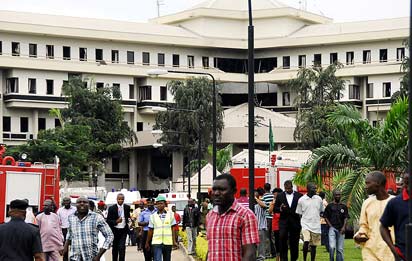
The UN House, Abuja
By Ochereome Nnanna
NOW, the eyes of the world are on us. We have set a new, macabre world record, beating strife-torn, sectarian violence-wracked Iraq to it. Before the penultimate Friday bombing of the United Nations, UN, building in Abuja, the highest death toll suffered by the “world government” was 22 people killed. And that took place in Baghdad, Iraq.
The dethronement of Saddam Hussein’s dictatorial Ba’athist regime by the United States and its allies in 2003 led to the collapse of security in the country. The foreign invaders did their best to grow a new government and security system before pulling out. But the result has so far proved no match in terms of effective control of the country compared to what Saddam’s regime was able to create in his 24-year rule.
The death of 23 persons at the UN House blast in Nigeria would suggest that our own security system in an otherwise “peaceful” Nigeria is at the same level – or worse than – post-Saddam Iraq. Our poor security system is part of the indices that rate this country as failure-prone. Others include doing business, corruption perception, performance on the Millennium Development Goals, MDGs, functional infrastructure and what have you. Nigeria is always listed among the worst performers, (which are mainly war-ravaged entities). Since we are not really at war with any foreign country or involved in a battle line-drawn civil war, being rated among war-torn entities can only mean that things are seriously wrong here.
Did you notice the aftermath of the UN bombing in high official quarters? An angry nation and a disappointed international community looked with reddened eyes in the direction of President Goodluck Jonathan. His Facebook pals shellacked him for failing to rein in Boko Haram, the al Qaeda cell operating in Nigeria. GEJ summoned his highest security officials to the State House last week Tuesday. You name them, they were there: National Security Adviser, NSA, General Owoye Azazi, Inspector General of Police, the much maligned Hafiz Ringim, Director General of the SSS, Mr Ita Ekpenyong and others.
The President transferred the anger to them. We hear he even hinted at sweeping off some of them. In fact, some newspapers even dropped names of possible successors to the NSA. These names included old timer, General Aliyu Gusau and General Sarki Mukhtar, who was earlier on sacked after the demise of President Umaru Yar’Adua.
Within 24 hours, the SSS announced that a combined team of the security agencies had made a big catch, comprising two “leaders of the Boko Haram extremist sect”.
They were named as Babagana Kwaljima (alias Abu Summaya) and Babagana Mali (alias Bulama). According to the statement, the arrests were made way back on August 21, 2011, five clear days to the UN House bombing incident. A third suspect, identified as Mamman Nur, who was still at large was declared wanted. Nur, according to the SSS, was the mastermind of the UN House bombing.
Well, this brought a sigh of relief out of many anxious Nigerians. At least something had started happening, even if it happened after the President breathed hot fumes at the agencies. Better late than never. Anything is better than nothing. The Hausa will say: in dare ya dare buzuzu ne ma nama. Which means: When the night falls (or in times of adversity) even the beetle becomes meat.
However, to those who tend to be more sceptical of the well known antics of our security officials, the news from the SSS came with some questions attached. If the arrests were made prior to the UN House bombing and the presidential censure of the agencies, how come nobody (meaning the public) was told about it? Perhaps, the services were still verifying their big catch? That’s possible. But would it not have helped if the arrests were made public, knowing that Boko Haram had issued a fresh threat on public institutions? Was it not possible for Nur to apply the breaks if his accomplices were paraded by the security agencies?
With this arrest coming after the bombing and presidential summons, the impression was given that this was just one of those eye-service parading of “suspects” often staged (especially by the Police) to give the impression that they are working. Many questions are being raised as to the effectiveness of the State Security Services, especially after the end of military rule. Yes, we have seen a Service that has appointed an identifiable spokesperson in the person of Mrs Marilyn Ogar. In other words, SSS has put on a human face. In fact, Mr Ita Ekpenyong once paid a courtesy visit to Vanguard editors, with this writer among those present to receive him when he was the Lagos SSS Director. He came across as a secret policeman yearning to build a new image for the Service by cultivating public partnership.
But in spite of this PR effort, the Service, whose job is mainly intelligence, has not seemed to be as effective in smelling out trouble before hand as it was in grabbing and detaining journalists and human rights activists to please dictators during military rule. Nigerians expect not just the SSS but other security agencies to study and identify flashpoints and cause government to raise the forces to nip threats in the bud. The network of kidnappers in the South East and South-South (they are now sprouting in the North) should be known to the SSS. The cycle of killings in the Plateau, the Boko Haram menace and even the well-choreographed post-election violence in the North could have been squelched before they boiled over if the security agencies were up to their duties, especially by applying the principles of vigilance and intelligence gathering.
I am aware that our security agencies are bedevilled by a large number of constraints such as corruption, ethnic politics, inter-agency jealousies, poor motivation in terms of equipment, remuneration and other usual problems associated with the Nigerian public services.
In this era of global terrorism, there cannot be a separate standard of security for Nigeria and a separate one for the world out there. Nigeria must get more serious about its security challenges. If we continue the way we are going we may find out, just as some have predicted, that by 2015 there may be no country called Nigeria (as we know it) to secure.
Disclaimer
Comments expressed here do not reflect the opinions of Vanguard newspapers or any employee thereof.