It’s been ten years since the AlQaeda terrorist attack on the United States of America. The attack which was executed with an eye for maximum devastation took place on September 11, 2001, hence the reference to 9/11, the shorthand formula by which it is now generally known.
It was by all accounts the worst terrorist attack on US soil, taking nearly 3000 souls and bringing down the 110-floor twin towers of the World Trade Centre, iconic symbol of American capitalism.
The attackers, armed merely with knives with which they hijacked the civilian planes they crashed into the WTC also went for the Pentagon, symbol of America’s military power after entering a section of the protected airspace that covers both the White House and the Pentagon.
At a point, President George W. Bush, his wife Laura and their dog had to be evacuated into the fortified bunker in the White House when it appeared the terrorist were about to attack the White House. It was the second time the President had to be spirited into a bunker, the first time was in Florida when news first broke that America was under attack and nobody knew what was going on.
But in the midst of the confusion, the people rallied and braced up to respond to the attacks during which four civilian planes were crashed by hijackers with one of them hitting the Pentagon exactly 60 years from the day the foundation of the sprawling military complex was laid. The attackers were nothing if not extremely daring.
They were not merely out to send a message but to show they could back every threat with action, striking at symbolic structures of the American society. The scale of the attack beggars belief. Which was why the Americans didn’t know how to respond in the first few hours.
Nobody could imagine terrorists striking the very symbols of American military and economic power and in the process short-circuiting her technological might in the manner the terrorists did. Americans could not imagine this as I couldn’t when my younger brother first told me of the attack.
In those 10 years, a lot has happened to alter the political configuration of the world, especially with regards to Middle East politics and the Persian Gulf. The removal and eventual execution of Saddam Hussein in Iraq, the Taliban in Afghanistan and the rendition of terrorist suspects all culminating with the May Day killing of Osama Bin Ladin are fallout of the 9/11 attack.
The NATO-aided fall of Muammar Gaddafi in the aftermath of the Arab Spring is not unconnected with the whole drama that started with 9/11. Although Gaddafi had been a real bugaboo for the Americans long before 9/11, he would learn to moderate his comments and action after he realised the West, especially the Americans, was out to take its pound of flesh following 9/11.
He played into their hands with his heavy-handed response to the Arab Spring protests that began last February. In the last one week Americans have been remembering the events of 9/11, the crushing pain it inflicted on many and how the people were able to rise with one voice to respond to the Al Qaeda threat. One constant refrain in all the accounts of the events is the crucial factor of leadership in American response.
From the President to the governor, the mayor to the congress, fire fighters and ordinary Americans on the street, the role of an effective and able leadership cannot be discountenanced in cutting back the initial victory borne by the surprise terrorist attacks.
President Bush was out of Washington when the attackers went into action. Immediately it was apparent that America was under attack and nobody knew the details of the attack and who was behind it, the President was moved by the secret service into a bunker in a military base from where he was to receive briefing and coordinate response to the attack.
He would later insist on returning to the White House as he didn’t find the image of an American president operating from inside a bunker in the heartland of America, away from Washington, the nation’s capital, fitting symbol of leadership. The psychological victory that would give the terrorist couldn’t be quantified. He returned to take effective charge.
But within the first 24 hours or thereabout, the face of American leadership beamed around the world was that of Rudy Giuliani, the Mayor of New York, equivalent of a local government chairman in Nigeria, who had been summoned from a morning breakfast with the initial report that a light plane had crashed into the WTC.
When the South Tower came under attack 17 minutes after the first and it became clear what was afoot was a terrorist attack, Giuliani took effective charge even as his attempts to reach the governor and White House failed. He went into the streets and rallied New Yorkers, acting the part of a true leader.
He went on air even in his dust-covered clothes to calm Americans and assure them that their leaders were taking necessary steps to protect American lives. In all this he received devastating reports and saw with his own eyes how people jumped to their death from floors high up the towers.
He moved around and calmed nerves. His action received the right response from the people who began to take steps to minimise the scale of the attack, rescuing trapped victims and providing round-the-clock care for the injured.
Threadbare rhetoric
It was not the time for threadbare rhetoric. Hundreds of kilometres away, the President who was in a school would get report on live television of what was going on in New York. Contrary to the image of the bungling politician projected in the media, Bush was presidential in his response even as he called off the school meeting immediately, leaving with his aides, not a moment betraying any sign of anxiety.
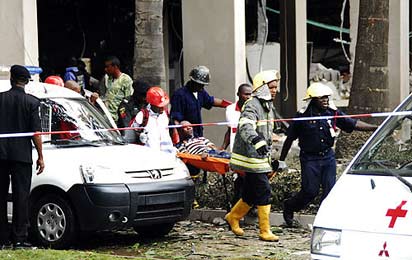
The Boko Haram attacks, as are attacks in other parts of Nigeria, are nothing compared to what Americans experienced on 9/11. But the response the Nigerian case called and still calls for are not dissimilar from that provided by Mayor Giuliani or President Bush in 2001- effective leadership. This has been lacking in Nigeria. President Jonathan has at best been tentative and lacking in decision.
There are certain qualities of leadership a potential president ought to possess. Such qualities of fast, decisive action and ability to think on the feet, not waiting until an entire cabinet is convened, appear lacking in Jonathan’s action. This is one point the President as are some who are blindly supportive of him would do well to reckon with if he must be a leader and not a mere politician.
Disclaimer
Comments expressed here do not reflect the opinions of Vanguard newspapers or any employee thereof.