By Emmanuel Edukugho
About 28 million, representing 42 per cent of the total number of primary school age children in the •. world who are not enrolled in school live in poor countries affected by conflicts. Thirty-five countries were affected by armed conflict from 1999 to 2008.
Children and schools are on the front.line of these conflicts with classrooms, teachers and pupils seen as legitimate targets.

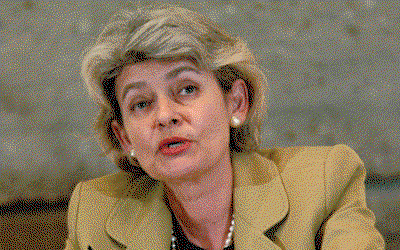
DG,UNESCO, Irina Bokova
The United Nations Educational, Scientific and Cultural Organisation (UNESCO) 2011 Global Monitoring Report (The Adviser Vol.6 No. 68, May 2011 ISSN 0794 5248 refers) warned that armed conflict, widespread rape, sexual violence and other human rights abuses have deprived 28 million children of access to good quality education.
Titled: “The hidden crisis: Armed Conflict and Education,” the report warned that the world is not on course to achieving Education for All ( EF A) goals by 2015 which over 160 countries (including Nigeria) signed to in 2000.
It noted that most of the goals will be missed by a wide margin especially in region engulfed by conflict, the report acknowledged that there has been progress in many areas.
Four Nobel Peace Prize Laureates: Oscar Aries Sanchez (Costa Rica), Shirin Ebadi (Iran), Jose Ramos Horta (Timor-Leste) and Archbishop Desmond Tutu (South Africa) endorsed the UNESCO report.
The Director-General of UNESCO, Irina Bokova said: “Armed conflict remains a major roadblock to human development in many parts of the world, yet its impact on education is widely neglected. This ground breaking report documents the scale of this hidden crisis, identifies its root causes and offers solid proposals for change.”
According to Archbishop Tutu, the report documents in stark detail, the sheer brutality of the violence against some of the world’s most vulnerable people, including its school children; it challenges world leaders of all countries, rich and poor, to act decisively.
In Afghanistan, at least 643 attacks on schools were recorded in 2009, going up from 347 in 2008. Insurgents in Northwestern Pakistan have made several attacks on girl’s schools including one in which 95 girls were injured. In Northern Yemen, 220 schools were destroyed, damaged or looted during fighting in 2009 and 2010 between government and rebel forces.
The report cautioned that armed conflict is also diverting public funds from education into military spending. That many of the poorest countries spend significantly more on arms than on basic education.
If they were to cut military spending by just 10 per cent, they could put 9.5 million more children in school Military spending is also diverting the resources of aid donor countries. It would take just days of military spending by rich countries to close the US$16 billion Education for All external financing gap. Aid for basic education has increased more than fivefold in Afghanistan over the past five years, but it has stagnated or risen more slowly in countries such as Chad and the Central African Republic, and declined in Cote d’Ivoire.
Rape and other sexual violence have been widely used as a war tactic in many countries. Insecurity and fear associated with sexual violence keep young girls in particular out of school. Although the international courts set up in the wake of the former Yugoslavia and the genocide in Rwanda firmly established rape and other sexual violence as war crimes, yet these acts remain widely deployed weapons of war.
In the Democratic Republic of Congo (DRC), one third of the rapes reported involved children while 13 per cent are against children under the age of 10. Unreported rape in conflict-affected areas in the east of the country may be up 10 to 20 times reported level.
Sexual violence has a devastating impact on education: it impairs victims learning potential, creates a climate of fear that keeps girls at home and leads to family breakdown that deprives children of a nurturing environment.
Children and education are not just getting caught in the cross-fire, they increasingly the targets of violent conflict, says Kevin Watkins, the report’s director. The failure of governments to protect human rights is causing children deep harm and taking away their only chance of an education.
The report calls for an end to a culture of impunity surrounding sexual violence, with stronger monitoring of human rights violations affecting education, a more rigorous application of existing international commission on rape and sexual violence backed by the international criminal court.
The report also sets out a comprehensive agenda for change, including tougher action against human rights abuses, an overhaul of global aid priorities, strengthened rights for displaced people and more attention to the ways education failures can increase the risk of conflict.
It will be recalled that the EF A goals are global in nature, establishing a framework for action designed to enable all individuals to realise their right to learn and to fulfil their responsibility to contribute to the development of their society. These goals are:
*Expanding and improving comprehensive early childhood care and education, especially for the most vulnerable and disadvantaged children.
*Ensuring that by 2015, all children, particularly girls, children n difficult circumstances and those belonging to ethnic minorities, have access to and complete free and compulsory primary education of good quality.
*Ensuring that the learning needs of all young people and adults are met through equitable access to appropriate learning and life skills programme.
* Achieving a 50% improvement in levels of adult literacy equitable access to basic and continuing education for all adults.
*Eliminating gender disparities in primary and secondary education by 2005, and achieving gender equality in education by 2015, with a focus on ensuring girls’s full and equal access to and achievement in basic education of good quality.
*Improving all aspects of the quality of education, and ensuring excellence of all so that recognised and measurable learning outcomes are achieved by all, especially in literacy, numeracy and essential life skills.
Disclaimer
Comments expressed here do not reflect the opinions of Vanguard newspapers or any employee thereof.