With Dele Sobowale
“A breakdown of the job creation figures shows that the Bank of Industry will create one million jobs; Department of Trade, two million jobs and others, 100,085 jobs”.
THE PUNCH, August 9, 2011 p 20.
Economics, like politics, is a game of numbers and while Nigerian politicians have perfected the method of falsifying election results, they have nor been able to juggle financial data just as they wish. Creating 3 million jobs in three years means adding 2,800 people to the workforce everyday. And each day that passes without adding to the number puts more pressure on government. By the time you read this, fifteen days would have elapsed or 42,000 jobs not created.
Last week, I quoted from the NATION, the announcement by the Minister of Trade and Investment through his Special Adviser on Communications, Mrs Yemi Kolapo. This week, another part of the press release had been taken from another newspaper for one simple reason – to avoid anyone claiming to have been misquoted. In fact virtually all the leading papers reported the same thing.
Again, last week, the focus was on the fallacy, often repeated nationwide and globally, that Nigeria possesses “abundant” land and labour for agriculture and agro-allied industries waiting to be exploited. That is the conventional wisdom; yet what is commonly taken as gospel truth is not totally true.
Certainly, less than one quarter of the arable land in Nigeria is now under cultivation. But, the notion that this nation is blessed with abundant land and workers ready to put more land into cultivation is not supported by actual experience.

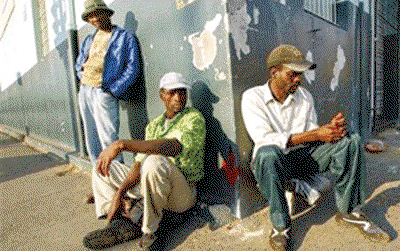
Job seekers
The typical Nigerian farmer is a 45 years old woman clinging to life through subsistence farming. The young men and women, as soon as they can, drift to lives mostly of crime and jobs without future in the urban areas. They have no intention of returning home to farm.
My experience with NORBRU FARMS LTD, a division of North Brewery Limited, Kano, points to a wide gap between the potential for food security and its sustainability and the actual results which can be achieved in the short term – defined as five to ten years. That, as anybody knows, is longer than the lifespan of this administration – with or without tenure extension now being canvassed. I will return to this matter later.
But, first, there is a need to remind our readers of the previous promises made by governments to create millions of jobs. Since, Babangida and Obasanjo have now again taken centre stage, let me start from those two regimes in our stroll down memory lane.
IBB in the late 1980s created the National Directorate of Employment, NDE, with a specific mandate to create jobs after the Structural Adjustment Programmed, SAP, had resulted in un-precedented unemployment in the country.
UAC of Nigeria, the nation’s largest private employer at the time, retrenched almost one quarter of its staff (Kingsway Stores and Chemists, among others were closed permanently); North Brewery shed about twenty per cent of its work force; so did other employers and Bompai industrial layout in Kano became a ghost land eventually.
Faced with rising anger and the social maladies attending having several million idle hands, the devil’s workshops, IBB attempted to create jobs. Those old enough would recollect the Better Life for Rural Women Programme, (or as cynics called it, Better Women for Rural Life) championed by Mrs Maryam Babagida, among other initiatives.
The initiative went with IBB. Mrs Abacha embarked on Family Support Programme now remembered by old codgers like me. The first Director General, DG, of the NDE on resumption of office announced that two million jobs would be created in two years based on expanded agriculture.
The government supported this effort by creating another agency, called DFRRI, which core mandate was to create rural roads linking farmland and urban markets in order to reduce the over 40 per cent of farmers agricultural products that traditionally got wasted in absence of storage facilities.
After a feeble attempt which created no jobs, but a few millionaires, and the hastily established farm cooperatives for women, the entire effort collapsed in failure.
Abacha came into power and in his first full year budget in 1994 repeated the promise of job creation; which had jumped to 5 million jobs in two years. Till his death, either providentially or by homicide, nothing came of the promise. General Abubakar, who succeeded Abacha, did not stay long enough to promise anything on job creation.
The next promise was given by the first Minister of Labour Obasanjo appointed. Chief Alabo Graham Douglas, in his first week in office in 1999 announced government’s plan to create 5 million jobs in two years.
I recollect writing a column reminding the former Minister of previous unfulfilled promises and expressing doubts that the goal would be attained. History would record that until Obasanjo finished his two terms less than one million jobs were created; and mostly in marketing of GSM products and entertainment. As at today, the growing job deficit, like the infrastructure deficit and fiscal deficit remains a fact of life threatening the national well-being.
The Minister of Trade and Investments should therefore not take this series of articles as a personal attack. Given Federal government’s track record on fulfilling its promises on job creation, skepticism is the only sensible response to the retreat’s communiqué.
However, while the disbelief is generic to every government, federal and states, there are three reasons for expressing doubt on the achievement of the goals announced on August 8, 2011.
One, I remembered my experience as a Cost Analyst for Polaroid Corporation in Cambridge, USA, in 1970; fresh from obtaining my MBA. My boss had asked me to work on some figures and produce the total. Two days after, I went to him with the total figure alone. He looked at it and asked, “What is this?”
“The total figure you asked me to get for you”, I replied.
“Then learn this, young man, you should never present total figures without presenting the components that make them up”.
Like all the previous government officials before him, Aganga and his Minister of State have produced a total, 3 million, without telling us how they arrived at the figure. There are literally thousands of job categories from agronomists to astronauts, from engineers to executioners; even pocket picking is a job as area boys know too well.
Nigerians need to be told how many jobs will be created in each job category before they can accept the total figure as realistic.
Two, the communiqué assigned one million jobs to be created to Bank of Industry, BoI. That raises at least two questions. Was the figure agreed with the BoI? And is that in addition to its current effort to create jobs – which was part of its mandate when it was established? Either way, BoI, in accepting the challenge is still under obligation to tell us how many jobs in each job category the nation can expect and how it intends to go about doing so.
Meanwhile, depending on the sort of jobs created, although, it can be inferred from the statements credited to government officials that they will be labour, not capital intensive, good management is essential if the organizations under which they work will endure. Farming, in particular, has certain peculiarities making it a minefield for the unwary.
If, as one management expert once said, “Anyone in charge of an organization with more than two people is running a clinic”, (VANGUARD BOOK OF QUOTATIONS p 29), then anyone managing a large scale farm employing hundreds or thousands of labourers is actually running a zoo.
That is the verdict of my experience as a consultant to Nigerian Sugar Company, now Bacita Sugar Company, and General Manager of Haske Rice Mill and Farms, Sokoto. It is doubtful if there are up to 1,000 people in Nigeria who can undertake to manage such ventures without going crazy.
Three, job creation is at the same time an investment decision and as such involves costs – irrespective of whether the jobs to be created are in the public or private sector.
One single individual starting a farm would soon find himself investing funds, time and energy in the venture whose result is uncertain. Farming, even in the most advanced economies is not like the Nestle production line for MAGGI.
Literally dozens of things can go wrong between the time the land is cleared and the seeds planted and harvest. To make matters worse, the farmers’ problems don’t end even when a bumper harvest results from his efforts.
Storage and security from pests and theft add to a myriad of other calamities waiting to waylay him and his reward for months of working like a galley slave. Lately, the problems associated with global climate change have increased the rate of crop failure as the old rules concerning the time to plant and expect harvest no longer serve as reliable guides.
Obviously, creating 3 million jobs will call for massive investment unprecedented in our history. Just as clear is the need to answer the question: who will pay.
Even if, for the moment, we ignore the prevailing corrupt practices and assume that every kobo budgeted for the great transformation will be honestly spent in our quest for this desirable goal, we must be sure about who will pay.
Minister Segun Aganga, in his days at the investment bank abroad must have known that “there is no such thing as a free lunch”. That being the case, he and his picnickers ended their visit to the holiday resort without answering two important questions. First, how much will the venture cost?
Second, who will pay? Unless they can provide definite answers to those two questions, it can be predicted authoritatively that there will be no 3 million jobs created in the period under discussion.
NEXT WEEK: WELCOME DR OKONJO-IWEALA; YOUR COURAGE IS ADMIRABLE.
Disclaimer
Comments expressed here do not reflect the opinions of Vanguard newspapers or any employee thereof.