By Sola Ogundipe
AS the rains came down in torrents especially in Lagos and environs over the weekend, the risk of exposure to disease and ill health have obviously gone up.
Although the immediate safety hazard from the flooding of the environment could be associated with drowning primarily, several more long-term health hazards lurk by the wayside.
But apart fromthe heightened danger of drowning either in submerged vehicles or collapsed buildings, large floods such as those in which parts of Lagos and other cities across the Federation were enveloped as a result of the heavy downpour, tend to pose a hazard to existing sanitation and drinking water systems.
Data from the World Health Organisation show that floods can potentially increase the transmission of a number of communicable diseases.
Top on the list are water-borne diseases, such as typhoid fever, cholera, leptospirosis and hepatitis A. Notable among the vector-borne diseases brought on by flooding include fevers such as malaria, dengue, yellow and West Nile Fevers.
Flooding could also be associated with an increased risk of infection from diarrhoeal diseases if the sanitation systemor potable water system, or both.

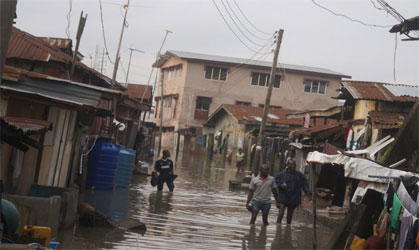
• A flooded section of Akatapo Street, Ajegunle, Lagos last Sunday. Photo by Diran Oshe.
In the wake of the recent flooding of Lagos households, a major risk factor for outbreaks associated with flooding is the contamination of drinking-water facilities, and since it is doubtful if this risk has been recognisedsince the provision of clean water is not essentially a priority.
Flooding of sewage systems couldlead to contamination of neaby river water bodies such as lakes, ponds and streams. Also possible is increased risk of infection of water-borne diseases contracted through direct contact with polluted waters, such as wound infections, dermatitis, conjunctivitis, and ear, nose and throat infections. However, these diseases are not epidemic-prone.
 In areas where ther is heavy rodent population, one major epidemic-prone infection that can be transmitted from contaminated water is leptospirosis – a zoonotic bacterial disease.
Transmission occurs through contact of the skin and mucous membranes with water, damp soil or vegetation or mud contaminated with rodent urine.
Public health experts warn that floods may indirectly lead to an increase in vector-borne diseases through the expansion in the number and range of vector habitats.
For instance, stagnant water from heavy rainfall or overflow of rivers can act as breeding sites for mosquitoes, and therefore enhance the potential for dengue, malaria and West Nile fevers.
According to the WHO, a malaria epidemic in the wake of flooding is common so it would not be unusual to expect a surge in a malaria-endemic area such as Lagos following the recent flooding episode.
The risk of outbreaks is greatly increased by complicating factors, such as changes in human behaviour (increased exposure to mosquitoes while sleeping outside, a temporary pause in disease control activities, overcrowding), or changes in the habitat which promote mosquito breeding (landslide, deforestation, river damming, and rerouting).
Tetanus is not common after injury from flooding, but tetanus boosters may be indicated for previously vaccinated people who sustain open wounds or for other injured people depending on their tetanus immunisation history. P
Hypothermia (abnormally low body temperature) may also be a problem, particularly in children, if trapped in floodwaters for lengthy periods. There may also be an increased risk of respiratory tract infections due to exposure (loss of shelter, exposure to flood waters and rain).
Power cuts related to floods may disrupt water treatment and supply plants thereby increasing the risk of water-borne diseases as described above but may also affect proper functioning of health facilities, including cold chain.
Disclaimer
Comments expressed here do not reflect the opinions of Vanguard newspapers or any employee thereof.