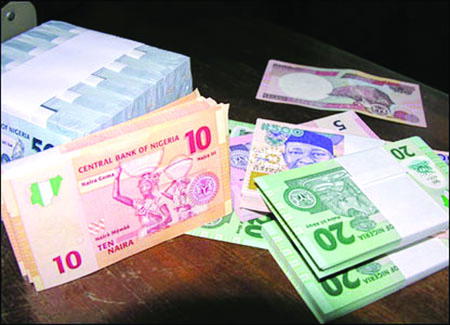
Naira
The Guardian Newspaper’s editorial of Monday, 13th June proffered what it considers a plausible alternative to Central Bank’s recent directive on cash withdrawal/deposit limits with Money Deposit Banks. Indeed, Nigerians have largely been agitated by CBN’s advance notice of daily cash withdrawal/deposits limits of N150,000 and N1 million for individuals and corporate bodies respectively, as from June 2012, in place of current limits of N1 million and N10 million respectively.
The reduced limits have generated a lot of criticism as being inappropriate for the peculiar nature of transactions in our heavily cash dependent economy. Popular opinion is stridently against 10% penalty for violation, especially when the punitive charge is compounded by a host of other traditional bank charges such as commission on turnover, VAT on COT and other charges.
In the event that the 10% penalty charge is also income to banks, an additional 5% VAT charge on the excess withdrawal/deposits may further discourage bank patronage.
CBN’s argument, of course, is that a customer will only incur these oppressive charges when they exceed the specified limits. Well, this may be true, but in a market context where traders’ daily turnover exceed millions of naira consolidated from a host of unfamiliar customers’ purchases, such deposit/withdrawal limits would seem impractical, while cheque payments would reduce speed of transactions; in those cases where buyers come from outside town, the three to four days delays for cheque clearing would be a costly impediment to trade, with the collateral of inconvenience, forced stay in hotels or with families/friends, while waiting for cheques to clear.
The problems become multiplied for the buyer, where requirements are for multiple products from different traders in the market. Similarly, sellers risk additional 10%+ on cost of sales if they accept receipts exceed CBN’s set limits from their customers. Inevitably, traders would increase sales prices by at least 10% to accommodate bank charges for depositing values above the prescribed limits in their bank accounts! Of course, banks would become the main beneficiaries of this arrangement in a farcical market space where customers pay as much as 10% to deposit (as against borrowing) ‘large’ sums of money!!
Well, the question is, why is CBN embarking on such a patently unpopular programme that could destabilize the volume/value of trade with adverse repercussions on an already prostrate economy? Curiously, the directive is not targeted primarily to curb the menace of money laundering or to facilitate the location and movements of funds looted by our ‘public servants’ (read as oppressors). CBN has also not defended the directive as necessary for improved management of money supply or inflation. The categorical imperative as defined in several press releases is to reduce the cost of cash management, which is projected to hit N192bn by next year, as indicated by Muhammad Ndah, Director of Currency Operations Department in CBN at a workshop organized by Chartered Institute of Bankers on Tuesday, 14/6/2011 (see report “Cost of Cash Management Increasing – CBN”) page 21 of Punch Newspaper, 15/6/2011.
The CBN Director noted that, “the cost of cash in 2009 was N114.6bn and grew to N135bn and N166bn in 2010 and 2011 respectively.” Muhammad Ndah submitted that, “as the volume and value of currency in circulation grows, the cost of cash management to the financial system will continue to mount. The total cash related costs, contribute 30% of costs to the financial system and on the average, 30% of branch physical space and employees are deployed to cash logistics, handling and storage”. In other words, if CBN’s cashless programme succeeds, current bank infrastructure can be reduced by upto 30% with savings on rent and or infrastructural maintenance as the case may be; in addition, the banks can lay off upto 30% of their staff and logistics companies who were encouraged to invest in armoured trucks for the safety of cash in transit could similarly trim down their operations with significant loss in jobs and incomes.
In spite of the adverse impact on employment and other providers of corporate support services, ultimately, the banks are the real beneficiaries of the cashless programme! The question is, whether or not the banks appealed to CBN for this special favour. Well, no one really knows, but CBN obviously believes that the reduction in cost would be translated into cheaper cost of borrowing (i.e. lower interest rates to the real sector) (see Punch report). So far, CBN’s convoluting reforms and policies have failed to bring succor to the real sector!
Discerning observers will confidently maintain that CBN appears to be chasing its own shadows, because it is obvious that high cost of funds is in reality the failure of CBN’s inarticulate monetary policy framework rather than cash handling costs. However, in its attempt to reflect itself as a Central Banker with a social conscience, CBN maintains that its cashless programme would be equitable such that high volume cash users would bear a commensurate service cost as it lamented that “90% of Nigerians, who are poor people are subsidizing the 10% who impose the huge cost of cash in the system”. How touching!! Regrettably, CBN does not have any qualms about the N650bn it injected to support ailing banks or indeed, the over N2,000bn sovereign debt incurred by AMCOM’s liquidity infusion into the banks, or indeed, the fact that the banks will be paid interest charges in excess of N500bn from the same government agencies that are providing the above listed financial support to them. Where is the spirit of equity and altruism in these huge subventions to a corporate sector that is patronized by less than 30% of the Nigerian population while the rest 70% are cash distressed?
On the surface, CBN would have Nigerians believe that the cashless project would reduce cost, but in another breath, we are told that 350,000 point of sale (POS) terminals would be deployed before 2015 to support the programme. Well, I do not know how much these things cost, but each terminal with installation, operation and maintenance charges are likely to cost over N1 million each; in simple arithmetic, this would translate to over N350bn!!
The CBN Director Ndah also confirmed that 16 mobile payment service providers have already been issued approvals in principle to provide the telecom back up service for this programme; the related cost of the service would be in addition to the N350bn for the POS!! Certainly, some Nigerians and their foreign counterparts are already positioned to reap abundantly!!
The above costs will be borne by no other than bank customers including the 90% recognized as poor by CBN, who willy, nilly will still pay the current ATM annual charge of N1200 if this fee remains unchanged!
What is certainly clear is that bank customers are in for a drubbing with the imposition of cashless economy and acquisition of hi-tech support apparatus. Now, the question is, since the real instigator of this CBN programme is the perceived high cost of cash management and consequent inability of banks to reduce interest rate, according to the apex bank, is there any other plausible strategy for reducing the volume of cash and handling operations in the economy? In response to this question, the Guardian Newspaper editorial of Monday, 13/6/2011 has suggested that the introduction of higher denomination notes of N2,000, N5,000 and N10,000! Holy Smoke! The idea is that less cash volume would be required if these ‘higher value’ notes join our currency profile.
Thus, a single N10,000 note will replace 10 x N1,000 notes, and N100,000 will be accommodated with 10 x N10,000 notes and so forth. In this manner, you can carry N1 million in each breast pocket and carry over N50m in a small brief case! Well, apart from the inherent heightened obvios security risk with this approach, there is the collateral of enhanced security support services for interbank cash in transit, as a result of the multiplied values in cash movements. The need for enhanced security marks and seals on the higher denominations will also leave a hole in CBN’s pockets with huge forex leakages for overseas printing costs. But, equally important is the evidence of spiraling inflation in those African countries, which adopted this simplistic solution to the cost of cash handling.
The examples of the Ghana cedi and the Zimbabwe dollars are well known! Incidentally, the inflation rate in these countries constantly exceeded 10% annually with high interest rates; yet they did not blame it on cash handling costs as CBN has done, but they recognized inflation as the result of too much money in the system. Thus, introduction of the N10,000 note would support the ready availability of more and more cash in the hands of consumers, which would inevitably spur the general price level. I recall that about thirty years ago, N20 was the highest value denomination in Nigeria, but abiding double digit inflation rate generated the introduction of 50, 100, 200, 500 and 1,000 naira notes, and indeed, the current N1,000 note cannot buy what the muri (N20 note) commanded in the beginning and our primary kobo coins have disappeared.
Nigerians, particularly CBN’s 90% poor citizens should shave their heads in readiness for the guillotine if CBN is misguided to follow the route of failed economies. Ghana trod that path and eventually introduced 20,000 cedis notes, which exchanged for less than $2; that country has since retraced its step but misguidedly tried to resolve the issue of inflation and large volume cash handling with redenomination, but have since found that any relief can only be temporary so long as the underlying cause of inflation is not recognized and dealt with; the Ghana cedis has lost over 50% of its value against the dollar since the redenomination exercise! Our naira value and our cash handling costs will continue to irritate so long as CBN refuses to admit that its capture of our dollar earnings and the substitution of naira is the suicidal factor at the root of inflation and the villain in our costly currency profile. As discussed above, cost savings from the imposition of projected cash limits will be replaced by the huge cost of equipment and facilities required to operate CBN’s cashless economy with attendant adverse impact on employment and trade contraction.
In spite of the normal high cost of cash handling, the banks, including some of the presumed ailing ones continue to post impressive profits results and we wonder why CBN has suddenly become a senior advocate for the banks against the people. In any case, it is baffling why CBN has chosen Lagos as its test market, against the standard practice of adopting smaller consumer groups for test runs before confronting larger markets. But this is Nigeria, where rubbish can be packaged as precious jewels by the establishment.
SAVE THE NAIRA, SAVE NIGERIANS!!
Disclaimer
Comments expressed here do not reflect the opinions of Vanguard newspapers or any employee thereof.