By Rotimi Fasan
LET us begin with a comparison by taking a short trip down memory lane. Our comparison makes a strong statement about the democratic credentials of both individuals involved and, to some extent, their relative suitability for the position of president for which they both sought the support of Nigerians recently.
Within days of his becoming Head of State in 1984 Mohammadu Buhari, a Major General in the Nigerian army, responded to an interviewer’s question on what he thought of Nigerian journalists and press freedom in general. His answer was unequivocal just as his hostility was not veiled.
Without mincing words Buhari vowed with every solemnity he could muster to ‘tamper’ with the freedom of the Nigerian press. His regime wasted no time thereafter in promulgating the infamous Decree 4 which sought to protect public officers by recommending a jail term for a journalist that wrote anything that could be remotely seen as embarrassing to a public officer.
In one fell swoop General Buhari inverted the very basis of a free press and one of the foundational principles of a democratic society. Not even the Official Secret Act upon which principles the public service has for long been sustained, variants of which the colonialists used to muzzle nationalist agitators- not even this Act had the draconian reach of Buhari’s Decree 4.
In no time at all two journalists working for the Nigerian Guardian, Tunde Thompson and Nduka Irabor who would later go on to be a legislator in the Federal House of Representatives, ran foul of the decree and were summarily, to use another favourite term of the military, sent to jail against local and international protests.
Buhari would follow this up with the setting up of military tribunals that sent many corrupt politicians and others the regime simply did not like to prison terms that were longer than several lifetimes in very harsh conditions.
Roll forward to 2011, some 27 years later and both Buhari and Goodluck Jonathan would stand before Nigerians to seek their votes to become president in a democratic contest. Buhari who had carefully preserved his unbending, iron-man reputation over the many years since he was ousted from both the military and power in a barrack coup would lose once more.
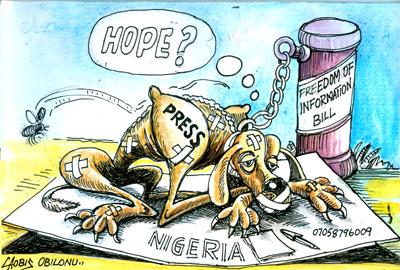
It was his third defeat in as many contests. The only difference is that his latest defeat was followed by an orgy of violent reaction by his supporters who seemed to have been acting out a script. Jonathan won the election and one of his first acts after he was sworn in as president on May 29 was to give presidential assent to the Freedom of Information Bill that had been languishing in the cold for several years.
The FOI Act had been made to look like a law intended to sanction unbridled intrusion into the private activities of politicians. In 2007 President Obasanjo, another reconditioned politician and democrat who earlier functioned as a military head of state, refused to sign the bill into law. It’s easy to imagine, given his antecedents, that Buhari wouldn’t have given assent to the FOI Bill had he won the presidential contest.
But Jonathan has done it, arguably, not as a populist gesture but as someone with an intellectual appreciation of what the Bill is meant to do.
In its travails through the corridors of power it’s not impossible that the true intent of the FOI Bill is hardly understood by the very people who had stood in its way. Yet the Bill seeks no more than to make public officers at once accountable and responsible to the electorate. It makes it mandatory for public officers or others in possession of sought information to provide them within seven days.
This is a great leap forward in our democratic ascent. No more can civil servants or others hide behind the Official Secret Act and such other laws to urge every civil servant, public officers and politicians to ‘keep our secrets secret’.
The books can now be opened for scrutiny, at least in principle. Those governors, senior officials and politicians said to be signing financial documents with their left hands in order to avoid detection may no longer find it easy. But we do know, as Nigerians, that matters are not as simple as that.
There would still be people holding on to principles of the old regime, refusing to provide information where they are sought. Such people would not always be politicians or top public servants. There would still be the old civil servants that have refused to change with the times. People like that should not have a part in the new dispensation.
They should, to borrow a cliché, either ‘shape up or ship out’. Even at that the matter is not settled. The passing of the FOI Bill into law imposes responsibility on journalists too. The era of lazy journalism is at an end. No more can somebody sit back in their newsroom to manufacture stories and cook up facts. This, it would appear, is the aspect of the journalistic trade that opponents of the FOI Bill dreaded.
In giving his assent to the FOI Bill President Jonathan is challenging Nigerians to stand up for the defence of their democratic rights and aspirations. The field has been opened to all to become more than arm chair critics of the system but active participants in the development of a new political culture.
Constituents who see their representatives as failing in their duties or short changing them now have the right to call for the records and insist on full disclosure of issues, especially with regard to the management of their resources.
In a country where many are not literate enough to know their rights or know of the existence of certain provisions of the law except only when they run foul of such provisions, there would be need for effective enlightenment of the electorate.
People should be made aware of the provisions of the FOI Act to give them opportunity to fully take advantage of it, and politicians and departments of government responsible for public enlightenment as well as the press have a major role to play in this regard. Nigeria might just have entered another phase in her democratic growth.
Disclaimer
Comments expressed here do not reflect the opinions of Vanguard newspapers or any employee thereof.