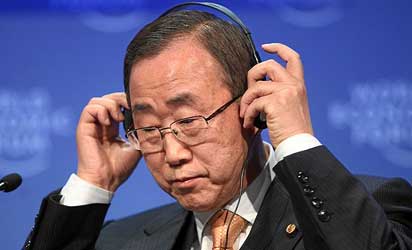
Ban Ki-moon
By John Amoda
THE UN Secretary General has formally initiated his bid for a second term having made his intention known by due process to both the Security Council and the General Assembly.
The General Assembly may support or not support his candidature- it is, however, the Security Council that can appoint him for a second term. This last statement is not exact enough. True indeed that all the 15 members of the Security Council can vote for him but any veto of the five permanent members is enough to deny him a second term.
So it is correct to say that under the present Charter of the UN, only the concurrence of the five permanent members can effect the appointment of the UN Secretary General. So the election process does not settle the matter.
It only serves as an indicator of the general acceptability of the UN Scribe when the whole of the Security Council approves through vote cast for this incumbent. It is reported that he may have his wish granted seeing that there is no obvious objection by any of the permanent members to his desire to serve for another five years when his present term expires December 31, 2011.
The Guardian of Tuesday June 7, 2011 reports that President Jonathan Goodluck may be one of two African President participating in a meeting on his application for a second term. While the reappointment of Ban Ki-Moon may be a forgone event, the Security Council that will be making the appointment appears strategically directionless in the so-called Third World. That is the global region within which its global strategic relevance is to be appreciated.
There is no doubt that as an institution of international security diplomacy, the Security Council is important both as an organ and as a global diplomatic platform. However, while the Security Council is important, its relevance in global security diplomacy is highly restricted. Its role in the Americas and the Caribbean and NATO Europe is contingent on the support of the US.
Ditto for the Security Council in the sphere of strategic interests of the other four permanent members. This is why the concurrence of the five permanent members is so important a factor in determining the relevance of the Security Council anywhere. The relevance of Ban Ki-Moon’s tenure in office is to be appreciated in terms of the institution of which he is the CEO.
What are the limitations of the Security Council in the world in general and in Arab and Africa’s Third world in particular? How do the democratization unrest in these regions define the capability and relevance of the Security Council?
Current events in the Maghrebs, Middle East and in the ECOWAS sub-region are being handle by the Security Council by reasoning informed by provisions in Chapter 7 of the UN Charter. According to the Charter, the security crises in these regions ought to be resolved by the provisions of Chapter 8.
Chapter 8 is inserted in the Charter because of the supposition that distinction can be made between threats to the global peace to be defended by provisions of Chapter 7 and local disputes which are amendable to pacific resolution.
The Charter identifies the sources of threats to the global peace as the Enemy States, the Axis Powers defeated by the Allied Powers in the War brought to an end in 1945. The authors of the Post-World War II international orders believed that local disputes were essentially residual and are matters concerning how common ends are to be implemented.
Thus they were disputes about means, not about ends or purposes. Not so the global conflicts addressed by Chapter 7, which were as perceived conflicts over world orders. Chapter 7 was to defend the Allied Power’s World Order vulnerable to threats posed by the Axis Powers.
Post- World War II events culminating in the Cold War has made critical review of Post-World War II statecraft design necessary and needful. The absence of consensus among the Allied Powers instanced by the Cold War is still the principal hindrance to the commencement of such review. In the place of reform informed by strategic appreciation of premises we have the continuation of the tradition of extra-charter improvisations legitimated by recourse to the Charter.
The present societal upheavals in Africa and the Middle East call for this statecraft review. Providing leadership for such review should be one of the planks of the New Foreign Policy Initiative of Jonathan Goodluck Presidency and the support of a second term for Ban Ki-Moon should be premised upon reciprocal support for such a review.
Disclaimer
Comments expressed here do not reflect the opinions of Vanguard newspapers or any employee thereof.