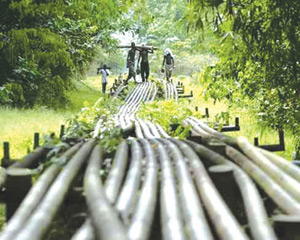
Oil-pipeline
By Anayo Okoli
UMUAHIA—AS part of the effort to reduce tension and conflict between government and oil-producing communities, a civil society group, Afrihealth Optonet, in collaboration with the United Nations, would soon begin the training of over 1,620 youths selected from the nine oil-producing communities of the country on how to engage the government on the development of their various areas.
Known as Sustainable Citizen Participation, SCP, in Nigeria’s Niger Delta Region, the project is funded by United Nations Democracy Fund, UNDP, with the aim of empowering civil society groups in oil communities to engage with government on a regular and sustained basis for the achievement of sustainable developmental goals in Nigeria.

Oil-pipeline
The projects would be purely rural based and the civil society groups would be working with youths and other stakeholders in the 81 local government councils of the nine oil producing communities. The value of the project is put at $242,000.
In Abia State, nine council areas of Umunneochi, Isuikwuato and Bende, Umuahia North, Umuahia South, Ikwuano, Aba North, Aba South and Ugwunagbo have been chosen as pilot project areas.
Development, Dr. Hagler Okore, Adirieje said, “we are implementing the SCP in nine states of Niger Delta, in each of these nine states; we are taking three local governments per senatorial zone. The nine states have 27 senatorial zones. So we are taking 81 local governments in the 27 senatorial zones”.
He told the commissioner that “in each local government, we take one civil society organization (NGO) which is a member of Afrihealth and we work there to implement this SCP by mobilizing the community in order to create a synergy in citizen participation in governance and synergize with the state and local government, particularly at the local level, to ensure that projects and development matter that are greatest need of the community people are taken care of”.
The project, he further explained would enable communities to select projects they actually needed instead of Government building for them projects they do not need.
“I will give you an example; there is a state I know where they don’t have functional Public Health Centres but they have a Federal Medical Centre that is working very well but underutilized. The state government went beside the Federal Medical Centre and built a Specialist Hospital with so much money that will do the same thing the FMC is under doing already, instead of going into the local government to spend that money and do more things.
“We have places where people are building schools when what the community really needs are roads to the stream, to that farmland. So with this project the community will be involved to say what really they need, in order of priority”, Adrireje said.
In his remarks, the commissioner for youth development, Hagler Okore commended the group for the project and expressed the readiness of the State to key into it.
Okore said that his ministry has over 1000 registered youth organizations which would make it easier for the NGOs to connect the youths to work with.
Disclaimer
Comments expressed here do not reflect the opinions of Vanguard newspapers or any employee thereof.