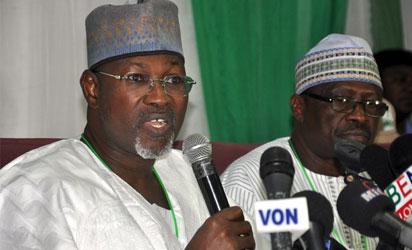
Presidential Election : From left, INEC Commissioner, Engr. Dr Nuru Yakubu, INEC Chairman Prof. Attahiru Jega and INEC National Commissioner Col. Mohammed Hammanga (rtd) addressing Pressmen on Presidential Election in Abuja. Photo by Gbemiga Olamikan.
By Patrick Dele-Cole
Before we forget in the euphoria to get rid of PDP, we must ask questions about the conduct of the last elections.
Who had what contract? Was it to produce permanent voter cards (PVC)?
What did the contract say?
Who signed the contract to produce PVCs?
The contract will have a cost, and time element, a payment schedule, and consequences to meet that schedule, bank guarantees from the contractor that, if he fails, his money is forfeited and the bank will lose thereby making the bank an interested party to see that the contract is performed.
There is nothing new about biometric and finger printing to capture the details of people. Such a liability was placed on the GSM companies and over 100million Nigerians were so captured.
Now CBN has asked for similar exercise called the BVN. INEC could have piggybacked on both exercises and obtain the information needed free of charge, instead of the trillion Naira it spent which it has not properly and probably cannot account for.
You may counter and say that in the GSM finger and biometric exercise, many Nigerians had more than one phone, and so there was duplication. But this is nothing for the computer to sort out; repeat finger prints and biometric identities would simply be eliminated. In the CBN BVN, one number will be peculiar to one account holder and no duplication will be possible. The point is to tie some product to a person which has a number, photograph, finger print, a product that is ultimately valuable to the person as it is unique, verifiable by anyone. The PVC is not.
Politics may not have allowed Professor Jega to profit from the data bases already in existence. That same politics has now destroyed beyond repair the concept of a PVC, which, judging from the last elections, was ignored with complete abandon by officials in very many places. I am not saying it should be discarded. It would form one of the verification layers that we need to know in properly courting ourselves. That there was no credible election in Nigeria 2015-was predicted by me, no one else is willing to look at a gift horse in the mouth.

Presidential Election : From left, INEC Commissioner, Engr. Dr Nuru Yakubu, INEC Chairman Prof. Attahiru Jega and INEC National Commissioner Col. Mohammed Hammanga (rtd) addressing Pressmen on Presidential Election in Abuja. Photo by Gbemiga Olamikan.
The result that Buhari won is accepted; PDP was due to be replaced. Or if you prefer, Mr. Jonathan was due to abdicate.
Poor history
But let’s look at the facts. Nigeria has a poor history of numeracy i.e. counting. No census has ever been accepted but this does not mean that some of the figures were incorrect or, even if so, not useful. Abuja is full of data bases under the Ministry of Internal Affairs, sitting in air conditioned ware houses for a very long time.
Nigeria had census in 1952, 1972, 1992 and 2002. We need therefore to use other data bases to validate and verify what we have.
Will school enrollment not help in mapping our demographics? Secondary, primary, tertiary institutions, banks, GSMs food production, water consumption, transportation etc are other indices of demographics. We have finger printing and photographs for driver’s licenses too.
Boil these down, condense all the above to an acceptable irreducible minimum. We need this to even begin to plan our economy, to know where to grow, what to grow when to grow, when and where to go, etc.
And then build from there. But there must be the political will to find out how many we are, what we eat, where we go to work, school in, how we live, etc. Each time we mention population, the old shibboleths are out in force. My journalist friends have heard me rail in full throttle about their lack of professionalism about Chibok and the whole of the North-East and Boko Haram. In Lagos, Ibadan, Umuahia, Port Harcourt, etc are tens of people from Chibok. Who has interviewed them? We must know how many tons of maize, cassava, millet, yam, Nigeria has had since Chibok. Is there a greater story than yams, cocoa, palm produce, rubber, cotton, Chibok? The Sambesa forest is depicted as a no-go area, etc. We need to know to plan properly. An evil forest that would eat you up, that is a Nollywood motif. Do we even accept the mysteries of this forest? If so, who did the voters registration there? How could they? They have no brothers and relatives. INEC would have to produce every evidence of registration in the whole of the North-East, Bayelsa, Rivers, etc. I have been a politician and can say with no fear of contradiction that since President Shagari’s days there has been no election in Rivers, Bayelsa, etc., regardless of the opinion of international observers.
No Nigerian journalist has been to the North-East since Chibok.
No brothers of Chibok girls, no list of Chibok girls, nothing. No group disappears like that if it has not been wiped out in a pogrom.
International observers are camouflage to cover an inconvenient truth.
Recently, the Nigerian Army found 300 odd women and children, I guess with PVC! This beggar’s belief. The Ijaw during the Niger Delta militancy can discover any amount of villagers politically whenever. The bottom line is we know the insurgents, can trace their family trees, etc. The Sambisa forest is not some unknown place waiting for a Mungo Park. Yes, it is a forest reserve like so many the British built in other parts of Nigeria – in Enugu ( Milliken Hill), Ibadan, Ilorin, Kaoluna, Ikom and Ogoja, Bauchi, etc. But these forest reserves have people employed to look after them. Their children go to school, and are treated when sick. Moreover, the British established the Sambisa forest reserve, then to be certain that a map of it exists somewhere. Do they not have local government? Are local government councillors not collecting money there? Are there no schools, clinics, administrative officers? Do they not have members of the state and national assemblies? Are there no banks, no local government treasuries, no fertilizer depots, or ordnance maps? If there are, who drew them, when were they updated and, if not, why not? What is this secret wall of silence? Is there no identity kit, photograph of Shekarau or any Boko Haram militant?
What are the security implications of having large areas of Nigeria with no police, no dungarees, no dongaris, no administrative units, and no military? Yet they have schools, otherwise we would not have Chibok girls missing? To have secondary schools means there must be a network of primary schools. What have the states of Yobe, Borno and Adamawa been doing with part of the 2% education grant distributed by the Federal Government?
Rigging
There was too little information from the North-East yet PVCs were fully distributed: there was a state of emergency. If it was during the militancy of the Niger Delta, no one would believe that Youth Corpers went there and distributed PVC. You could not.
On election day, March 28, people were killed by bomb in Gombe while waiting to cast their votes, the same was repeated in Plateau, yet there was voting there! I know Nigerians like democracy but to go out and vote after bombing polling stations is taking credibility too far.
The reaction after the presidential election goes to show that only Mr. Jonathan changed in this election. The results at the gubernatorial and the national and state Houses pools have been full of bitterness; we were back to square one. Throughout Nigeria, there were guns everywhere and the security forces did well to control the situation. Speak to all who voted and over 70% could have one tale or another; ballot boxes snatched, money freely changed hands: speak to bankers and let them tell us how they scrambled to find cash because of the heavy demand for money despite CBN rules: where Naira would not do, there was liberal gifts of foreign exchange.
In conclusion, the PVC discarded, wide spread rigging characterized the elections.
Under aged people in line with the PVC, over counting, double voting; all the old characteristics of elections were not abandoned. All parties engaged in them.
There would be many who would pretend otherwise. We do so at our own peril. We do not trust ourselves. In the South of Nigeria, no one accepts the figures from Kano, Yobe, Sokoto, Borno etc as authentic. Nor do the people from those northern states accept the figures of Rivers, Bayelsa, etc.
From 2013, Mr. Jonathan had lost the presidency. One third of the area of Nigeria paid little attention to him as he and insurgents competed for power in the North-East, a quick time line would show just how much the President was incapable of stamping his authority on Nigeria. Boko Haram struck any where, anytime, at will.
What Jonathan should have done was to invoke Section 135(3) of the Constitution of Nigeria which provides for a situation where a section of Nigeria was at war. If the President considers that holding election was impracticable, he should make such view known to the National Assembly who, by a resolution, could extend the tenure of the President and themselves by six months; subsequent extension could be obtained, if necessary, for further six months.
Mr. President Jonathan did not do this or could not do because of the pressure he was under and, perhaps, he wanted to get out while the going was good. If the President had gone to the National Assembly and obtained a six-month extension, that would have invalidated all the primaries hitherto, including his and Buhari, i.e., a choice between two disasters, between a rock and a hard place. We would then go back to the drawing board, try to institute party democracy that would have saved us from the Hobson’s choice of Jonathan or Buhari. We would have had time to demonstrate how the PVC worked, suggested to INEC the utter futility of waiting for accreditations, and then voting when these two steps could be achieved in one seamless move; engaged local and state radio stations, T.Vs, social media to publish results as have been pasted on each polling booth. Nothing will increase credibility in the electoral system more than early announcement as and when voting is completed.
Please do not cancel the results. But regard this as an eye opener. I cannot say it would not happen again. But if it does…
Disclaimer
Comments expressed here do not reflect the opinions of Vanguard newspapers or any employee thereof.