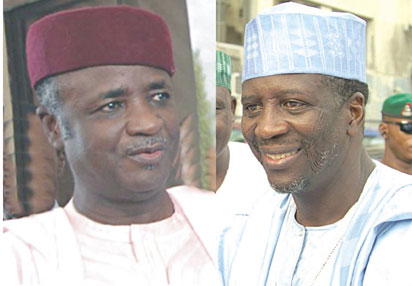
Wamakko and Bafarawa
By AMANZE OBI
The week just gone by was particularly busy for me as a political journalist. Those were the days I had to criss cross the south and north of the country in the bid to appreciate better the content and complexity of the Jonathan campaign.It all began in Imo where Jonathan’s campaign train had stopped over last Saturday. Thereafter, I trailed the campaign train to Sokoto. All this afforded me the opportunity to have a personal feel of the campaigns.

Wamakko and Bafarawa
While I was in Owerri for the president’s visit, I used a number of platforms, including radio and television, to tell the story of the Jonathan Presidency. The narratives served as an eye opener to many who, hitherto, were ignorant of the bag of luck that Goodluck is. I do not want to repeat myself here. Suffice it to say that the people of Imo State were convinced, more than ever before, on the need to continue to cruise on the victory bandwagon which the Jonathan continuity mantra represents.
After the Imo experience, I trailed the campaign train to Sokoto where I came face to face with brand new realities about the politics of the state which many are unaware of. I have witnessed a number of presidential visits to Sokoto state, beginning from the era of General Obasanjo. But the crowd of enthusiasts that filed out to receive President Jonathan four days ago made my earlier encounters look like child’s play. The rally was the second that I have witnessed in Sokoto under the Jonathan presidency.
The first was when Alhaji Attahiru Dalhatu Bafarawa, the former governor of Sokoto State, was to join the Peoples Democratic Party (PDP) in February last year. It was heralded by a presidential visit. President Jonathan was in Sokoto to receive Bafarawa and his teeming supporters into the PDP. I was a witness to that event.
At the reception rally last February, Bafarawa had told Jonathan not to lose sleep over Sokoto. He told the president that he and his supporters would deliver the state to the PDP in 2015. Almost a year after, the time to make good the promises have come. Jonathan therefore had to return to Sokoto. He had come to solicit for the people’s votes to enable him return as president. He had to connect with them personally again as he did a year ago. But much more than that, it was an occasion for Bafarawa to tell the president how much support he had rallied for him since last February.
For any observer of what transpired in Sokoto this Monday, the story was a simple one to tell. The mammoth crowd told all the story. The expansive Shehu Kangiwa Square, venue of the occasion, was bursting at the seams. The sea of heads made what we have been witnessing elsewhere look like mere rehearsals.
The people of Sokoto state turned out in their large numbers as a testimony of their belief in and acceptance of the Jonathan administration. In fact, the mammoth crowd made Bafarawa’s story an easy one. The people have told the story for him with their exuberant support and displays. But he still needed to say it in his own words.
When it was time for Bafarawa to talk, he dutifully reminded Jonathan of what he (Bafarawa) said a year ago. He had told Jonathan then that Sokoto, thenceforth, belonged to PDP. That he was going to get the people of the state to vote massively for Jonathan in 2015. Bafarawa had to reiterate it again. And nobody who was part of the occasion, including the president, had cause to doubt him. Sokoto, from what we saw, is clearly on the side of Bafarawa and the PDP team at all levels of the election.
If you are a keen follower of politics in the state, you cannot but wonder what has happened to Governor Aliyu Wamakko and his supporters. How did the governor burn out the goodwill he once had?
To address this issue, we must cast our minds back to how Wamakko found relevance in Sokoto politics in the first place. Let us recall that Wamakko was an accident on the Sokoto political landscape. The Obasanjo presidency used him in 2007 to upstage Bafarawa, the then outgoing governor, who had turned down Obasanjo’s entreaties to join the PDP.
The manner of Wamakko’s emergence was bad enough. He was a product of treachery. But it was worse that the governor, on ascension to power, used his office to undermine his successor. Bafarawa has had to live with the humiliation from Wamakko for nearly eight years now. But judgement day is fast approaching.
The politics of the last eight years has taken a toll on the development and growth of the state. Rather than embark on people-oriented programmes and projects, Wamakko chose to pursue hate and vendetta. After eight years of shadow-boxing, the people are now asking questions. How did they come to this dangerous bend? Why and how did good governance take flight from the state?
To situate the situation, the people are now making comparisons. They have cast their minds back to the Bafarawa era and are feeling nostalgic about it. They remember the hundreds of kilometres of roads that Bafarawa gave them. They remember the life-changing, people-centered projects of the Bafarawa era. Those good old days are not just gone, the present offers no hope. Consequently, disenchantment has set in. The people are protesting. They are seeking a way out of the quagmire.
Fortunately for the people, the PDP has presented them with a viable alternative. Those who are not close enough to the state would think that the name, Senator Abdalla Wali, sounds distant or unfamiliar. That is the PDP governorship candidate in the state. He is the man that promises to restore hope to the people of the state. He promises to bring about a change that the people will be proud of.
But Wali is not just any name. He is a technocrat who rose to the highest levels in the corporate world before the tour of duty took him to the Sokoto state civil service. He forayed into politics during the Abacha era and contested and won election to the still-born House of Representatives at the time.
He was a senator of the Federal Republic between 1999 and 2003 and was the first Senate Leader at the time. He was also the first Minister of National Planning under the Obasanjo presidency. Wali’s latest public office was that of Nigeria’s envoy to the Kingdom of Morocco, a position he relinquished in October last year to stand election as governor. He is bringing this rich pedigree into the contest.
Indeed, the duo of Bafarawa and Wali pose a serious threat to the reign and rule of Wamakko and his followers. Whereas Bafarawa would tell you that there is no basis for comparison between him and Wamakko in politics, Wali sees both Wamakko and his anointed candidate, Aminu Waziri Tambuwal, as junior politicians who operated “under us” before their accidental elevation. For Wali therefore, both Wamakko and Tambuwal remain political feather weights who will easily cave in when confronted with the dexterity and sagacity of the Bafarawas, and now, Walis of Sokoto state.
In fact, the story in the streets of Sokoto is that the 2015 contest is essentially between Bafarawa and Wamakko. It promises to be a show of political strength and superiority. But for Bafarawa, the election will be a no contest because, as he puts it, “Wamakko is my student.” Bafarawa does not see how a student would constitute a challenge to his teacher in the area of knowledge. Such a student-teacher equation cannot balance.
Then when you introduce Tambuwal into the mix, the people concerned simply laugh. They tell you that this Tambuwal you people talk about is not known beyond the two local government areas that he represents at the National Assembly. They will also tell you that Tambuwal is a creation of Abuja and that his popularity, if he has one, does not go beyond Abuja. The people of Sokoto state hardly know him and cannot reckon with an unknown quantity.
Besides, Wali easily dismisses Tambuwal because, as he put it, he (Tambuwal) is operating under the shadow of Wamakko. Since the people are disenchanted with Wamakko, they also will not be properly disposed to whoever he anoints. The point being made is that Tambuwal would have fared better if he were not operating under the tutelage of Wamakko. Such is the permutation. In a matter of weeks, the supremacy contest will graduate to the realm of practicality.
Disclaimer
Comments expressed here do not reflect the opinions of Vanguard newspapers or any employee thereof.