By Prince Osuagwu
The National Information Technology Development Agency, NITDA, has sprung to action in the new year, strongly indicating its desire to upscale its capacity building efforts through training and research of government agencies and departments.
 The agency also promises to continue the broad objectives towards boosting Nigeria’s ICT capabilities and skills in the year 2015.
Part of NITDA’s new year resolution, is to establish research fund to
sponsor ICT focused academic research projects for Nigerian scholars and educational institutions across the world.
NITDA’s core mandate is developing ICTs in Nigeria, and this, the Agency said it has been implementing through training Nigerians across all strata and investing in researches to increase the country’s knowledge base in ICT innovations, especially in the area of software development.
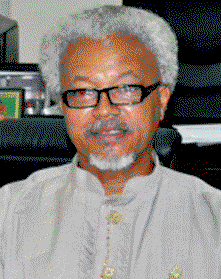
In a likelihood of a new year message in Abuja, the agency’s Director General, Mr Peter Jack, said that in 2015, his agency will explore its ACT which mandates it to
proactively assist Nigerian governments, agencies and companies to improve
their processes and product quality, adding that this has been its focus through its initiatives of trainings and re-training programmes, which
many Nigerians have benefitted from.
However, he promised that to increase the tempo and fast track the nation’s development with technology, the agency, this year, will raise the bar on its ICT training programmes.
NITDA’s training focus, Jack said, can also be seen in the establishment of technology incubation programs, rural ICT programmes, ICT clusters and other IT development networks, which are been used to stimulate the growth of the sector.
The NITDA DG said that in broadening the scope and focus the Agency is undertaking in 2015, he had seen a companion in the 2014 E-Government Survey tagged ‘E-Government for the Future We Want’, where the United Nations noted that “E-government and innovation can provide significant opportunities to transform public administration into an instrument of sustainable development.”
Jack said that “the opportunities offered by the digital development of recent years, whether through online services, big data, social media, mobile apps, or cloud computing, are expanding the way we look at e-government.”
He also claimed that NITDA was taking the issue of capacity building in government circles seriously in order for Nigeria to key into the UN agenda, adding that while providing all the necessary incentives to encourage the use of information technology in all spheres of life in Nigeria, it will also ensure that government and its agencies adopt a transparent and open way of doing business.
Disclaimer
Comments expressed here do not reflect the opinions of Vanguard newspapers or any employee thereof.