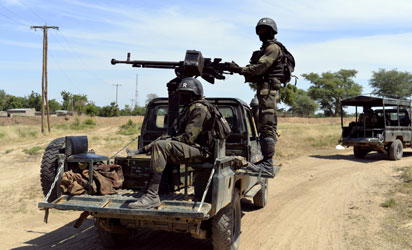
File: Cameroonian soldiers patrol on November 12, 2014 in Amchide, northern Cameroon, 1 km from Nigeria. The city was raided by Islamists from Nigeria’s Boko Haram, killing eight cameroonian soldiers and leading the population to flee on October 15, 2014, before another six coordinated attacks that killed at least three civilians in the remote north of the country, on November 9, 2014. Boko Haram’s five-year insurgency in neighboring Nigeria has left thousands dead, and the Islamists have occasionally carried out attacks over the border. Cameroon has deployed more than 1,000 soldiers in the extreme northeast of the country to counter the Islamist threat. AFP PHOTO
By Caleb Ayansina
ABUJA—The Federal Government, yesterday, gave reason for the cancellation of the training of Nigerian soldiers by American security experts, attributing it to logistic problem.
The U.S. Government, through its Embassy in Abuja on Monday said in a statement that “At the request of the Nigerian government, the United States will discontinue its training of a Nigerian Army battalion.”
But Nigerian government explained that it did not cancel the training, but that the condition placed down by US government was not healthy for the security of lives and property of its citizens, particularly those in the north east region.
The conditions, according to it, include withdrawing of some military equipment from the battle field, so that the American could use them to train the soldiers.
The Coordinator of the National Information Centre, Mr. Mike Omeri, who stated this during a routine briefing on security situation in the country, in Abuja, said the government would not expose its citizens at the mercy of insurgents because it wants to train its solders.
However, Omeri maintained that the two countries were not at variance as being insinuated by some people in the country. “Nigeria and America have strong military relation till date. It’s still ongoing and strong,” he said, disclosing that Nigerian soldiers had concluded two phases of the training out of the three.
Omeri explained that the third phase had to do with logistical components which the Americas did not provide but instead relied on Nigerian Military equipments, which was currently in use in the troubled states.
Disclaimer
Comments expressed here do not reflect the opinions of Vanguard newspapers or any employee thereof.