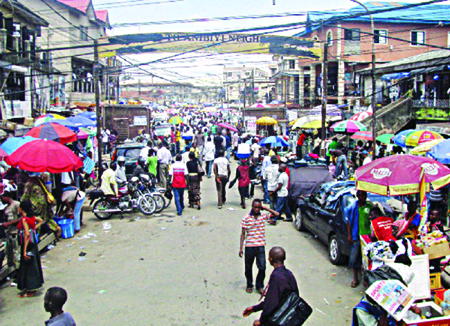
One of the busy streets in the Computer Village Ikeja, Lagos
By Henry Boyo
The above title may seem out of place in the wake of the launch of “Nigeria’s Industrial Revolution Plan” (NIRP) by the Jonathan administration in February this year. The NIRP is clearly a recognition of the embarrassingly modest contribution of manufacturing (less than 7%) to our Gross Domestic Product; conversely, the contribution, for example, of the services subsector has grown from about 23% in 2011 to a robust 52% by 2013 without any significant job creation component!
According to President Jonathan “the NIRP and its sister project, the National Enterprise Development Programme (NEDEP) will address the constraints that have consistently inhibited the growth of manufacturing by building industrial infrastructures, prioritising power for industrial use, reducing borrowing cost and mobilising funds for the real sector to produce and reduce the drain on our reserves…”
Subsequently, at the inauguration of the Presidential Advisory Committee on NIRP in May 2014, Mr. President tasked “the manufacturing sector to work harder to add value to Nigeria’s produce rather than just exporting raw materials”, as “no country has ever become prosperous, only by extracting and exporting its raw materials.”
However, the question is whether Mr. President’s noble vision is supported by the actual reality on ground, or could this also be another ‘feel good’ propaganda in the manner of earlier failed projects, such as Operation Feed the Nation, NEEDS, SEEDS, and visions 2010 and 2020 programmes respectively?
It may be too early to make a call on the possible success or failure of NIRP and NEDEP, but some observers may insist “that the morning shows the day”; consequently, such critics may refer to recent developments that could conscribe the NIRP and NEDEP programmes to the dust bin.
Early in December 2014, the CBN Governor, Godwin Emefiele, unexpectedly reneged on his earlier assurances to maintain Naira exchange rate at the 5 year rate of about N155=$1, consequently, the Naira now trades at between N165-N173/$1 at the official retail Dutch Auction window with CBN; however, these ‘premium’ rates seem only applicable for government transactions; thus for example, the CBN would substitute a minimum of N165 for every $1 of distributable dollar denominated revenue, before sharing to the three tiers of government, a process that, incidentally, instigates the poisonous economic burden of excess liquidity!
There are already allegations by manufacturers that their forex bid for importation of raw materials/inputs were directed to the interbank window, where the dollar currently exchanges for close to N190/$1, i.e. about 30% more than what manufacturers paid for their dollar requirements barely a month ago!
Regrettably, the current demand pressure may likely push the interbank Naira exchange rate above N200=$1, with disastrous consequences for the funds requirement of the real sector. Thus, a manufacturer who usually required N100m for imported raw materials/inputs, will now require upto N130m to buy the same inputs if the Naira exchange rate approaches N200=$1.
Worse still, the same manufacturer who barely survived the burden of borrowing N100m with 20% interest rate, may unfortunately, now need to borrow N130m, with possibly higher cost of funds to remain on the same spot. Meanwhile, the Nigerian manufacturer still carries the burden of providing his own power as well as provision of access roads, security and other extraneous expenditures to stay in business. It is a no-brainer that, ultimately, Made-in-Nigerian products will certainly be more expensive, than the imported, finished or intermediate equivalent.
Furthermore, the inflation ravaged income of Nigerians may not be enough to persuade a patriot to buy Made-in-Nigeria goods because of the relatively higher price. Instructively, all income earners including the N18,000 minimum wage earner lose 40% of the purchasing power of their incomes every 5 years at the current annual average inflation rate of 8%!
Some Nigerian may recall that several event centres, churches and mosques that dot our landscape were once vibrant factories whose ‘lives’ were truncated by the series of Naira devaluations under SAP; indeed the proliferation of more carcasses of such factories is a clear indication that the Nigerian industrial landscape is probably still a long way from where it used to be between 1983-93. The SAP devaluations not only decimated our industrial base, but also led to a disruptive and retrogressive brain drain as Nigerian professionals exited our shores in droves in order to protect their lifestyle and dignity.
Consequently, the latest round of devaluations may be seen as an unwelcome de ja vu as it portends another cycle of social oppression and industrial embattlement which certainly run counter to President Jonathan’s vision of transforming Nigeria’s manufacturing sector with NIRP and NEDEP.
In a related development, ECOWAS member states ratified a Common External Tariff (CET) Protocol in Abuja on the 15th of December 2014. The CET was curiously, sponsored by the European Union under the umbrella of an ‘Economic Partnership Agreement’ (EPA). Clearly, under the provisions of CET, European and other import sources of both raw materials and finished consumer goods will have unhindered access to ECOWAS markets, with Nigeria (with close to 200m population and relatively superior consumer demand) as the prime destination!
Under the CET, ECOWAS countries can no longer seriously protect local industries, and indeed the highest tariff category of 35% is for a limited range of goods for which ECOWAS countries have proven capacity to produce. This rather lopsided ‘partnership’ has been described as an Enslavement Partnership Agreement by some observers, because, Made-in-Nigeria products will obviously have no chance against more competitive imports from those countries with the established requisite infrastructure, such as adequate and competitively priced power, very low cost of funds (between 3-7%) as against 20-25% rate of interest to Nigeria’s real sector.
In the light of the preceding, President Jonathan’s is clearly misguided in his expectation that with NIRP and NEDEP, Nigeria will replicate China’s industrial revolution and become a credible world class economy. Instructively, China did not carelessly throw open its borders for a pot of pottage of EU 6.5bn which was promised 15 ECOWAS member states by the European Union over the next five years.
Indeed, China’s industrial incubation lasted for over 20 years, during which time they quietly developed their local industries and only systematically opened up its market as Chinese industry developed sufficient skill and muscle to compete with imports from anywhere.
As it is, with the ratification of the ECOWAS Common External Tariff and the economic destabilisation related to the present Naira devaluation, we may just have sold the future of Nigeria’s manufacturing sector to our economic oppressors, and we may ultimately just remain a country with a bourgeoning services subsector with minimal jobs opportunities and deepening poverty.
Save the Naira, Save Nigerians!
Disclaimer
Comments expressed here do not reflect the opinions of Vanguard newspapers or any employee thereof.