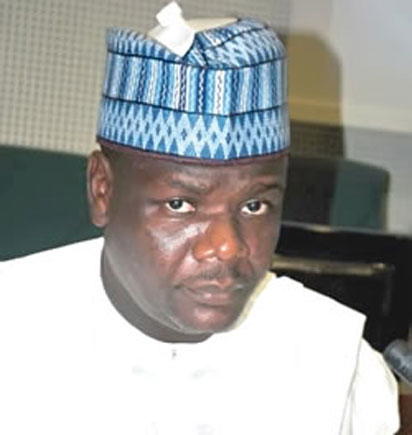
By Emman Ovuakporie
Honourable Kaka Kyari Gujbawu, representing Maiduguri in the House of Representatives, is a Peoples Democratic Party (PDP) governorship aspirant in Borno State. In this interview, he speaks on the request for the extension of emergency rule in three North-east states of Adamawa, Borno and Yobe by President Goodluck Jonathan, declaring that the issue should not be politicised.
Excerpts:
What makes you feel you can govern Borno State?
It is going to be an onerous task to become a governor. If elected, one, you need to rebuild the battered socio-economic life of the people of this state. You need to work on the psyche of the traumatised people of the state. Anybody who sits somewhere and tells you ‘this is what I want to do to fix Borno State in the next two or three years’ will be dreaming.
Borno today is acutely sick. You need to diagnose it. As a doctor, when patients come, you need to thoroughly diagnose them so as to avail yourself of the sickness before you come up with an effective treatment. Borno is sick. All the symptoms of a body that is terribly sick are showing everywhere.
 So, first of all, if I become the governor of the state by Allah’s grace, my initial task is to diagnose it, look at the depth and spread of the destruction brought about by the insurgency, study the remote and immediate causes of the crises. And, finally bring on the table the experience and sagacity of our elders, the vigour and vibrancy of our youths and the intellectual acumen of our scholars. Everybody’s hand got to be on deck. Some of the critical and nagging challenges of Borno even prior to the state we are in now is the appalling data whereby we have 7 out of 10 children of school age not attending schools.
Where the Tsangaya education system which accommodates the larger chunk of school-age students is neglected and falls outside the purview of government legislation and developmental plans. We got to address this fundamental challenge squarely. No community , and indeed, no nation will have any meaningful development where the institutions that mould the greatest percentage of her youth who are its foundation and future, are woefully and entirely neglected. Agriculture, which is the mainstay of the economy is still practiced almost the same way it was practiced a thousand years ago whereby farmers employ crude method of employing hoe to till their farmland, and more than 90% of these farmers who constitute more than 70% of the total population are still engaged in subsistence farming method..
So, we need to revolutionize farming profession to evolve from subsistence to a rewarding business enterprise by availing farmers means of affordable mechanization and modern farming technologies as well as aggressive and holistic value chain development. We Leverage on the opportunities that the Almighty has blessed us with such as promoting massive production of wheat in the arable and most conducive land in the chad basin belt so as to partake in the large wheat consumption market of Nigeria where more than N630 billion is expended yearly in the import of wheat into the country.
Again, we will also reinvigorate and develop the hitherto enviable position of Borno as a thriving trans-Saharan trade route where at present, the State is positioned as a trade route interconnecting other markets in the country to various markets in mainland Africa via the three border posts of Cameroon, Niger , and Chad. Borno has been for almost a thousand years not only a centre of learning, but also served as an international inland market port and route.
President Jonathan has sought for the extension of the state of emergency in your area. As a stakeholder, do you support that, considering the fact that the insurgency still persists?
As a legislator, whatever opinion I should be offering should be based on the provisions of the constitution of the Federal Republic of Nigeria. There is no lacuna in our constitution as far as such measures are concerned. Section 305 of the constitution has made clear provisions under which circumstances the president can proclaim a state of emergency.
Section 305, sub-section (d) says ‘the president can proclaim a state of emergency if there is a clear and present danger of an actual breakdown of public order and public safety in the federation or any part thereof requiring extra-ordinary measures to avert such danger.’ This is about the third time the president is seeking the constitutional six months state of emergency extension.
Yes, the State of emergency has arrested the escalation of the insurgency campaign in a way. That is to say, hypothetically, the state of the insecurity in the affected states could have been worst had it not been for employing the additional tool of ‘state of emergency’. Or, exploring in a rhetorical perspective, we may ask ourselves “ what could have been the level of the insecurity if the State of emergency were not applied? But has it finally solved it? No. Again, does it impede the counter-insurgency campaign? Certainly NO. So, to me, if the security agencies feel that they require this tool, then, to deny them will be preposterous.
Whereas, some of the actions by instituted authorities that are truly counter-productive to the counter-insurgency campaign is the attempt by some state governments and political parties to have the effrontery of politicising the entire insurgency campaign. There are records to back that. This is seriously impeding a focused and articulated programme of the security agencies to achieve an effective counter-insurgency campaign.
For instance, the abhorrent attempt at persuading the civilian JTF or vigilante groups to involve in political activities is not only negating the counter-insurgency campaign, but will end up complicating the entire security situation. As responsible leaders and politicians, we should collectively desist from such immoral acts so that the patriotic citizens should focus on being part and parcel of the solution, and not become part of the problem.
You said some state governments were trying to politicise the issue. But there are also allegations that some vested interests in Abuja are doing the same thing. What’s your take on that?
Let them bring the facts. I have the facts. Let us present them before Nigerians. It is unfortunate that the insurgents do not have a party, maybe it is a BHP, Boko Haram Party. To them, whether you’re PDP or the All Progressives Congress (APC), you’re the same. I’m calling those in the APC and whoever is in the PDP to be on the same page when it comes to this. We should not politicise it. This crises started from a little point. It is now taking over an entire region of a country. It is a truism that everybody wants to see an end to this.
What implications will the emergency extension have for the 2015 elections in the affected states?
We’re talking about peace, lives, orderliness. I believe peace is a sine qua non to elections.
Despite the emergency rule, the insurgents continue to capture several towns and villages in the three states. Why have we not invited Super Powers to come and flush them out?
It does require Super Powers for the insurgents to be flushed out of Maiduguri and Mubi. I do not think the Super Powers will bring the final solution to this.
What do you think is the solution then?
I’ve always advocated, it should be a community-based approach. It is now becoming glaringly true and practically so that for us to restore peace and order in that part of the country, we have to involve the community people.
We’ve tried this in my own constituency of Maiduguri. These youths came together across party lines to restore peace. But now, as I mentioned earlier, it is sad that there are subtle, persistent and ominous attempt to politicise them. Obviously, for us to have solution, the communities have to be involved.
Are the civilian JTF men being carried along by the security agencies?
Yes. I believe they are actively collaborating with them.
So much money has been expended on security. Are we really seeing the output on ground?
I’m not in the committee on army or security. Since, my oversight functions and invariably my I indepth knowledge are limited to the committees that I am part of, I can hardly proffer answer to this question.
Disclaimer
Comments expressed here do not reflect the opinions of Vanguard newspapers or any employee thereof.