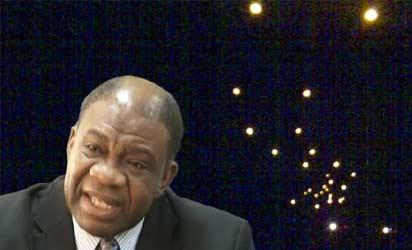
Prof Chinedu Nebo
Minister of Power, Prof. Chinedu Nebo, in a chat with journalists, assesses the challenges in the power sector after one year of privatisation. He also talked about government’s efforts to stabilize the market. Sebastine Obasi was there. Excerpts:

Prof Chinedu Nebo
You said a lot of money is required to transmit power in Nigeria. Can you give us the exact amount required to transmit this power?
It is too difficult. We have to have a stage wise systematic development of the transmission infrastructure in Nigeria. The reason is there is no way you can get infrastructure for transmission to meet 170 million Nigerians. It has to grow. It is not something we have to do in one fell swoop.
We need a minimum, I mean barest minimum of $1 billion every year in transmission alone, not even generation or distribution, in order to be able to continue to grow the national grid to where after several years most Nigerians will now be connected. But so far it is not possible.
The federal government last month announced a N213 billion fund for the GENCOs and DISCOs. But these companies said they are yet to get the money. What is happening to it?
The federal government is not giving anything. The federal government is trying to stabilise the market by meeting the short falls accruing from privatisation by remaining on a tariff regime that is not competitive enough and a tariff regime that is not cost reflective enough. This is to make sure that gas is paid for and all the power supplied are paid for.
What the government is trying to do through the Central Bank is to stabilise the market. It is actually a loan that is given to the generation companies, because of debts that are owed the gas companies in the past, so that they will now have the impetus to invest the money in expanding their facilities in a way that Nigerians will benefit the more.
How long will it take for them to pay back the loan?
Ten years; and on a good interest rate of just about 10 percent.
When will the fund be ready?
Oh it is ready. We want to sign off. We want every one of them to sign off. Within a week or two, we should. In fact, we were hoping that we do that later part of this week. There are one or two little things like dotting the I’s and crossing the T’s, and I believe it will be done very soon.
Early this year, Nigerians were promised that the transition electricity market, TEM, would take off soon. The year is coming to an end, when is it going to take off?
That would be in a few weeks’ time. The transition electricity market is going to kick off the contractual agreement and ensure that everybody plays his or her own role in a way that is governed by contracts which are legally binding.
We know that it is going to help shore up investments. We don’t want the baby to be born prematurely, that is why we are hoping. We believe that by the end of the year we would declare the transition electricity market.
Complaints of estimated bills from the DISCOs are prevalent. What is the government doing to discourage estimated billing and make available pre-paid meters?
If you notice, you can see that the international business people are very savvy and intelligent. Many of the companies here in Nigeria are doing smart and intelligent meters, and this is what the country needs. The government is trying to breach the gap. The metering gap is too wide in Nigeria
At a time it was estimated to be 2.7 million and it is even said that it is as much as 8 million that is needed in the next one or two years in order to meet the metering gap. This is very critical, and we know it is not fair for individuals to be paying for something that is unquantifiable and immeasurable.
We want to be scientific about the metering issues and we are hoping that if any money goes to the DISCOs from this Stabilisation Fund, it has to go into metering and developing their capacity to deliver electricity to the people. Hopefully, most Nigerians would get meters because it is very critical.
Also, the Nigeria Electricity Regulation Commission, NERC, has made it mandatory, and given a time frame that every DISCO should have all their customers metered.
What is government doing about areas that are off-grid?
That is the reason I have been talking about renewable energy. When you talk of off-grid, for instance, you want to take power to the hinterland, like the South-South area that is swampy; you can see the terrain difficulties and the challenges are quite enormous.
Even in the hinterland, you take all your measurements, do all your feasibility studies, order the equipment and these equipment can only be manufactured when you have ordered them; the sub-stations and so on. At the end of the day, to do the due process, maybe six months to do the purchase, the design and everything are all going together. By the time you place the order, the manufacturer does it in 18 to 24 months.
By the time it is brought in and installed, we are talking about 24 to 36 months. These things do not happen overnight. The Presidency is taking the bull by the horn, and that is why we are seeing measurable increase in the supply of electricity, expansion of our transmission network, and even in the distribution network before the hand over to private companies.
What we have done, and which many Nigerians hailed it when it happened, was that on the 13th of January this year, President Jonathan, personally commissioned three villages where we installed 24-hour power supply with solar PV sells.
These three communities where flagged off by Mr. President and life has grown in that area, property cost has tripled in value, businesses are being set up, and that is what electricity can do for the people. And we intend to use the same technology to bring electricity to the rural communities.
Are you satisfied with what the investors have done one year after privatising the power sector? Also, there have been speculations that NERC would increase tariff after the review, what should Nigerians be expecting?
We don’t want to see any increase in tariff until power generation and distribution increases. This is because people want electricity. For instance, we are talking of megawatts, what the ordinary Nigerians care about is not megawatts but electricity. Yes, there would be adjustments, but if electricity stabilises and it is stabilising, and we are able to go beyond what we are doing now, which we will in the couple of months. Then we will look at the whole thing and see what cost is reflective enough.
NERC, the regulator will not allow any tariff that would be punitive on the customers. We want a measurable tariff that will give a little bit of comfort to investors, so that they can recoup their investment, make a little bit of profit and continue to expand. But nobody is in a hurry to adjust the tariff at this moment.
Some state governments complain of the bureaucracy that is stalling their ability to generate power. How do you react to this?
It is not really bureaucracy that is stopping them from generating power. The only thing that can be deployed easily within a year or in a few months is renewable energy, like solar.
When you start to think about gas turbine to generate electricity, you have to get your gas supply or gas sale agreement; you have to secure the gas. Is that bureaucracy? You have to make sure you have done your EIA, Environmental Impact Assessments. Is that bureaucracy?
You have to make sure that the transmission studies have been done and that the transmission lines can take whatever electricity you are trying to bring in. Is that bureaucracy? It is just that everybody wants to be methodical.
Some of them think you can just buy turbines and start power station. If you bring them, just like we made that mistake several years ago before President Jonathan came on board; power plants were built but there were no gas for them.
We are trying to solve that problem now and with the help of the Petroleum Resources Minister, who has been synergising with me as the Minister of Power, a lot has been done in that area, and gas is gradually beginning to grow in supply. It is not really bureaucracy per say, but one has to do the right thing. You have to secure the license, secure power purchase agreement, make sure that the transmission network and infrastructure can cope with what you want to generate.
So if any government is interested, we would help that government to leap flog so that we would get there because what Nigerians want is electricity.
What are the encouragements given by government to Nigerians who can also contribute to the development and growth of power generation?
If you look at Nigeria, there are tens of thousands of communities. I am dreaming about a time when young men and women would come and go to the Rural Electrification Agency, and say, “I want to supply solar panels to these communities.” And since it is less than one megawatt, you don’t need licenses from NERC.
They will allow you to go there, power the community, and collect the tariff yourself; it is doable. But then, people have to be entrepreneurial to be able to do such. That is part of the reasons why we are starting the NAPSAS, National Power Sector Apprenticeship Scheme, to train young people to achieve a sustainable means of generating income for themselves in their life time, and that would be kicked off hopefully by the President in the next two weeks.
Yes, it is very easily possible. We are working on that framework and people are encouraged. Remember also that it is the brain. Look at Azura Power Plant, it is owned by a young Nigerian, David Ladipo. He went all out and gathered almost all the major financiers in the world to support the power plant he wants to build and the President flagged that off some weeks ago.
Anybody can do the same, but you need to use your brain. We are in a knowledge-driven economy, and only the knowledgeable can drive the economy to possess their possessions in times like this.
Disclaimer
Comments expressed here do not reflect the opinions of Vanguard newspapers or any employee thereof.