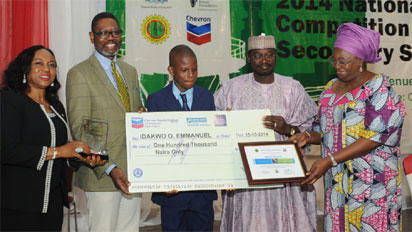
From right: Mrs Abimbola Fashola, First Lady of Lagos State, respresentative of Minister of Education, Mr Mustapha Abdul, Winner of the senior category, Master Idakwo Emmanuel, Mr Deji Haastrup, General Manager, Policy Governtment Public Affair, Chevron and Jane Ashini, Public Affairs, NAPIMS during the Chevron sponsored National Art Competition award ceremony held at the Muson Centre, Lagos.
By Dayo Adesulu
THE Minister of Education, Mallam Ibrahim Shekarau has urged stakeholders in the sector to encourage the study of history stating that it is vital part of national development. Just as the First Lady of Lagos State, Dame Abimbola Fashola at the same event also lamented the extinction of History from Nigeria’s school curriculum.
Shekarau whose speech was read by the Officer-in-Charge, NECO, Abuja, Mr. Mustapha Abdul during the 2014 NNPC and Chevron National Art Competition, CNAC, held at Muson Centre, Lagos said: “Children’s Art is a vital part of any nation’s development and history.”
According to him: “Some of the things we know about the people of pre-historic times are based on their cave paintings and drawings.”
The Minister who lauded the organizers of the national art competition said:“By supporting and providing our children with opportunities to project their creativity, the NNPC/CNL joint venture is helping to preserve some of our today for posterity and also encourage imaginative interpretation of our collective experience.”
Collective experience

From right: Mrs Abimbola Fashola, First Lady of Lagos State, respresentative of Minister of Education, Mr Mustapha Abdul, Winner of the senior category, Master Idakwo Emmanuel, Mr Deji Haastrup, General Manager, Policy Governtment Public Affair, Chevron and Jane Ashini, Public Affairs, NAPIMS during the Chevron sponsored National Art Competition award ceremony held at the Muson Centre, Lagos.
Recalling President Goodluck Jonathan’s address during the flag off of activities marking the centenary celebrations, he quoted him saying: “We owe it to ourselves, to past generations and to the future generations to tell our own story, the story of our experience, our challenges and most certainly our strides within the continent and the world.” He explained that telling a story is part of history.
The former governor who was delighted with the objective of the competition, noted that the theme gives another veritable chance to tell the Nigerian story. He said: “the various entries submitted have helped to capture the country’s feat and to tell the story of the country through the passage of time to present day.”
Speaking in the same vein, Abimbola Fashola who frowned at the removal of history as a subject from our curriculum, said we need to put history back into Nigeria’s school curriculum.
Fashola who was elated by the art works of the 20 students, urged them to read about those who have done well in that profession.
Arguing in favour of restoration of history, she said that the documentation of heroes of a particular field of study which students read about and are challenged is history on its own.
It will be recalled that at a different fora, Professor Ayodeji Olukoju and other stakeholders in the sector had spoken in favour of the restoration of History as a subject in to Nigeria’s school curriculum. Meanwhile, Machiavelli who commented seven months ago on the extinction of history in Nigeria’s schools curriculum said: “Sad, very sad and dastardly. One inalienable means of nation building is by inter group relations among constituent groups of a geopolitical entity. History fosters unity and cohesion. Through history we can link Sokoto to Calabar.
“History is the father of Diplomacy and International Relations and grandfather of Politics. History directs Commerce. Remember the great book Trade and Politics in the Niger DeltaI by K O Dike?
“Without history how would we have known that Maiduguri had had contact with Spain even before the State of Nigeria came into existence? How do we know how Sakkwatto became Sokoto? How do we know that the four market days of the Igbo are the same with that of Bini? How do we know that Potokiri is Portuguese and that the Binis have had contact with them over four centuries ago? How do we pinpoint their architectural influence in Eko Kingdom?
“The present Oba of Lagos during the last kingship scurried part of his claim to the”forgotten” Akinsemoyin Dynasty. He had to establish filial linkage to this forgotten Monarch that collaborated with the Portuguese and took Lagos to its acme.
“Without history how would we know that what we have and see as Lagos today are all breaths of the Oodua, Bini Kingdom and The Portuguese. The word Lagos is Portuguese meaning Lagoon. Eko is Bini word meaning Camp. Bajulaiye is a Yoruba corruption of the Bini name Bazuaye.
“Today my study and proper knowledge of history worldwide has served me as VISA to audiences around the world. It has won me friends and gotten me out of trouble severally. I am proud of History and my great History teachers.”
Ogom who also shared his own view said, “My first contact with any Nigerian history was a book of Civil War photos by Peter Obey. This was in my form 4 and I asked myself then: “How come all this is new to me?” I asked my mother; did this really happen?”.
“I have read a lot on my own since then, but I have had a deep conviction our leaders have long connived to keep us ignorant of our history.”
On his part, Mr. Gold Force said: “I saw this coming while growing up, as I sought to know exactly what led up to the civil war and what really happened during the war. My father told me his own side of the history having fought on the Biafran side. Yet there is no official historical account of the 1966 Pogrom and the Nazi-styled extermination of millions of Igbo civilians in the defunct Biafra -via starvation. No government account of these atrocities whatsoever. Therefore how can the present generation draw useful lessons from the war and prevent another one from occurring?
“Nigeria has long showed its disrespect for history and archeology, thus this scrapping does not come as a surprise to me. This is certainly a step in the wrong direction.
“For a nation to scrap the compulsory study of History, which has helped to shape great nations like USA and Britain into who they are today, is, to say the least, the greatest atrocity a nation can commit against its present and unborn generations. “How then can a nation know where she is heading to without a sense of where she was coming from? Posterity will never forgive this present crop of Nigerian leadership for commiting this crime against humanity.”
Mr. Brown Eredia, while lending credence to the foregoing asserted, “They stole our commonwealth,they mortgaged our future,took away our pride,and now still want to take away our history. History is a people’s memory, and without a memory, man is demoted to lower animals . Shame to those behind this brainless idea !” Speaking in the same vein, Mr Okwu averred:“They removed History because they want Nigerian youths to be developed on the lies they wanted to persist about the nation.”
That’s why today, if one wants to insist on the truth being told, he or she would be accused of opening old wounds. Yet a people without their true history are just as equivalent to animals without the conscious memory of their past, because it is conscious memory that separates animals from humans.”
Safiya Ismailia Yero, on his part noted, “While in secondary school, I was the only history student in a class of 64: it was a government secondary school. Students were to choose beween government and history right from SS1. In SS1, I asked my classmates and friends who all chose government instead of history why they chose government, they told me it was simply because that was what everybody chose, including our seniors. I then approached the senior students and asked the same question to which I got the same response i got from my friends.
Disclaimer
Comments expressed here do not reflect the opinions of Vanguard newspapers or any employee thereof.