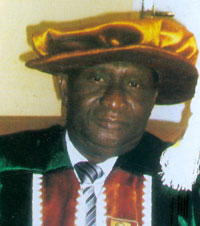
Prof. Hassan Kehinde Okeleye
By Emmanuel Edukugho
Crescent University,Abeokuta, is the first Islamic University in Southern Nigeria. Its establishment was the vision of Judge Bola Abdul Jabbar Ajibola, a former Minister of Justice and Attorney-General of the Federation, also one-time Judge at the World Court in Hague, Switzerland.

Prof. Hassan Kehinde Okeleye
It all started on Sunday, January 5, 2003, at the weekly Adhkar sessions of the Islamic Mission for Africa (IMA) where he revealed to the congregation his vision of an Islamic university in a predominantly Christian Southern Nigeria. “Before then, universities belonging to Christian missions had begun to thrive and it was only logical for us as adherents of Islam to have our own too,” Ajibola who is the Proprietor had said at the 3rd Convocation ceremony of the university held on Saturday, 8 October, 2011.
He added that it dawned on him rightly that achieving that objective was a herculean task, but knew and believed that it was achievable all the time.
“I have never believed that any individual should singly carry the burden of this type of task alone and it is on record that the intellectual summits held to fashion out ways of achieving our aim of an Islamic university in Southern Nigeria had more than 70 Muslim intellectuals and scholars drawn from tertiary institutions and Islamic organisations from all over the country.”
The six year- old institution, established in December 2005, has a fourth Vice-Chancellor. The pioneer was Prof. Fola Lasisi, second Prof. Ola Adams, and the third was Prof. Sherifadeen Tella.
Saturday Vanguard was at Crescent University, Abeokuta, Ogun State and had an exclusive interview with the Vice-Chancellor, Professor Hassan Kehinde Adebayo Okeleye, an Agronomist – a crop scientist, a consummate scholar, seasoned academic, passionate and committed Muslim. Below is the question-and-answer interaction with the Vice-Chancellor.
How’s the experience so far as Vice-Chancellor here?
I didn’t come up to this position from being a staff. I was invited from the University of Agriculture, Abeokuta where I started my academic career, rising along the ranks – from Lecturer II to becoming a Professor. I spent 16 years from 1989 to 2010.
I’m an
Agronomist, a crop scientist. Agronomy is the Science of crop production. We’ve produced three sets of graduates as this university started with Direct Entry intakes and JAMB. The first set graduated in 2009 with over 50 students. There was an impressive progression with 98 graduates in the second set. The third convocation had 118 graduating students for the first degree. The student population is improving with progress in admission, less causalities except those having carry overs, which are minimal.
If there are no carry overs, all students graduate and leave, because of an inbuilt system which enables students who fail to come and attend summer schools. They will resit and have chance to correct any deficiency. If they go through, they eventually graduate and go away. This has reduced human casualties so that anyone who comes here is sure to graduate.
What’s the current population of students in this university?
The population is now 1,100 students across all the programmes and all the levels. There are five levels – 500 level for those doing programmes of five years, 400 level for those running four years programme and like that. For the avoidance of doubt, this is a Muslim school owned by the Islamic Mission for Africa. But we don’t discriminate in the admission of students and recruitment of teaching staff. There is a mix, with Christian students also here.
We have a good spread of students from across Nigeria – North, East, South-South, West. Also are the staff – administrative and teaching. By and large, though this is a Muslim institution, but it still accommodates all shades. We have a mosque on campus.
And a church or chapel for the Christians here?
No chapel, because it’s a Muslim school. Christian students take exeat to go out to worship. They are given exeat three times and can use such to go outside to the church which is an opportunity for them.
What academic programmes are run in this university?
Our academic disciplines
are varied. There are four colleges: College of Natural and Applied Sciences, College of Social and management Sciences, College of Information and Communication Technology and College of Environmental Sciences. (Several departments like Banking/Finance, Business Administration, Economics, Actuarial Science, Political Science, Mass Communication, Microbiology, Botany, Zoology, Fisheries, Computer Science, Economics with Statistics, Information Technology, Aarchitecture, Estate Management, Urban and Regional Planning, Environmental Planning are all located in the four colleges). These are our approved courses.
Why don’t you have a law programme bearing in mind that the Proprietor, Bola Ajibola is a renowned Lawyer and Jurist?
For now, no Law programme. But the National Universities Commission (NUC) has visited us for resource verification, which if successful and also the Council of Legal Education that runs the Law school will come. These are the two bodies which can approve a Law programme. Once we get the nod, we will start. We would have started this session if they came. But by next September, if they come, we will resume with a Law programme.
Is it not becoming too late?
The proprietor initially had tried to identify the major problems of Muslims – Science and Technology so he started with the Sciences and Technology. Then pressure was coming, for Law to be taught. But the original idea was to have Muslim youths trained in Science and Technology. So when so much pressure was coming from his primary constituency, it had to be considered.
In your own view, is there comparison between Western and Islamic education?
Education is education, whether Islamic or Christian (Western). All universities are guided by minimum academic benchmarks provided by the National Universities Commission (NUC). There are academic standards for any programme which must be satisfied. But we have Islamic touch. Like in General Studies, we have Philosophy of Islam, Islamic Thought, which are compulsory. There is Arabic for beginners.
If you walk around the campus, see the difference in dressing. Men in corporate dressing except on Friday.
What about female students?
Females are not allowed to move about without headties, or wear mini, can put on trousers, but dress decently well, not show your curves. They must cover themselves beyond knees.
Do you have something unique, different from other conventional universities?
We teach Elements of Islamic Banking, Islamic Cooperatives among the staff, and move to Islamic Micro-finance Bank, which is now operating very well. These have marked us out. It’s unique. We say the five daily Islamic prayers. The 5.30 a.m. Morning prayer in the hostel, the other four said in the mosque. Technically, there is a break between 12 – 2 pm, to make for lunch and other things. Classes end at 6 p.m. Prayer period is left free on the time table. Enough time allowed in the time table to do all these things. There are two in-house Imams. One is from Egypt on rotational basis, the other Imam is a Nigerian.
We have a Guidance and Counselling Unit where students go for help. It is not religious. The unit can handle spiritual, handle emotional, and different forms of problems – male and female.
The Guidance and Counselling Unit also handles problems of Christian students because we are all human beings – psychological, academic, irrespective of faith.
The major one is funding. The institution is solely funded by the proprietor. But the Islamic Development Bank has approved $500,000 for ICT.
Disclaimer
Comments expressed here do not reflect the opinions of Vanguard newspapers or any employee thereof.