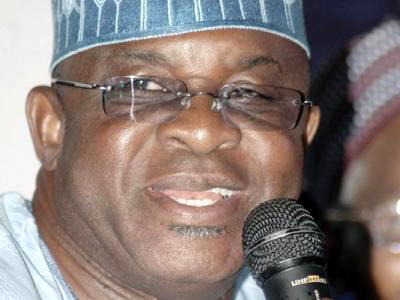
Senate President, David Mark
By Tonnie Iredia
If the current Senate President, Senator David Mark decides to contest the next Presidential election, he would surely be missed for his contributions to legislation in Nigeria, particularly his leadership of the National Assembly for two consecutive terms. This is thus a good junction to draw his attention to a subject which if reorganized under his watch can leave his name in gold.
The subject is no other than oversight functions by the legislature-an issue that is presently the most topical of the factors which oil the wheels of the nation’s high corruption index. The on-going scandal involving the House of Representatives and the Security Exchange Commission (SEC) no doubt underscores the need to deal decisively with the subject now and create a framework that would disallow the use of oversight functions as a strategy for corrupt enrichment by legislators.
In earnest, whereas the revelation that the chairman of the House committee on Capital Market and his deputy surreptitiously collected estacode allowances from SEC may be mind bugling, such unwholesome behavior is in reality a hobby of some legislators. Indeed, the SEC story is almost a non-issue to those of us who having had the opportunity of managing public agencies in Nigeria came face to face with the fraud involved in the matter
The modus operandi usually takes this form. Several channels are used to send messages to the chief executive of an agency to paint a horrifying picture of the battle readiness of the relevant committee of the legislature to ensure that the agency is properly run.
To the undiscerning, that would ordinarily look like a good move but alas it is nothing more than blackmail. To increase the level of intimidation, “surprise-visits” are paid to the agency or any of its branches to unearth some lapses real or imagined. Then through some deft data gathering the chief executive is invited to appear before the committee “in person” when he is most likely to be unable to honour the invitation.
Where he manages to attend, he is publicly rubbished and dehumanized; but if he fails to attend, a bench warrant is either issued to arrest him or he is given a last warning and a few more hours to appear unfailingly or face the wrath of the law making body. It is usually like a drama piece but it is no doubt a framework that needs urgent attention. First, the erroneous impression that oversight functions are not budgeted for needs to be corrected.

Senate President, David Mark
As Senator Enyinnaya Abaribe testified last week, the National Assembly has “rules ensuring that financial provisions are made” for all its activities including public hearing. Abaribe’s position makes sense because if oversight functions are as important as they have been presented to the public by the legislature, financial provisions ought to be made for them during budgeting-an assignment over which the same legislature is legally empowered to have the last say.
If surprisingly however, matters like oversight functions and public hearing are among those which are not financially provided for, then they ought not to be done because the National Assembly itself would correctly frown at any organization which executes projects for which no appropriations were made. It is irrelevant that an organization managed to make savings from its budget to undertake such “unapproved “projects”.
Thus, for our legislators to carry-out oversight functions with funds provided by the oversighted agencies is illegal and unethical. Luckily, the Senate leader himself, Senate Victor Ndoma Egba has openly opined that “if the support of any kind is requested or obtained from a Ministry, Department or Agency (MDA) to be oversighted, in carrying out that responsibility the legislature’s power and functions would have ab initio been compromised”.
Ndoma Egba who spoke last Monday at the commissioning of the ICT Research and Training Centre of the National Assembly added that ‘though the legislative power of oversight is a constitutional one, its efficacy, however, derives from the legislator’s moral authority to exercise it”. Put differently, it is wrong for the legislature to use its oversight powers to demand or accept funds from an agency while purporting to propel better service delivery from the said agency.
Also, the present posture where our legislators appear to believe that they can oversight any person, group or organization; whether in the public or private sector is too elastic to enhance the credibility of the legislature. While it may be in order for the legislature for instance to check mate the top hierarchy of the executive branch such as Ministers, it amounts to an invasion of that same branch for the legislature to be allowed to go below Ministers and directly supervise executive agencies that are answerable to the same Ministers.
To make matters worse, there is too much of impunity on the part of legislators in their transactions with executive bodies. Here, let us recall the case of the Director General of the Bureau for Public Enterprises (BPE). The legislature investigated certain matters in her organization and publicly determined her appointment.
Several months after her condemnation, she is still in post. How is the public supposed to understand that? The situation would probably have been different if the legislature had transmitted its findings for necessary action to the executive to which the lady is answerable. At the same time, how are we sure that the hostility towards the lady is unconnected with may be her failure to provide funds for public hearing or oversight functions?
Sometimes, the legislature functions like an interloper. Only last week there was the story of a warning letter reportedly written to the immediate past chairman of the Economic and Financial Crimes Commission (EFCC), Mrs Farida Waziri, over her alleged failure to hand over the property of the commission in her possession.
The letter which was dated March 19, 2012 was not written by the EFCC but by the chairman of the House of Representatives Committee on Drugs, Narcotics and Financial Crimes, Honourable Jagaba Jagaba, who claimed that his committee discovered during one of its oversight visits that Waziri was still in possession of the commission’s official residence and vehicles.
This according to the committee contravened laid down government regulations for which it assumed the power to handle!! Interestingly, the current chairman is too experienced to require such mundane support.
The private sector is also not spared. Here, there is the old story of how the Senate committee on Environment visited the Ibadan branch of the Nigerian Breweries Plc a few years back and ordered them to within 2 weeks improve sanitation and industrial safety in the premises.
At the end of the visit some staff imagined that perhaps the committee needed some drinks. Against this backdrop, a presiding officer like David Mark must have an eye on history and its verdict by evolving a design which determines the bodies which should be oversighted as well as empirical guidelines on the conduct of the subject.
He owes the duty to society at large but more especially to the many well meaning legislators stigmatized by the indiscretion of a few.
Disclaimer
Comments expressed here do not reflect the opinions of Vanguard newspapers or any employee thereof.