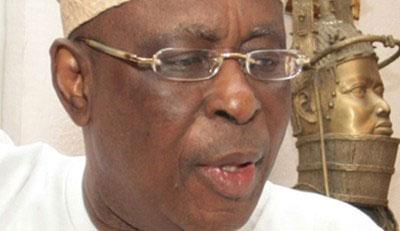
Olusegun Osoba
Continues from yesterday
SO at the boardroom I told them the story and at the end of the meeting they asked what I was going to do. I told them there would be structural changes. “We must reward initiative,” I said. “It is not every day that we have a coup. But the man who can show self-sacrifice and can handle uncommon situations is a leader. Therefore, Segun becomes editor of the Daily Times.”

Olusegun Osoba
That was in July. Earlier in June, I had unfolded a succession plan to the board at a meeting. Then, I had told the board that by December of that year, I would be 50. When I am 50 in December, I will relinquish the editorial directorship for Areoye Oyebola who was then the editor of the Daily Times.
Two years after, Laban Namme who was four years older than me would have retired as the deputy managing director to pave the way for Emmanuel Adagogo Jaja. My plan was to resign as the managing director at 50 and Jaja would become managing director.
I would only keep the chairmanship post. But while Oyebola becomes editorial director, Gbolabo Ogunsawo, editor of the Sunday Times would become editor of the Daily Times. Segun Osoba would become editor of the Sunday Times. I had made that succession programme because Daily Times had a sound management succession programme. We had a full-time manpower development programme. So, I felt that my programme had not been put to test. But with the development, I made Oyebola managing editor and Osoba editor of the Daily Times. And that was the beginning of the crisis that led to my retirement.
The editor’s reason for not showing up on the day of the coup was that he misplaced his car key and couldn’t find it. If you look at my memoirs, they are all there. Some people at the inquiry said Osoba was an opportunist. But let’s look at it this way. You wake up in the morning as a journalist and you hear there is a coup. You felt that the paper must be changed for the coup story to be on the front page.
In the first place he demonstrated leadership by responding to the coup story, by coming out of his house and going to the house of the managing director, the man who had the power to make the final decision as to whether the paper should be changed or not. He understood the Daily Times culture that if somebody as high as Zik had died in Onitsha, the reporter in Onitsha would have phoned me first to say: “Chairman/ MD, I can confirm to you sir, that Zik is dead. I have been to the palace of the Obi of Onitsha to confirm the story.”
Phoning the managing director
He knows a story of that magnitude is a front-page story tomorrow. He knows that if he phones his editor there is a chance that something may happen and the story may not come out. So as a kind of insurance, he would phone the managing director. By phoning the managing director, he knows he is dealing with a man who was a reporter himself and knows the value of that kind of story. Daily Times is an institution which I was, and is still part of its history.
I joined the company as a technical trainee in 1941. I left in May 1946 to go to the Comet and came back in 1948 as a senior reporter and I represented the paper and the company first in the West, then in the East and in the North. When I became editor I was told by the board on December 1957 that, “your country is now approaching independence.
People say the paper is foreign controlled. We want this paper to be independent with the country. We want an editor who knows this country and who would lead it to independence and after independence.”
As editor, I had to strive through editorial presentation to disabuse people’s mind and change the perception of the paper as being His Majesty’s voice. I had to stamp my personality on the paper. You can run the UAC or any other corporate organisation on Presbyterian democracy.
For example, at that time, you can run the Nigerpak, a Daily Times subsidiary on management committees, you can run the Times Press on management committees, but you couldn’t run a daily newspaper with its associated weekly and evening papers on Presbyterian democracy.
Somebody has to have the last word. Somebody has to be the captain. The buck has to stop somewhere. Remember these were crucial times in the history of Nigeria, 1957 to 1960. We were attending constitutional conferences, on the political scene were Zik, Awolowo and Sardauna, conflicting personalities, the first five years of independence; all the crises that were there, then the Nigerian Civil War. Somebody had to be in charge.
Somebody had to give the paper leadership and editorial direction. So I stamped my personality on the paper. We published a paper that was trusted by readers. To be trusted you have to show the integrity of a leader. The people know that I have no political ambition. I had access and was consulted by highly placed government functionaries, prime ministers, presidents. So they know that whatever we did, it was not because I am a Yoruba man.
They have seen the paper openly attacking Awolowo. They know I am not contesting an election. All the years I was working for Daily Times, from 1948 when I was a reporter up till the time I left, I did not vote in any election. Because Daily Times was an independent newspaper.
My grooming as a newspaper manager: When in 1954, I was an assistant editor of the Daily Times, whenever the editor went on leave I would act for him. My main function as assistant editor was to produce the front and back pages besides other editorial functions.
One day the Chairman, Cecil King, came from England and said: “Jose, you are Zik’s protege and Zik is going to the East, aggrieved after his disappointment in the Western House of Assembly, following his failure to become premier of the Western Region. Zik is going to the East as Leader of Government Business. I want you to go to Enugu and cover him. He is proud of you. You can cover him. You will be like Daily Times’s ambassador in the East.”
I protested because I was next to the throne as editor. But King said that didn’t matter. “You go there as our representative,” he said.“At present we are not well circulated there. You go there, appoint distributors or agents who will be on commission. Then appoint reporters in what you consider strategic places.” I asked what would be my title and King turned to the general manager and said: “You just go there.”
Regional representative
From the job description I called myself Regional Representative. I had the power to appoint and fire reporters. The drivers that were bringing the papers to the East were appointed in Lagos but if any of them misbehaves I will recommend to the general manager to discipline or fire, but if I find very grave bad judgement on their part, I might take instant action that was deemed necessary.
That was how I went to the East. Two other British young men, graduates of Oxford University, were appointed representatives in the West and in the North. In 1955, the chairman came to Nigeria and invited me and other senior staff to Lagos for consultation. After the meeting with him, he invited us to launch but I absented myself. After the lunch we continued the meeting and King remarked: “By the way, Jose I did not see you at lunch and I observed that throughout the meeting you did not drink tea.”
I told him I was observing the Ramadan fast and he did not say anything. That night the general manager phoned me at home. I was lodging in my father’s house. He said the chairman wanted to see me tomorrow at 7.30 a.m. He would leave at 8 o’clock for the airport.
So I went there and the chairman said: “Jose, I am enormously pleased with your spiritual development. I used to know you to be in love with Star beer. If you want to spend your life on the solid foundation of spiritual development, we should encourage you. When is the next hadj? You will go to Mecca, to Jerusalem, to Cairo, then you will go to Turkey, to Istanbul to see great mosques.”
Continues tomorrow
Disclaimer
Comments expressed here do not reflect the opinions of Vanguard newspapers or any employee thereof.