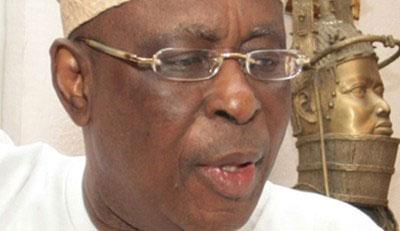
Olusegun Osoba
All my reporting life, I have thrown small pebbles into a very large pond, and have no way of knowing whether any pebble caused the slightest ripple. I don’t need to worry about that.
My responsibility was the effort. I belong to a global fellowship, men and women, concerned with the welfare of the planet, and its least protected inhabitants. I plan to spend the rest of my life applauding that fellowship and cheering from the sidelines…” —Martha Gelhorn, wife of Ernest Hemmingway.
GOD is for leader writers, I am a reporter,” says a character in Graham Greene’s novel, The Quiet American. His Excellency, Chief Olusegun Osoba, a two time executive governor of Ogun State, the man whose monumental newspaper life is being celebrated in this book, might as well ascribe this quotation to himself and declare with all professional pride: “I am a reporter.”
Osoba in the technical sense is not a leader writer, not a feature writer and not, strictly, a sub-editor. Sure, in his days, the reporter was expected to do a bit of all that. The reporter who covered the breaking news could also write a feature story on the event. In the heat of production, he could roll up his sleeves to sub the story, if it came to that. The typical newsman was versatile to that extent.
But notwithstanding such seeming generalisation, Osoba was and still is quintessentially a reporter. His special niche is reporting. His “core competency” as management experts would say, is news reporting. He is in the special league of reporters who took the noble art of news reporting to an Olympian height.

Sycophancy and peer rivalry
In a trade that is professionally stingy with praise, where praise is often derided as sycophancy and peer rivalry, although ultimately benign, is often eternal, Osoba enjoys a unanimous accolade from his peers, senior and junior associates as the “reporter’s reporter.”
Well, then, so what? What is so special about being the archetypal reporter, especially for a man who has climbed all the professional mountains? A man who has climbed every peak in journalism, rising from a reporter to become the editor of the Lagos Weekend and later Daily Times. A man who has distinguished himself as a media turnaround manager. A man who as the general manager of the government-owned Herald, (Kwara State) and Sketch (the Western states) turned these drain-pipe newspapers into cash cows that were not only self-supporting but profitable.
A man who later initiated a massive re-engineering of the octopus Daily Times Group, again delivering the company from losses and subsidies into profitability while under the grip of a military dictatorship. For such a man, wouldn’t there be any better source of professional acclaim than being heralded as a reporter? Why not Osoba the great editor, Osoba the turnaround manager and so on? Why the reporter’s reporter? What’s the big deal about being a reporter?
Everything: The reporter is as crucial to journalism as news is vital. In the newspaper world, reporters are the real journalists, the news technocrats, the news explorers and the arrowheads of journalistic enterprise. No matter how vital all the other departments and personnel are to the news business, they are more or less appendages, albeit essential appendages. The others may be everything else important but the reporter is the soul of the business. At the heart of journalism is the reporter. An Osoba, the news hound, the ever curious and restless cynic with his ears to the ground, sniffing out every whiff of news – whatsoever is of public significance, whatsoever is topical, whatsoever is timely, whatsoever is hidden, whatsoever somebody tries to hide, whatsoever somebody wants to read about.
The others may write their features, editorials, analysis or opinions, but they are incidental to news reporting. Without news, there would be no editorial, no news analysis, nothing topical to express an opinion about. And, as the circulation man would say, it is news that sells the paper. If in doubt, try something else to your own peril. As the Americans would say, it is the news, stupid. Of course you know it already – all things topical are news!
Anybody can express an opinion but not everybody can gather and report news. It is indeed an art; you need to be initiated to be among the elect. In journalism, many are called but only few end up among the chosen. So many others may be called into the news business, but the reporters are the chosen. They are the elects, the sacred cows, and the hard-nosed cynics trained in the intricate art of newsgathering and reporting. But for some that turned out great reporters, something more than mere training counts. Something intrinsic interned in their nature by the Creator counts far more than academic laurels.
No doubt, academic training – whether formal or informal – is an asset. Yet, the unusual curiosity, the overdose of creative cynicism that takes nothing at face value, the adventurism, the networking spirit that comes from being extroverted, the sense of justice and objectivity, the understated intrepidity that at times border on the suicidal, among others, are things that are often more inherent than learned. And these are the hallmark of the great reporters. They are those with the hound’s natural instinct who can sniff out a line of news even from the haystack. And Osoba belongs here.
The news hound. The reporter.
Again, who are reporters? They are the ones who have been trained formally and informally to report the news without which there would be no newspapers. Reporters are the soldiers of the news business, the infantrymen who go out daily into the field to battle for the news. The archetypal reporters are the not-so-gentle “gentlemen” with their legendary brim hat, a swashbuckling gait and a razor sharp nose for the unusual. They are the men on the beat who must file in stories to the newsroom from their own corners – the beats. They are the firefighters who must speed to the scene of breaking news to capture events in transit and present them exactly as they happened, without colouring them with their own views.

Olusegun Osoba
They are the hunters hunting for truth and facts in a forest of falsehood, rumours and misinformation. They are the folks who bring into light the hidden things of darkness; who beam the searchlight of truth and facts into whatever things are shrouded in darkness or what is only whispered in utter secrecy. They are the ones paid to expose what others are paid to hide, what others would rather pay off to conceal from light. They are the ones who know that news is what somebody somewhere is prepared to hide at all costs; everything else is PR.
Who is a reporter? He is the storyteller who tells us every day, every week, the uncomfortable truths, the daily peccadilloes of the great and mighty, the famous and the infamous. He is the storyteller who tells every day, every week, something new, something we never expected, something that would interest us, something that would jolt us, something we are ready to pay our hard-earned money to read, something worthy of news. A reporter is the quintessential newsman, that bundle of courage and curiosity always daring to go where even angels fear to tread.
He is the one we count on, the one who carries us mentally to the scene of newsbreak. He is our eye. He is our ear. He is our mouthpiece. He is the one who reports events from our perspective, in a language that we understand. He is a man we trust, a man of integrity, a man we rely on to tell us the truth, who would not fake stories just to sell his newspaper. He is the man with clouts, who probes behind the official version of what is taking place to tell us the hidden truth behind. He is the man working against deadlines, against all odds and doing everything possible to get his story across on time. A reporter is a throwback to the marathon runner of ancient Greece who would run miles and miles to deliver the news from faraway.
Osoba is everything a reporter is and more. His unique attribute as a reporter is best captured by Alhaji Babatunde Jose, the former Chairman and Managing Director of the Daily Times and Osoba’s mentor: “Segun Osoba was the ubiquitous reporter who was everywhere with his scooter. He was a man about town, who knew a lot of people. He had telephone at home and with it he was able to build a network of news sources and contacts. A good reporter must have contacts. For every story you must know whom to link to get you more facts on the story.”
Chronicler at the forefront of history
A reporter is the chronicler at the forefront of history, recording history and presenting it hurriedly in form of news. When you read a newspaper, you really are reading history viewed from the perspective of the present. In a way a reporter is a historian. From the hundreds and thousands of events that happen every day, newspaper reporters and editors must, as a daily ritual, sort out what in their perception is the most important. They have to decide instantly which events are historically significant and which are not.
At times, when reporters are reporting history, they end up being part of the history. Osoba’s footprints in the sands of history are there for the younger generation of journalists to see and emulate. He made history when as a reporter at the Daily Times, using his investigative skills, he found the corpse of Nigeria’s first Prime Minister Abubakar Tafawa Balewa. The Prime Minister had been assassinated with other politicians in the wake of Nigeria’s first coup d’etat in 1966. There was confusion and uncertainty in the air. Nobody knew where the corpse was. Then all of a sudden, Segun Osoba by sheer serendipity got the biggest exclusive story of his entire life.
A contact had tipped him off on the whereabouts of Balewa’s corpse. He obviously sped to the place, combed the bush and luckily saw the gory sight of the Prime Minister’s corpse in all its awfulness. A world exclusive that would make every reporter proud! An emotional story that would make any reporter feel like the first man to walk on the moon. That is one big story that was Osoba’s defining moment as a newspaper reporter.
A reporter is not just a historian. He is a seer who sees today what others would read or hear about tomorrow. He is a leader, a knowledge leader, an informed leader, and an opinion leader with a rich databank of information from which he can always tap.
A reporter is forever looking for drama and reliving the drama of life in the form of news. And sometimes he is also caught in the drama, making news himself. Osoba made news when in the wake of a coup d’etat he braved all odds to go to the office to produce the newspaper of the day with his managing director while his editor stayed at home, unfortunately. He was rewarded with editorship which triggered off the Daily Times crisis, an event that is part of Nigeria’s media history.
From editorship, Osoba moved up to distinguish himself as a newspaper manager at the Herald, Sketch and later the Daily Times. From the newspaper house, Osoba moved over to Government House where he was elected twice the Executive Governor of Ogun State. What special edge does a newspaper reporter bring into governance? Eminent journalists like Alhaji Lateef Jakande and Alhaji Alade Odunewu answered the question in this book – veteran journalists who once served in government. Jakande as the Governor of Lagos State earned the tag of “Action Governor” for his achievements as governor.
To see this book as simply a newspaper biography of Segun Osoba is to limit it. This book goes far beyond Osoba. It is also a book about journalism history and practice from different eras, from the eyes of some of its leading practitioners. In celebrating Osoba, they are celebrating journalism excellence, they are celebrating good reporting against the backdrop of modern falling standards in journalism where many occupy the editor’s chair without first paying their dues as reporters.
In Osoba’s days, that would have been tantamount to a journalistic heresy. In these days when veteran reporters like CNN’s Christianne Amanpour lament the “demise” of journalistic orthodoxy where news is the supreme driving force rather than the “irrelevant, super-hyped sensationalism”, Osoba’s media years looked like the golden age of Nigerian reporting.
If as Amanpour quotes a veteran colleague as saying, “news and journalism died in the nineties” and many newsrooms these days are populated by reporters who would have a hard time recognising news, not to say, reporting it, then the objective of this collection would be well served if it helps to rekindle the zeal for quality reporting. For as many veterans have often lamented, despite the great leaps in technical quality and at times, even quality of writing, many strangers have invaded our trade, prancing like kings and wearing their inexperience like a crown for all to see. Celebrating Osoba is celebrating reporting which is the heart of journalism. It is a celebration of a man who is an all-round newspaperman, a man who loves journalism, a man who has journalism in his blood.
From these tributes to Osoba by his professional colleagues, you will see Segun Osoba as a study in leadership. From the journalism point of view, he is a news leader. His success in every other sphere of life including his political life is derived from his success as a journalist – a veteran reporter. Even as the general manager of Herald, Sketch and managing director of Daily Times, he remained a reporter at heart. Naturally, as a state chief executive, Osoba, we are told by many, has not changed. Like an aging boxer, his reflexes have remained that of a reporter who takes nothing for granted, who takes nothing at their face value, who is impatient with bureaucracy and red-tapism, who trims off wastes like a merciless budget director, who not surprisingly knows how to play the media game.
Believers in people
Leaders are people to look up to. They inspire others. They are ambitious. They dream dreams and also explore their dreams. They are believers in people. They are willing to take risk and are committed to excellence. Leaders don’t often suffer fools gladly. Leaders leave their mark on the sands of time. Osoba is both a leader and a reporter. Like the great Ziks, the Awos, the Onabanjos and Jakandes before him, Osoba showcases today, the great possibilities in journalism. For a profession that has always been haunted by the spectre of its veterans who spend their twilight in the cold hands of penury, the Osobas of this world show that all is not lost. Behold, it is morning yet on creation day. We can still sing a new song, after all!
A word about our approach to the book. Once again, we are relying on first person narrative and the subjective voice of Osoba’s contemporaries to paint a kaleidoscopic portrait of Osoba and as well document their own media odyssey within the ambit of the Osoba media era. Basically, it is a friendly portrait, hence the apparent reluctance of the various voices to say uncomplimentary things about Osoba. It was not for lack of trying on our part. Usually, we asked. We know that even Osoba, after all, will be first to admit that he is not an angel. But then, this is not a full character portrait but only a subjectively objective portrait of the man’s professional life. The good thing is that most of the time, media life is an open book – anybody can read it. Critics – if any – who think that Osoba’s colleagues have been too generous in their compliments, certainly know how to exercise their intellectual or literary liberty.
Ours is the reporter’s role. Like in our books, 50 NIGERIA’S CORPORATE STRATEGISTS – Top CEOs Share Their Experiences in Managing Companies in Nigeria and NIGERIA’S MARKETING MEMOIRS – 50 Case Studies, our preferred reporting style remains the first person narrative approach, a style that has been dubbed by the media as our form of higher journalism.
Lifelong reporters
As lifelong reporters, we are comfortable with that approach. In any case, how better do you report about a reporter than by employing a reportorial genre? If at the end of the day, we are credited with evolving – or merely drawing attention to – that genre, our dream would have been realized.
How Osoba became editor of the Lagos Weekend
When we started the Lagos Weekend, it was another person we appointed as editor. We appointed a man whom we judged to be a very good reporter as editor. We appointed as editor the late Isaac Babalola Thomas. There was another reporter by name Chief Theophilus Ola. He is also deceased. He was a better reporter than Isaac Thomas, but he was not a leader. He was a better reporter in the sense that if anything happened in Ikoyi or in Surulere or in Agege, he had so many contacts who would inform him. If a reporter was arrested last night, before this morning, before Ola got to the office, somebody would have told him. He had that kind of contacts. He had friends in politics as I had in my time. So he was a better reporter but he was not a leader.
Everybody knows there is a difference between a columnist and an editor. A columnist can spend an hour in the office. He may have written his column at home, he comes to the office, spends an hour, discusses with the editor and walks out. The editor may not see him for the day. But the editor is a manager, he is a leader, he is a team player. So we did not choose this man and he was not pleased with me. I had to sit him down and explain the situation to him.
I said: “Ola, I employed you as a reporter in Enugu when I was a regional representative. You have been working with me. You came to Lagos with me. I sent you to Ibadan as chief correspondent but your problem is that you are not a team leader. You are not a team player. You are a better reporter but Isaac Thomas as the sports editor of the Daily Times has shown skill as a team player and the editorship of the Lagos Weekend requires a team player. He would be collecting stories from various reporters and at the end of the day, by midweek he determines what is going to be the lead, the back page, which stories he is going to give emphasis to. This is why I have appointed this man editor. Editorship is not only about being a good reporter. You must have managerial skills, leadership skills, be able to manage people and motivate them. This is the edge Thomas has above you.”
I had to sit Ola down and explain all that to him. As the pioneer editor of the Lagos Weekend, Thomas did a good job. After doing it for 18 months, we asked him to go on vacation, because he was getting tired and he needed a holiday to freshen his mind so that his battery would be recharged when he comes back from holidays. While he was away we looked for an enterprising reporter who is also a team player to take his place. We picked Segun. As a reporter Segun also had proved himself as a team player. He knows what story is good. Oftentimes he would go to the editor of the Sunday Times and say: “This story is good for Sunday. I am holding it for Sunday. If you use it for Sunday, it would sell your paper.”
He has a nose for news as well as good news judgement. On that score I told him: “Segun, go there and act for one month as editor of the Lagos Weekend.”
In that one month, he transformed the paper. We started Lagos Weekend as a paper for training fresh reporters. Our objective was that newly recruited reporters either with degrees or Higher School Certificate would use it as training ground. They would write their stories in triplicate to be examined by their teacher and the other to be published. It was a paper that specialized mainly on divorce cases and crime. In one month, Segun had changed the character of Lagos Weekend. We continued to use it for training, we didn’t bother if it would make money or not, but Segun changed the character of the paper so unbelievably that the paper was being read by young people, by secondary schoolchildren. So when Thomas came back from his holidays we welcomed him but told him we have a better editor. That was how Segun got the editorship of Lagos Weekend. And the circulation of the paper rose, rose and rose.
The Daily Times crisis revisited
I have stated in my memoirs, Walking The Tight Rope, my account of what is now referred to as the Daily Times crisis and of which Osoba was a key actor. He took a big risk professionally. You don’t have coups every day. And when machinery such as a newspaper is set in motion, any average man or any editor can stand by it while it is working. It is only a man of initiative who can say: “This machine, the sound is changing. Something is wrong. Something has gone wrong somewhere. Something ought to be done to rescue the situation. Osoba is that kind of man.”
So, when a man is on leave, any average man can hold fort for him and make no change but a man who can make positive changes that is so obvious for all to see, is uncommon. An editor must be capable of making a difference out of the ordinary, which is to say he must be extraordinary. As a background to the crisis, there was a coup, a curfew was imposed, roadblocks were mounted but Osoba risked his life to come to my house at Ikoyi. He had received details of the decision of the Supreme Military Council, (I think from General Emmanuel Abisoye who was a member of the SMC) and had rushed to the office to write the story only to discover that the office was deserted. His editor was nowhere to be found. Meanwhile, telephone services had been cut off by the soldiers, so there was no way he could contact me or his editor.
Changing the paper without authorisation
Our office then was at Kakawa Street, his editor lived at the mainland while I lived at Ikoyi. On his own, Osoba cannot change the paper without authorisation. He decided it was closer for him to come to my house rather than head back to the mainland to contact his editor. When I saw him, I was surprised and asked how he came since by then, the curfew has started. He said he came with copies of the first edition of the paper with which he was giving out to the soldiers at the checkpoints to gain his passage. I told him that in that case, let’s go to the office. And when we got to the office, he changed the paper and published an extraordinary edition, a late edition. And naturally, I was in the production room with them until around midnight.
In the early morning after production, when I was going home, I left a note for my secretary: “Please type a circular, make it signed by the chairman: I congratulate, I praise all those in production and editorial that worked long hours to produce a special edition of yesterday’s paper, the evening paper and today’s paper. Every one of them would get a bonus. I deplore the attitude of those who for fear of risk absented themselves from office. The executive directors should meet me at 10 o’clock in the boardroom.”
Disclaimer
Comments expressed here do not reflect the opinions of Vanguard newspapers or any employee thereof.