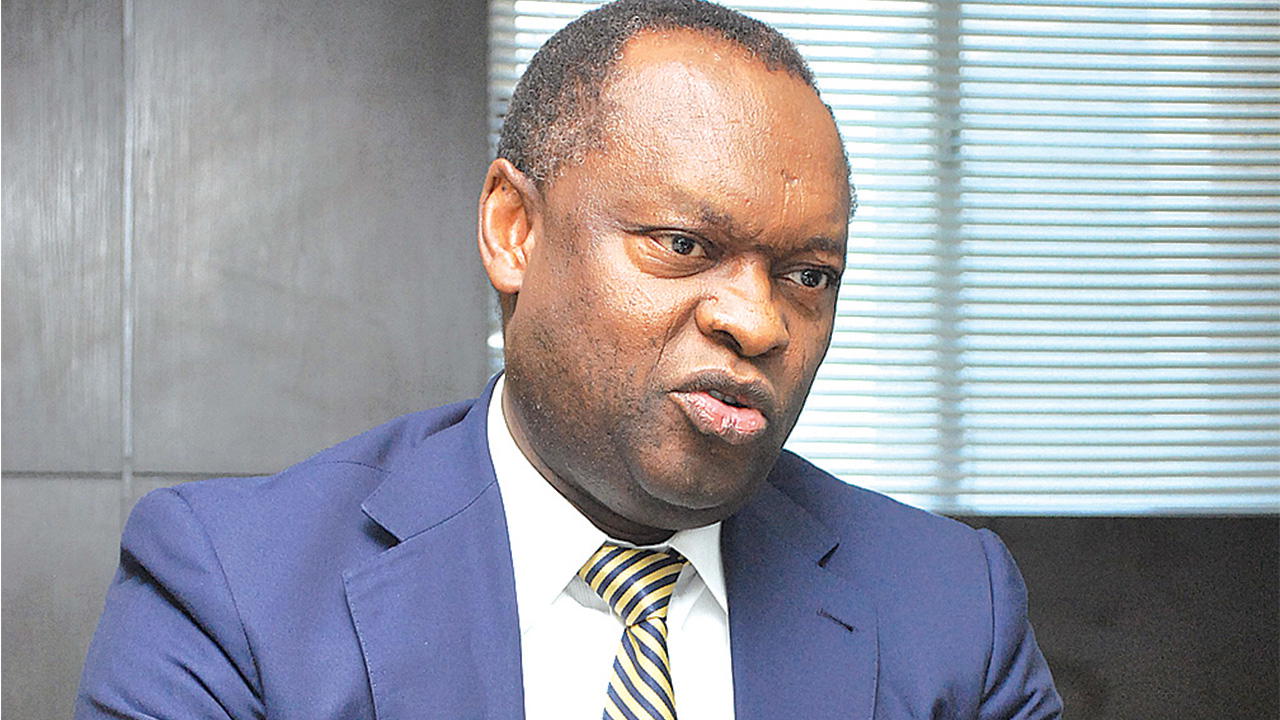
At the second edition of the Vanguard Newspapers’ Economic Discourse with the theme; “Economy in Rebound: The Pitfalls, Trajectories and Resetting”, held in Lagos two weeks ago, Mr. Kyari Abba Bukar, one of the lead discussants at the event, in a post-event interview reinforced some of the points raised by the keynote speaker, Mr. Bode Agusto, a renowned economist and financial expert. Bukar emphasised the need for the government to adopt an economic and institutional reform that will open up the economy with a view to attracting local and foreign investors.
The Excerpt:
By Nkiruka Nnorom & Providence Emmanuel
First Words
IN 2016 Nigeria recorded the worst economic recession in the history of the country. In 2017, we had the process of recovery, I am not going to say we recovered, we went into the process of recovery and we are still on it.
Those two years especially, the key factor, primarily, is tax. This should raise concerns about certain quality of growth in this country.
Without doubt, there would be growth in 2018. However, the conversation today, is how inclusive is that growth going to be like, for the short, medium and long term and what measures are required for this country to achieve sustainable, broad based, high growth trajectory.

High growth trajectory
The theme of the discourse is economy in rebound, the pitfalls, trajectories and resetting and you did mention while you were talking that there are some measures that need to be put in place to achieve sustainable recovery in the economy.
So, what are some of the pitfalls you have observed and what measures are you prescribing?
Based on what has happened in the country in the last 15 years, the growth in the Nigerian economy, even when the growth was in the high single digit, they were not inclusive.
That is why we had growth that did not create jobs. Therefore, one needs to look at re-assessing the type of economic model we have and I think the paper presented by Bode Agusto basically stated some hard facts that we need to take as a measure.
Population growth is not commensurate with Gross Domestic Product (GDP) growth. The issue of looking inwards, by that meaning emphasis on productive sectors of the economy, it talked about the issues regarding whether the Central Bank of Nigeria should focus on price stability or whether it should be focusing more on gap between the Nigerian currency versus the US Dollar whereby you will realise that we will be looking more at employment issues rather than price stability per se. Short term, we may have some gains, but long term, we will have sustainable economic development or growth. I think these are some of the key highlights that he listed.
Obviously, all stakeholders must have a role in the discourse whether it is the central government, state or local government, the central bank, financial market, as well as businesses and households.
So, all of those have specific roles highlighted, which I believe if properly structured and properly implemented, we can begin to see medium to long term sustainable growth that is inclusive and sustainable.
A lot has been said about population growth in Nigeria, including its challenges and advantages. I want to know what your position is on this and what correlation population bears with economic prosperity of the nation?
Basically, it is very simple. It says that we are producing at a certain level and unless our production level is ramped up, we are going to continually be poorer if our population is growing at a faster rate, than our productivity; it is a very simple arithmetic. The keynote speaker gave example of different countries’ population growth versus ours’ and how their economy grows compared to ours. I think it is a problem that needs to be addressed.
So, what it means is that our population is an asset, but it isn’t because if we are not careful it might be a time bomb that is about to explode. So, you have to look at everything from both sides whether it is an asset or not.
Economicstructures
Is it skilled? Do we have the necessary jobs, is the economy structured to absorb the kind of workforce that we get every year? I think all of those needs to be there in terms of whether we can translate the population growth into an asset as a catalyst for the economic growth of the country.
One of the visions of the federal government’s Economic Recovery and Growth Plan, ERGP, is to collaborate with the private sector in the plan to achieve sustainable economic growth. To what extent would you say that government has succeeded in this objective?
I think the government is doing its part in ensuring that there is a partnership between the private and the public sector. I think that there is a need for a lot of emphasis on the private sector to be taken along.
It is not about giving out contracts or things like that, it is more about investing together with the private sector where a project has a very strong economics and strong impact.
The private sector should play a role along with government; the government may become a shareholder. In that way transparency comes in and then it would be grown as if it is a business. I believe that if that were to have happened, then the integration and role of the private sector becomes clear and they will then become the agents in driving the economic growth of the country.
Disclaimer
Comments expressed here do not reflect the opinions of Vanguard newspapers or any employee thereof.